- Insights This article was written by a TIA community member. Insights pieces undergo the same rigorous editorial process that newsroom-produced articles have.
 Joseph Thia · · 5 min read
How I built a growth team at Traveloka
When I joined Traveloka in 2016, I had limited exposure to media and advertising. Back then, the concept of growth teams was still nascent, having been first popularized by tech companies in Silicon Valley after being coined by Sean Ellis.
There was little to no growth framework in Traveloka at the time, as most of the team members in the early days were specialists for specific marketing channels and did not have a view beyond their direct scope of work.
The early iteration of growth teams in Southeast Asia was nothing more than data-driven marketing activities, as there was often a delineation between product and “growth” teams. This was especially true if the founders had engineering backgrounds and had a preference to build the company around products or solutions.
At Traveloka, the word “growth” was misconstrued in many dimensions, and it became a catch-all for anything to do with meeting quantitative targets, be it new customers, booking volume, gross merchandise volume, optimizing customer acquisition cost, etc.
The data infrastructure was also built with only input from product team members which resulted in the lack of actionable data for the growth marketing team. After a period of frustration, the marketing department hired its own mini-data squad that led to a fragmentation of the data nomenclature and schema that further compounded the problem.
Due to a lack of OKRs (objectives and key results) in the early days, there was also a lot of back and forth between product and growth teams around who should be responsible for falling behind targets of the company’s unicorn-level ambitions. Both teams didn’t speak the same “language,” and it was a constant clash of ideologies and methodologies.
To get around this, we needed to infuse systems thinking into each team and enable collaboration and knowledge sharing between different teams and functions.
Cogs and wheels
Sustainable growth only happens when growth loops are intact, but most of the literature out there tend to oversimplify the concept by showing only the core flywheel or growth loop.
In reality, the business is a network of multiple loops similar to cogs and wheels in a machine. Growth leaders have to adopt systems thinking so they can make the right trade-offs in every decision and tactical move.
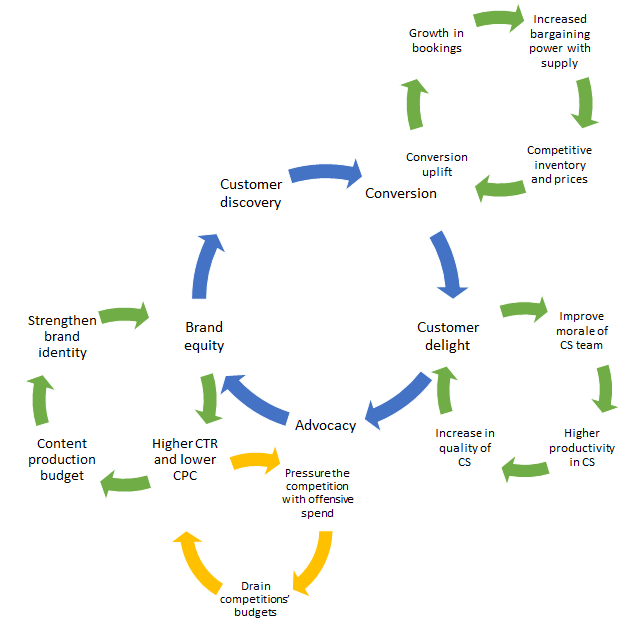
The diagram above is a microcosm of the thought process I go through whenever I discuss monthly budgets with my team members in Indonesia and Vietnam. With a finite amount of dollars, I have to deploy it where it greases the overall machine the most.
In our early days, most of the focus would be on the immediate cogs adjacent to the blue wheel, which I like to call the “primary cogs” (colored in green). Over time, as a company gains scale and clout, it will need to start allocating resources into the “secondary cogs” (colored in yellow) and are usually very tactical in nature.
As you can see, the cogs cut across multiple functions and departments such as business development for supply, customer support, brand management, and content production. Product teams have a role to play across most of these cogs as the creators behind solutions for internal user or customer problems. The primary role of a growth lead is to marshal resources and obtain multiple stakeholders’ buy-in for various missions that are anchored with the organization’s OKRs.
The driving force
And we can’t forget the key driving force behind growth teams: the talent themselves. To me, that was the biggest challenge of all. How do I assemble and retain a team of high performers and keep them motivated and committed to their respective missions?
Team structure
Parting words





Stay updated on the go with our mobile app.
Get latest insights with smoother, more personalized experience through TIA mobile app.