Kylee McIntyre · · 7 min read
Affordable tech for people with physical challenges: how India’s making it possible
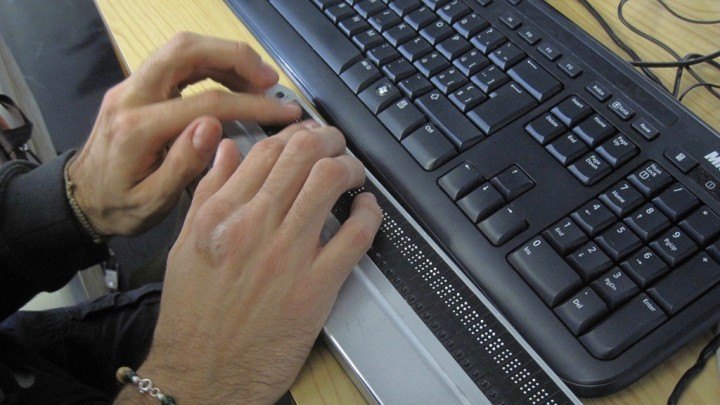
Photo credit: visualpun.ch
Creators design tech to make our lives more convenient, and a lot of tech uses a screen or a keyboard as a starting point. For an individual who is visually impaired, these screens are inaccessible without modifications. An estimated 2.21 percent of India’s population – more than 27 million people – have a physical or mental challenge. Of that group, 47.6 percent are visually impaired. And that only reflects the people who reported their condition as “disabled” to the government.
Inclusive tech has existed for years. Flashing lights, for example, can alert a hard-of-hearing individual when there is someone at the door. Manufacturers continue to scale them up. More recently, Uber showcased options for deaf or hard-of-hearing drivers, including flashing light notifications for drivers. Uber users get sent a uniform text informing them to text rather than call their drivers.
Apple includes accessibility options on OS X, iOS, and the Apple Watch. Voiceover, for example, can be turned on to provide the user with a screen reader that describes everything that’s happening on screen. Greyscale options help users who have trouble seeing the full spectrum of color.
Still, none of this means anything if people lack knowledge about inclusive tech.
Mumbai-based BarrierBreak wants folks with disabilities to be able to work and keep up with the pace at which the world runs. Its founder, Shilpi Kapoor, worked for two years in a virtual work environment, which piqued her interest in inclusive tech. She was particularly interested in how a visually impaired person could use a computer.
Shilpi works to bring information about inclusive tech to conferences and into schools for easy accessibility.
In her research, she saw that while institutions may take steps to accommodate differently-abled students, the students were still segregated. They were taught in separate rooms. Assistive technology was hard for schools to come by, and companies were not willing or well-equipped to hire disabled workers. She started BarrierBreak in 2004 to raise awareness about all this – and about the array of inclusive technology. Her goal was to bridge the gap that marginalized some people.
An Ashoka Fellow, Shilpi works to bring information about inclusive tech to conferences and into schools for easy accessibility. She also does government lobbying work for individuals with physical challenges in India. Her startup organizes a biennial conference, Techshare India, to bring together creators of tech to aid the elderly and those with visual, hearing, or learning challenges in India. The conference, which began in 2008, offers assistive and accessible product demos as well as a space for policy makers to have seminars.
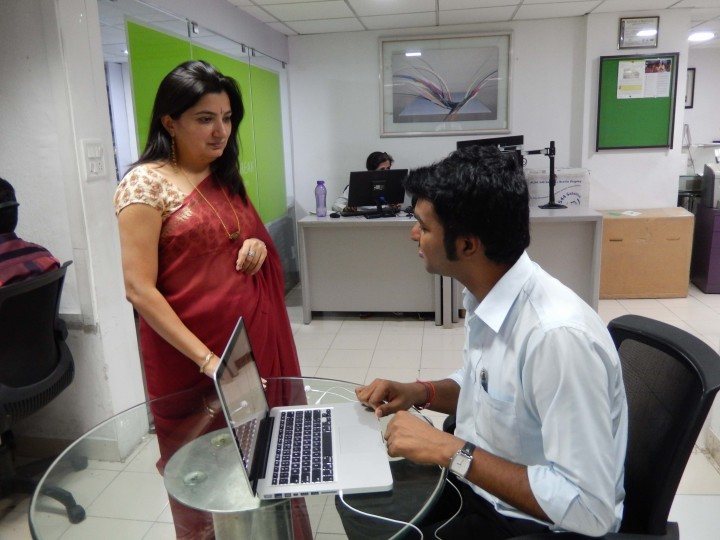
Shilpi Kapoor, founder and managing director of BarrierBreak, aids a man with visual impairment using a laptop.
But it’s not all work. “You should have seen the conference,” says Reeta Gupta, who works with BarrierBreak. “There was one spot where people were just playing games.” That was the specially-designed games area. She says Techshare gathered an audience of about 1,500 in 2014.
Bringing the price down
Inclusive tech options can range from free – minus the cost of the gadget the tech modifies – to over a thousand US dollars, which can make accessibility, well, inaccessible, to a large number of people who need it.
The center focuses on training women with visual impairment in computer use for future employment.
Accessible options
Open for improvement





Stay updated on the go with our mobile app.
Get latest insights with smoother, more personalized experience through TIA mobile app.