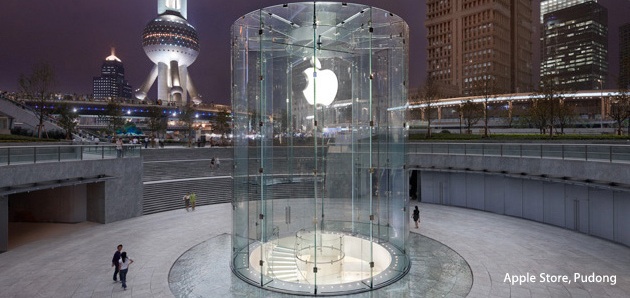
“Apple to open 25 stores in China over next two years…” So trumpeted the headlines back in February of last year, after Apple stated the intention in a shareholder meeting. But now, as the two-year deadline looms, those grand ambitions seem to have fizzled. Has Apple shelved that plan?
As summer starts to fade and the end of 2011 nears, I’m not hearing the pa-ching pa-ching of industrial staplers, smelling freshly-opened tubs of paint, or seeing huge pine tables being carried out of trucks.
The Cupertino company has four stores in mainland China at present: two each in Shanghai and Beijing. But the 25-store expansion was supposed to be Apple’s venture into smaller cities where there’s a sufficiently large middle- to high-income populace – cities like Hangzhou, Suzhou, Wuhan, Guangzhou – to sustain the kind of foot traffic and store revenue that Apple demands.
Actually, only two new stores look likely to be opened this year: yet another in Shanghai (this time on the city’s busiest high-end shopping street, Nanjing West Road), and its first in Hong Kong.
So, by the end of this year, it looks like there’ll only be six stores in the greater China area. That’s far short of 25.
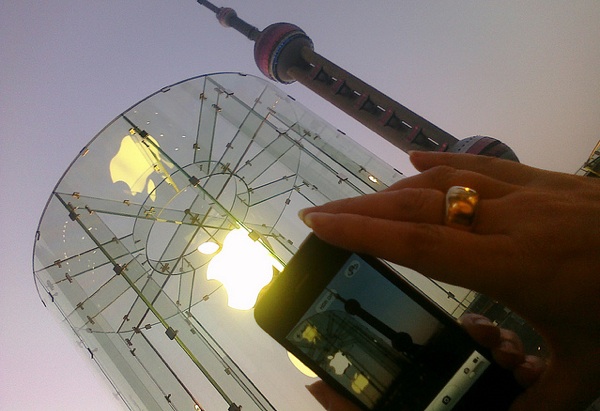
Apple's flagship Shanghai (Pudong) store. Image credit: Flickr user 'globalx'.
If we look at Apple’s China strategy in contrast to, say, Burberry’s, we see that Apple has been enormously conservative. Burberry has just over 50 stores in China – strategically placed in 30 of China’s wealthiest first- and second-tier cities – and has even made the £70m investment to fully buy up its former franchises.
And although an electronics retailer can operate very differently from a clothing brand, with a whole host of official and unofficial resellers ready to sell a firm’s gadgets – as happens across China with Apple resellers – Apple is a different beast. Steve Jobs’ Apple Inc loves to control its retail channel. It has 239 stores in America alone.
If Apple has a store in Randyville, Ohio (I might’ve made that up) it’s looking increasingly insane that it doesn’t have one in Hangzhou, where Mercedes and Audis outnumber cheaper locally-made cars.
Indeed, Apple’s Q2 2011 earnings report – quarterly net profit of US$7.31 billion on record quarterly revenue of $28.57 billion – is pertinent here. Those numbers were greatly bolstered by booming sales in China. COO Tim Cook said China was “key” to the company’s success, since China alone accounted for $6.33 billion of revenue in Q2. (See the WSJ’s liveblog of it).
But I’m not really seeing how just two new stores this year makes China “key” to growth…
Command-C, Command-V





Stay updated on the go with our mobile app.
Get latest insights with smoother, more personalized experience through TIA mobile app.