C. Custer · · 4 min read
Bringing foreign mobile games to China, boutique-style: the story of Oniix

Oniix’s US team
To Western game developers, China’s mobile gaming market looks like a potential goldmine. Mobile game revenues in the Middle Kingdom have been shooting up at breakneck speed – 2014’s mobile gaming revenue was 8.5 times the size of the industry’s 2012 revenue. And with a US$4.3 billion (and growing) market up for grabs, what mobile developer wouldn’t want a taste?
Publishing a foreign game successfully in China is easier said than done, though. And while there are big Chinese firms that work to address this need, there are also smaller boutique studios like US-based Oniix, which focuses exclusively on helping foreign firms localize and publish their mobile games in the Chinese market.
“When Oniix was founded, we saw a gulf between what the top gaming studios expected and what their Chinese publishing partners actually made available to them,” said Mario Alvarez, Oniix’s head of business development. Oniix saw big China-based publishing companies taking on so many clients that individual games didn’t always get the attention needed to make them successful. “There was a need,” Alvarez said, for a company that took the “low volume, high quality” approach: accept only a small number of games as clients so that each game would get the localization and marketing attention it needed to be a success in the Middle Kingdom.
When Oniix started in late 2013, it had a team of fewer than a dozen people. Alvarez, who was part of the original team, says that what unified them was passion for the mobile market and for gaming. “I grew up playing Ocarina of Time and Goldeneye,” he said. “Little did I know [gaming] would end up on my phone, but that actually gets me. I’m really passionate about that.”
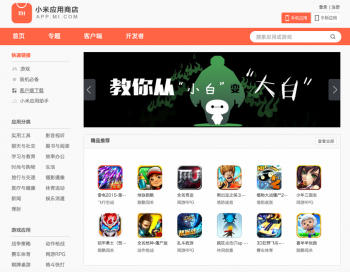
Tap Titans gets a frontpage feature on Xiaomi’s app store (bottom row, third from right)
Like China’s mobile gaming market, Oniix has grown fast, and over the past year and a half its has more than doubled to 25 people. It hasn’t always been an easy journey, of course. “It has mostly been a challenge upholding our values of transparency,” Alvarez said. China is a country where it can be tough to find detailed data, and Oniix likes to provide its clients with comprehensive reports. Tracking down that data is “a constant uphill battle.” But thanks to a couple of China-based teams that Oniix has built up over the past year and a half, Alvarez thinks it’s a battle the company is winning.
To date, Oniix has remained true to its “low volume, high quality” mantra: the company has published just three titles. But each title gets a lot of attention. In the case of Oniix’s most recent release Tap Titans, for example, Oniix head of publishing Everett Wallace said the company created a whole new introduction to the game, changed a lot of the visuals, and totally revamped the monetization scheme in addition to carefully translating the language. “Our focus,” Wallace said, “is making the game appear made for Chinese, so if a Chinese user picks up his game, it isn’t just culturally relevant, it actually seems like it was made for that user.”
So far, it’s a strategy that seems to be working. The Xiaomi and Qihoo 360 app stores have both given Oniix’s version of Tap Titans a homepage feature, and just six weeks after its release it is already in the all-time top 50 RPGs on the Qihoo 360 app store. Reviews of the app are overwhelmingly positive on every platform I checked. Oniix wouldn’t reveal specific revenue figures for Tap Titans, but Wallace told me that the game’s early numbers are “very promising.”
Given that, it’s understandable that Oniix’s plans for the future are basically more of the same. “We have considered […] bringing other categories of apps” to the Chinese market, Alvarez said, but that’s “very far down the line.” The company is also considering outside investment, but it’s not an immediate priority because “things are going very well.” For now, the focus is on games.
Whether the company expands in the near future likely depends on whether it runs into an investor who shares Oniix’s vision and passion for the mobile gaming space. “If we do raise capital,” he said, “the number one priority would be to find the right investor.” Alvarez said.
“We don’t need the capital,” Wallace emphasized. “But if we find the right partner, it’s a great option.”
Oniix seems to have put itself in an excellent position, but the company is likely to face more competitors in its “boutique” China game publisher space as China’s mobile gaming revenues continue to grow.





Stay updated on the go with our mobile app.
Get latest insights with smoother, more personalized experience through TIA mobile app.