This article is brought to you by Studios, Tech in Asia’s advertising arm that connects brands with Asia’s tech community through the power of storytelling.
By now, most of us have heard about, seen, and even been the target of content marketing. Whether it is influencers summarizing government fiscal policies in 31 words or something as elaborate as a brand enlisting a Formula 1 Racing Team, companies have found ways to give the audience a bit of entertainment or education in hopes of making a return on their investment on a potential customer.
We typically call this a conversion, which sounds like a fancy new digital marketing word but is actually a practice that has existed for more than a century now.
In the early 1900s, Jell-O salesmen went from door to door handing out free cookbooks that contained, among other recipes, an introduction to preparing Jell-O.
The reaction to it was rather wild: Delighted by the gift of a free home economics class, people would flip through the color-printed cookbooks, unable to resist the temptation of trying to prepare Jell-O after learning about it.
A hundred years later, that marketing practice has not changed much. Audiences consider trying out a product or service and in return receive a bit of entertainment and/or education. There’s a reason why when you open a Tech in Asia onboarding deck, you are greeted with bullet points that describe our content as compelling, informative, and relevant.
So it’s a strategy that sounds cool and looks cool. But how does it work with us? Even more important: When does it not?
The problem with branded content
Strangely enough, digital branded content in the form we consume it today has not been around for very long. The advertorial model is already antiquated but the digital publishing industry was slow to adopt this business model. Tech in Asia started using this only six years ago.
Back when advertorials were first published in print, there was a natural overlap between a brand’s target audience and the publication’s readers. Subscribers of automotive magazine Classic Driver New Zealand, for example, were good targets for advertisers promoting premium engine oils.
But when digital publishers apply this approach at scale by creating purpose-driven content for audiences across a region as large as Asia, they have to be sure that the readers, viewers, and attendees they attract with their sponsored content match the audience profile their clients need.

Many marketers might not know how to interpret vanity metrics such as “5,000 views” on a paid article, and it’s a fair predicament to be in. For example, if Publisher A offers 5,000 views at $500 while Publisher B offers 7,500 views at the same price, you have to figure out which publisher could deliver the impossible metric: quality views.
Determining the impact of content on readers
Tech in Asia is trying to help solve this problem, as every publisher should. How do we give a reasonable estimate of the ROI of our pieces?
While we haven’t yet calculated the exact bang a client will get for their buck, we are increasingly turning to data to give a better idea of who is reading our sponsored pieces. We can categorize our audience by geography, industry, profession, and interest to narrow down the scope of our boosted campaigns. For one article published on Tech in Asia, we can tell you where it was read, for how long, and of course, the number of clicks the link to the featured product gets.
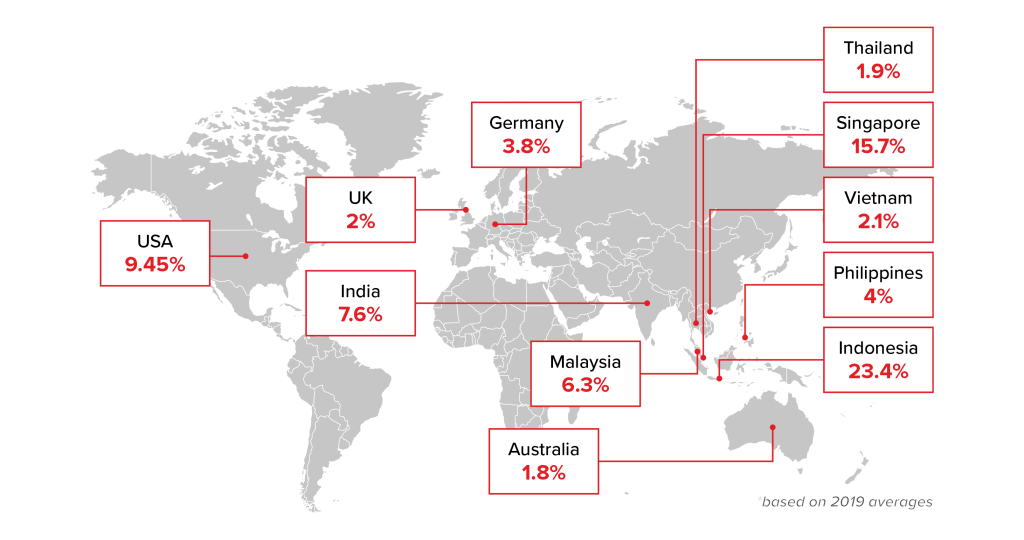
Statistics of Tech in Asia’s engaged audiences. View more here.
This is standard practice – and most content publishers cannot go beyond that. But what if you want to know just how well your article did with your target audience? What if you want to qualify the readers of your piece, or perhaps get an idea of how likely attendees of an event will buy your product?
While it’s not an exact science, we employ a few predictive methods to tell whether or not a piece of branded content delivered what the client needed. We pair up with insights platform Milieu Insight to find out just how well a piece would perform among a sample panel of our readers and whether they are out to find a product or service similar to what the client offers.
Say Startup A is looking to make a stronger move in Asia. For their first partnership with us, we ran a survey via Milieu’s panel that was representative of their target audience. Startup A then signed up for two articles and sponsored one of our annual conferences, with all items to be delivered in H1 2020. By taking on a healthy mix of both awareness content (articles) and lead-generation activities (conferences), we were able to survey our audience and retrieve promising results.
While article #1 performed better than article #2 in terms of raw views, article #2 had more readers who were potential buyers.
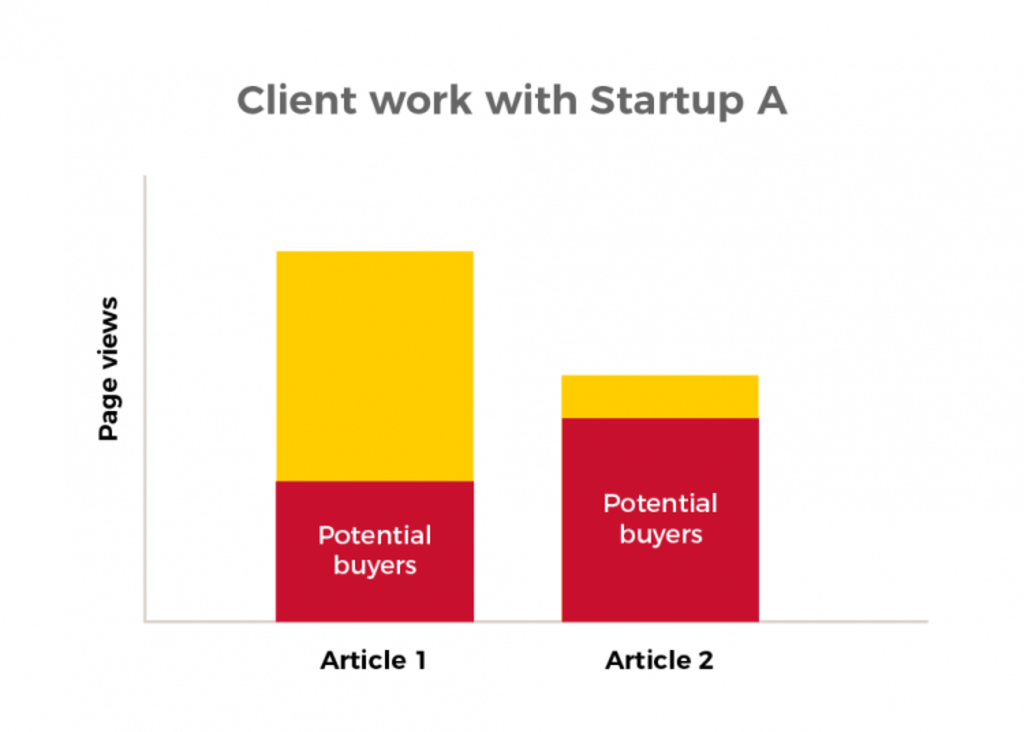
Then once the conference concluded, we were able to see which readers had read both articles and attended Startup A’s session at the conference. When we checked these attendees against the client’s target category definition, we found that despite receiving average views compared to the other conference sessions, it was attended by an exceptionally good number of product purchasers.
We were happy to see that there was a confirmed ROI originating from our campaign. While this seems like a given, it’s often very hard for both sides of a publisher-marketer relationship to nail down just how effective a campaign was.
Achieving tangible results
When it comes to increasing a client’s brand awareness, we can also run surveys that measure exactly the uplift they’ve experienced after getting exposure on our website and extrapolate on how this was achieved.
Many clients reach out to Tech in Asia to first have a sample of the content we can create for them. Perhaps you are already considering the same halfway through this article? If so, view our media kit below.
A recent client-partner, Startup B, was also making some of their first moves into Asia.
We then ran a sampling survey with Milieu in conjunction with the publication of a partnership article to determine our audience’s readiness to familiarize themselves with Startup B. While we typically see a 1% to 5% rise in brand awareness among the Tech in Asia audience for a partner, we were again glad to see that there was a 7% rise in awareness even though the article’s vanity metrics wasn’t particularly robust. This was determined by subtracting the number of people who had known Startup B beforehand from the number of people who did after it was featured on Tech in Asia.
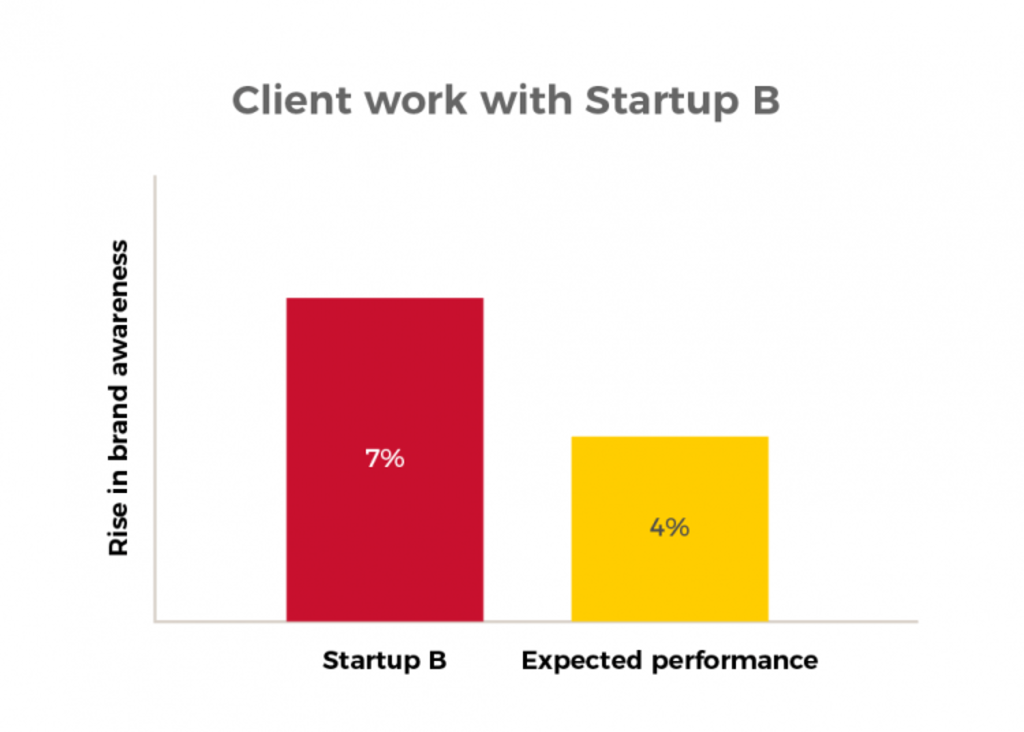
That figure is much higher than one could expect from a campaign targeting an audience as large and wide as Tech in Asia’s. Startup B even shared that getting a 1% to 2% rise in awareness in a sample survey can be difficult, especially after it had done its own larger marketing campaigns in similar geographies.
In the data analysis done by our team and Milieu, the explanation for the rise in brand awareness is quite obvious:
The newer the brand and the less it has worked with us and our audience before, the more it is going to get out of its first partnership with Tech in Asia.
So if you have a brand that you would like to introduce to our audience and you also want to see verifiable lifts in awareness, do get in touch here.
When it comes to lead generation, we can only get better at providing quality leads as our client partnerships grow. As we gather more data from different types of rollouts and interactions with our audience, we can give companies immediate estimates on how on-the-mark we are when it comes to attracting attendees to our events. We familiarize ourselves with our clients’ targets – and make them our targets.
For 2021, we’ve set the goal of idealizing what the perfect campaign on Tech in Asia looks like – but we also need help to test our hypothesis. Given that our content performs well consistently and organically, we are sure we’ve got the right cookbook. What we need now is the perfect Jell-O recipe to add in.
Enjoy the Jell-O
Because these kinds of metrics are highly variegated and highly customized, they do not often sit comfortably on a marketer’s media planner. Comparing statistics between two publications and even traditional digital marketing channels is often a thankless task. But fret not, because we are more than happy to share our success stories with you – and help you build your own.
Data is the lifeblood of our industry, but it is often hard to interpret. Even when a content marketing piece performs well, it’s often hard to attribute its success to particular factors. Click-through rates (CTR) are often a poor measure of performance, given that what companies are really after is the ROI they get from a piece of content marketing. The same holds true for the call-to-action (CTA) link: Fifty clicks from the right individuals are worth a lot more than 1,000 clicks from the wrong people.
Solutions-oriented sales are always the solution, and we are not afraid to say when we know things won’t perform according to what a client needs.

Photo credit: Georgejmclittle
We don’t try to impress with exaggerated reports of compounded views or extreme impressions. Rather, we set targets and we hit them every time. This assures a baseline of quality – but we can do much more than that. After years of doing this, we can do a lot of things with numbers that are less about the flash and more about the bang.
Take a look at our options, find your product/market fit in our cookbook, and let everyone have a taste of your Jell-O. You can get in touch with us here or view our media kit below.
Stay updated on the go with our mobile app.
Get latest insights with smoother, more personalized experience through TIA mobile app.
Recommended reads
 Animoca co-leads $1.75m round of IreneDAO creator
 Shein’s style under strain
 Coinbase to halt operations in Japan amid crypto slump
 Meta launches Avatars Store in Singapore
 How ecommerce firms can get the most bang for their buck with digital advertising
 Navigating the changing digital advertising landscape
 IDN Media launches $3m fund for livestreamers
 So you think you know startup growth
 CapCut could be ByteDance’s next cash cow
 Binance, YG team up for metaverse, blockchain projects










📅 Upcoming Events
22 October 2026
Payoneer x CSPN Summit 2026