 Lilian Tang · · 6 min read
This startup is getting enterprise data ready for the AI agent era

Summary:
- Enterprise data is becoming harder to manage as AI agents create more queries, require fresher context, and rely on accurate retrieval across different data types.
- VeloDB, built on Apache Doris, brings SQL analytics, full-text search, and vector retrieval into one real-time analytical database. It aims to become the data and context layer for enterprise AI.
- VeloDB is part of the IMDA Accreditation program, which aims to support the growth of promising Singapore-based enterprise tech companies. Learn more about how it can help you.
Experiencing a problem firsthand is often the most direct path to understanding it.
A decade ago, Linjiang Lian was building large-scale data analytics infrastructure for major internet companies. These businesses served millions of users, and they needed live data to make their decisions.
This demand led to the creation of Apache Doris, an open-source real-time analytical database.
From this, Lian and his co-founders decided to build VeloDB, a database startup that aimed to bring Apache Doris into a cloud product that enterprises could adopt and operate more easily.
“Our vision is to make analytics fast and easy for everyone,” says Lian, who serves as VeloDB’s CEO.

Linjiang Lian, co-founder and CEO of VeloDB / Photo credit: VeloDB
After all, real-time data is essential to help teams accelerate fraud detection, optimize supply chains, personalize customer experiences, and manage risk, among others. According to IBM, 63% of enterprise use cases must process data within minutes to remain useful.
And as the industry moves from passive AI – such as chatbots – toward autonomous agents, the need for real-time data and analytics becomes increasingly critical. Today, businesses must evaluate whether their data infrastructure can actually keep pace with the rapid speed that AI agents require.
Fragmented data slows AI down
Many enterprises face a major hurdle limiting their ability to leverage AI: data fragmentation. This issue arises because information is often trapped in disparate systems across an organization.
“Every data type has its own database,” Lian explains. “For example, a warehouse for structured records; a search engine for text and logs; or a vector database for embeddings.”
While each system may have made sense when it was first introduced, together they create a data sprawl. Agentic AI makes this harder to sustain.
“A single autonomous agent can generate more queries in an hour than an entire analyst team produces in a week,” Lian points out.
This puts pressure on enterprise data infrastructure in three ways:
- Concurrency: As organizations deploy additional AI agents, systems must manage a growing volume of machine-to-machine requests.
- Retrieval accuracy: Agents extracting information from various databases require consistent and relevant context rather than just similar data.
- Freshness: For time-sensitive applications like incident response or fraud detection, data must reflect the latest changes rather than being minutes out of date.
Fragmentation also changes the cost equation. Agent workloads can be unpredictable and come in bursts, but companies may still need to keep a vector database, log store, and warehouse ready to respond when called. Over time, as Lian points out, the cost of maintaining multiple systems, even when some sit idle, becomes harder to justify.
“An agent is only as good as the context it retrieves,” Lian says. “That context has to be fresh, accurate, and capable of supporting high-volume requests.”
One engine for multimodal data
VeloDB’s answer is to consolidate various workloads into one engine. It offers a real-time analytical and search database that enables organizations to analyze business data, search logs and text, and retrieve AI-relevant context from one unified platform.
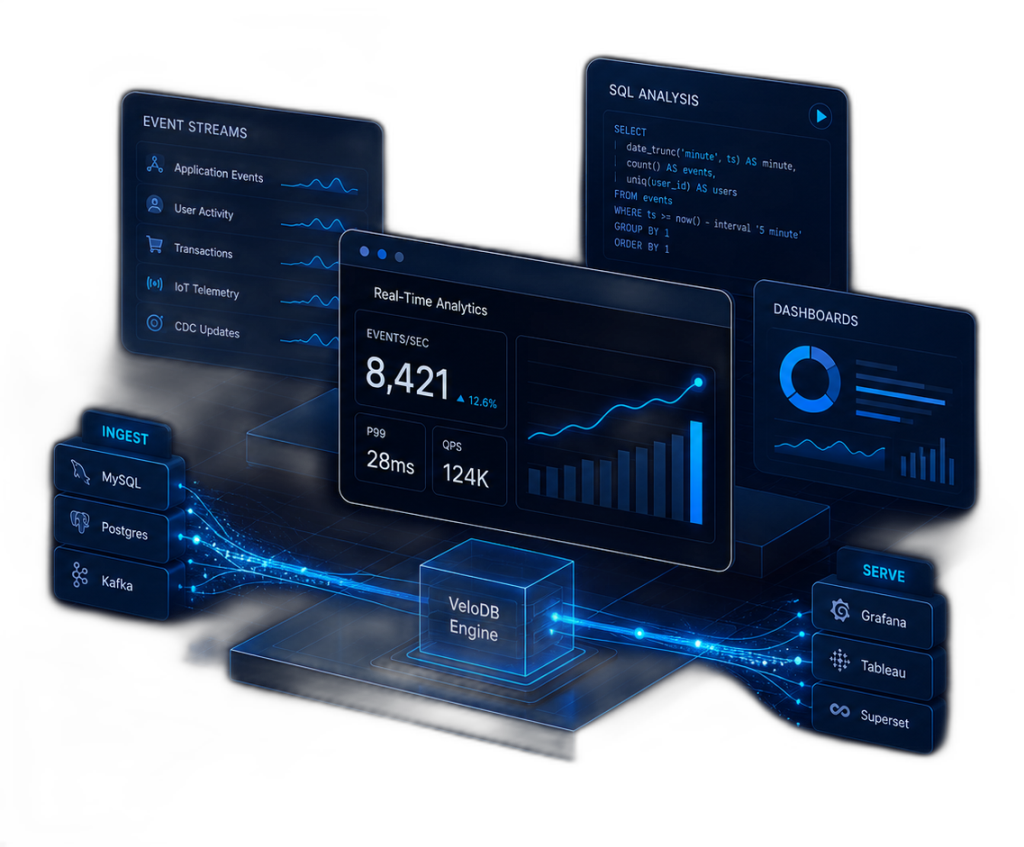
VeloDB’s platform brings event streams, SQL analysis, and dashboards into a real-time analytics engine / Photo credit: VeloDB
Yet, consolidation alone is not enough. According to Lian, many “all-in-one” databases struggle when different workloads compete for the same resources.
“Most ‘all-in-one’ databases collapse under mixed workloads,” Lian says. This is because a resource-heavy analysis slows down real-time updates, while large data uploads cause search results to fall behind.
To address this, VeloDB was built with workload isolation. For example, a customer service team could pull live data into a real-time dashboard, while another team uses the same dataset to analyze customer spending patterns in the background. This allows different workloads to operate from a shared data foundation without constantly slowing each other down.

This can simplify how AI agents retrieve context. Instead of reaching across a warehouse, a search engine, and a vector database, an agent can issue one query and receive fresh, consolidated, and ranked information from one place.
One example of how this looks like in practice is ByteDance. By moving to Apache Doris 4.0, the version of the open-source database used in this deployment, ByteDance was able to bring vector search, text search, and SQL aggregation into a single engine to improve retrieval accuracy with a very small hardware footprint.
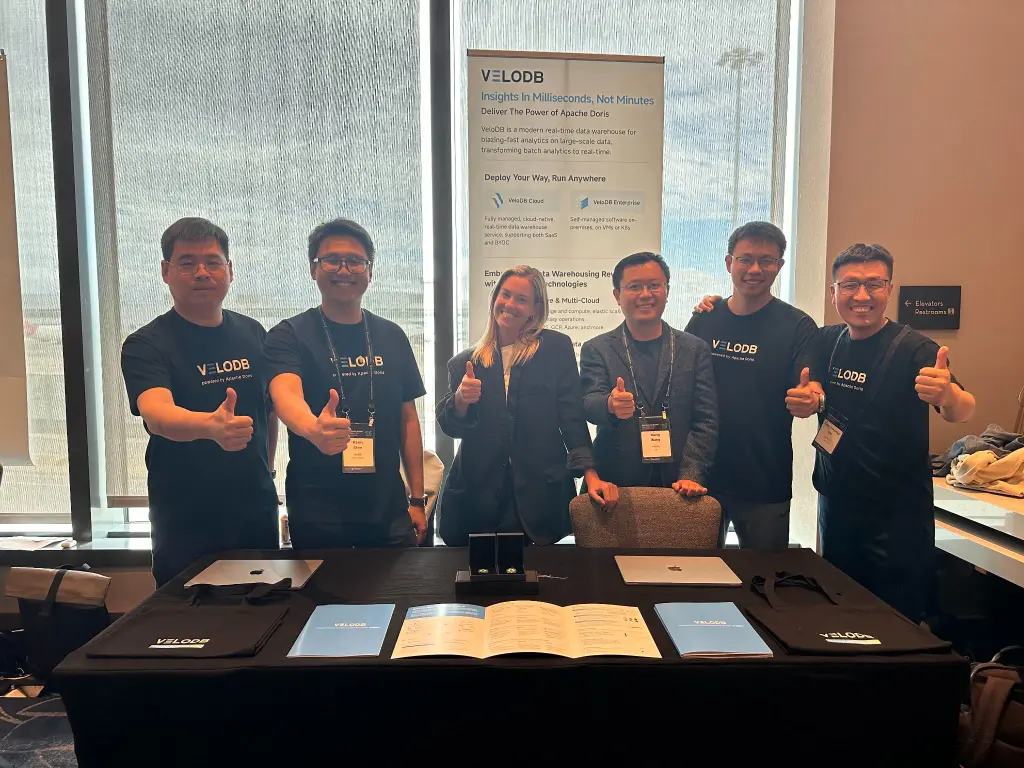
The VeloDB team showcasing Apache Doris at a data streaming summit / Photo credit: VeloDB
According to VeloDB, the deployment achieved a latency of 400 milliseconds – 7x faster than pure vector search – and had an accuracy of 89%. More importantly, it showed how AI retrieval can become more reliable when semantic search, keyword matching, and structured data are handled together rather than stitched across separate systems.
“Agents need correctness as much as they need speed,” Lian says. “When the search results and the analytics come from the same row at the same point in time, there is nothing to reconcile.”
Where VeloDB fits in the AI story
As AI adoption matures, VeloDB wants to play a larger role in the infrastructure behind enterprise AI adoption. The company’s work has been adopted across industries such as banking, gaming, SaaS, and more.
Lian describes the company’s ambition as becoming the “data and context layer” for AI agents. That means helping enterprises store and analyze different kinds of data – from structured tables and JavaScript Object Notation (JSON) to text, logs, and vectors – while supporting hybrid search and real-time analytics.
“We call this context engineering – building real-time data pipelines that deliver context to AI systems,” says Lian.
VeloDB’s solution is designed to serve a variety of stakeholders within an organization. For engineers, the platform simplifies data consolidation and governance. Data engineers can use the platform as a unified solution for real-time applications, data warehousing, retrieval-augmented generation, and context engineering. Meanwhile, business teams stand to benefit from the long-term potential of more immediate, intelligent decision-making and analysis.
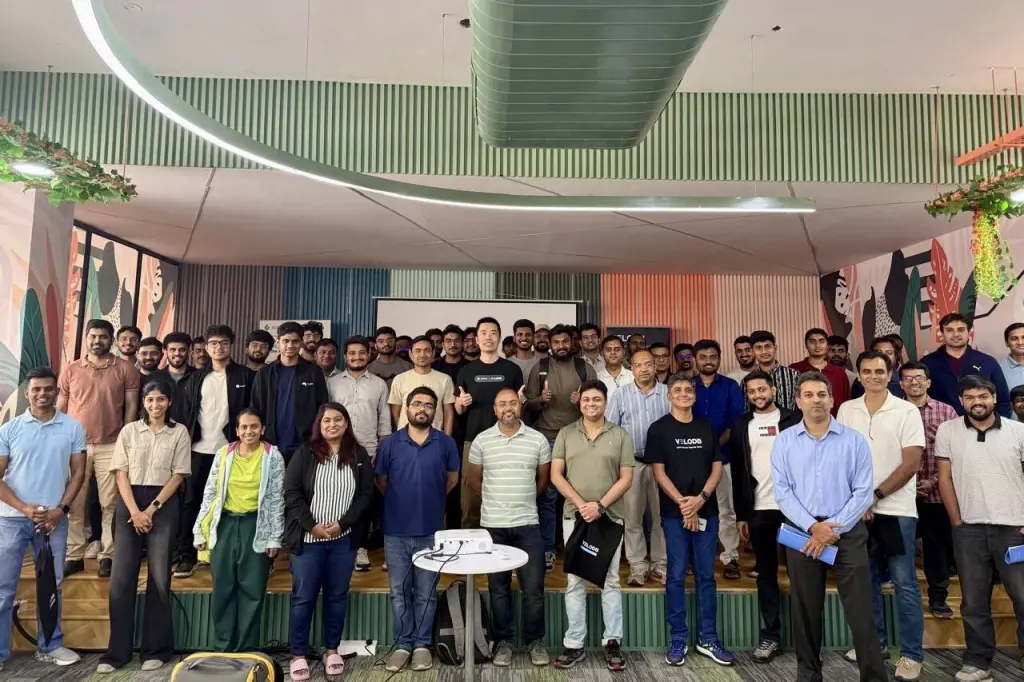
The VeloDB team in Bangalore / Photo credit: VeloDB
As part of IMDA Accreditation, which supports promising Singapore-based enterprise tech companies in building credibility and business traction, VeloDB is positioning itself for a market where AI adoption is increasingly tied to the quality of a company’s data foundations.
“Models will keep changing, and the need for fresh, accurate context stays constant,” Lian says. “We want VeloDB to be where that context lives.”
Launched in 2014, the IMDA Accreditation program aims to accelerate the growth of promising Singapore-based enterprise tech companies. It helps them establish credentials, build business traction, compete in the global market, and gain more opportunities to showcase their solutions to spur technology adoption. Discover how IMDA Accreditation can empower your organization here.
VeloDB is a commercial real-time analytics and search database built on Apache Doris, a leading open-source real-time analytical database. The platform aims to democratize insights for all data users so they have access to the most up-to-date information for real-time decision-making. Learn more about VeloDB here.
This content was produced by Tech in Asia Studios, which connects brands with Asia’s tech community. Learn more about partnering with Tech in Asia Studios.
Stay updated on the go with our mobile app.
Get latest insights with smoother, more personalized experience through TIA mobile app.
Recommended reads
 Flipkart’s costly late push into quick commerce and food delivery
 Inside Singapore’s government team that kills its own products
 Once an IPO hopeful, SCI Ecommerce nears collapse
 Who’s betting big on ChatGPT ads? Not Asian brands
 VC tracker: Granite Asia launches US$50 million fund
 GCash trims IPO ambitions to meet market realities
 Igloo CEO eyes global M&A: ‘We have an appetite to grow more’
 Why SBI paid a premium for Ajaib amid a tough market
 OpenAI warns building for today will cause technical debt





Editing by Stefanie Yeo and Jaclyn Tiu
(And yes, we’re serious about ethics and transparency. More information here.)



📅 Upcoming Events
22 October 2026
Payoneer x CSPN Summit 2026