Yanting Sim · · 6 min read
How a blockchain startup raised $19.5M in 48 hours to rent your computer storage space
This week, Tech in Asia Jobs shares insights into how successful companies operate, hire, and more.
You’ve probably been part of the sharing economy. Have a spare room in your house? Rent it out on Airbnb. Have items around the house you no longer use? List them on eBay or Carousell. Have extra seats in your car on the way to work? Offer them up via UberPool or GrabHitch.
Now, what if you could get paid for the extra space in your computer that you don’t need?
That’s what Bluzelle, a blockchain startup, hopes to be able to do by as early as December 2019.
I sat down with Bluzelle CEO, Pavel Bains, to find out more about Bluzelle’s journey and how it intends to achieve its goal.
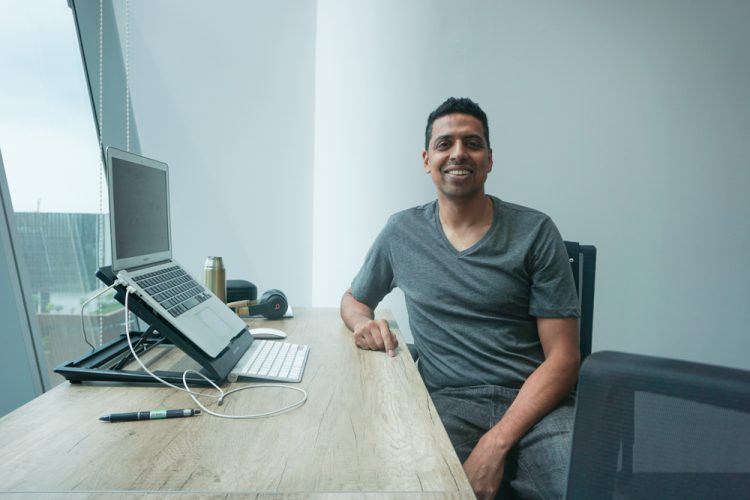
Bluzelle CEO Pavel Bains / Photo credit: Sim Yanting
An alternative to cloud database services
Using blockchain technology, Bluzelle is building a decentralized database service that businesses can use to store their data. It aims to replace cloud database services such as those offered by Oracle and Amazon.
Founded in July 2014, Bluzelle is designed like a marketplace.
The Singapore-based startup will serve companies that are looking for data storage. But Bluzelle isn’t offering a centralized cloud service. Instead, it breaks down data, then encrypts and stores them across a large group of nodes (computers) called a swarm. Because each fragment of data is stored on multiple computers, should one node go down, the others are still there. This eliminates downtime and central points of failures.
Furthermore, successfully hacking into one node would only reveal a single fragment of data without any context, rendering the information useless. According to Bains, this creates a system that’s reliable, secure, and completely scalable.
People can provide storage resources to the Bluzelle network in exchange for Bluzelle tokens (BLZ). These individuals have extra space in their computers, which they can add as nodes in the network and get paid for it.
Bluzelle isn’t exactly a blockchain like Ethereum. Instead, it’s what’s known as a database protocol, or proprietary technology that other blockchains like Ethereum and Neo can connect to. Right now, Bluzelle is targeting blockchain companies and developers building decentralized applications (dapps), but its goal is to support non-blockchain projects in the long run.
“Eventually, anyone who wants to make an app, whether is it a mobile game, calendar app, or media app, has to store their data somewhere,” says Bains, “And we want it to be on Bluzelle.”
While Bluzelle’s headquarters is in the city-state, it also has an office in Vancouver, Canada, where Bains comes from. The Bluzelle team is currently 16 members strong. The Singapore office focuses on sales, marketing, and finance, while the core technology and R&D team, led by co-founder and CTO Neeraj Murarka, is in Vancouver.
How Bluzelle came about
The ICO
Challenges
Hiring





Stay updated on the go with our mobile app.
Get latest insights with smoother, more personalized experience through TIA mobile app.