Terence Lee · · 4 min read
Bio3D wants to print body parts and make prescription drugs cheaper and better

Mingwei Fan, co-founder of Bio3D Technologies, took the stage to pitch at this year’s Startup Arena competition. The startup is creating a bio 3D printer that Fan believes could drastically reduce costs in medical trials, leading to better drugs created at a faster clip and more cheaply.
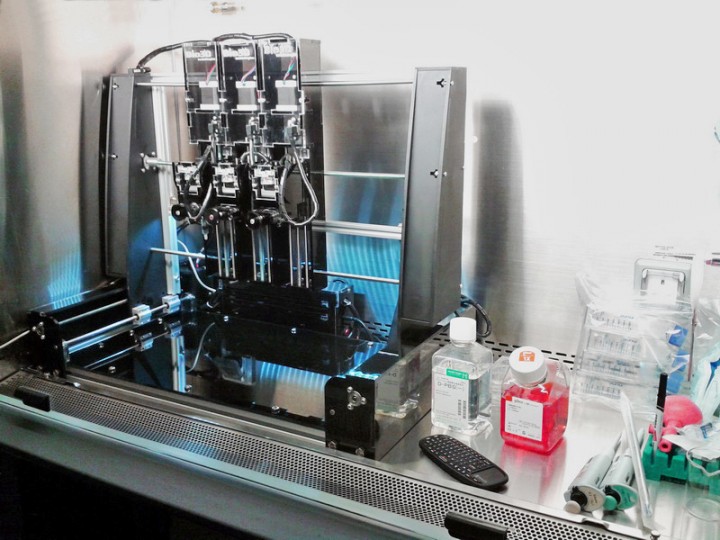
Fan’s bio 3D printer is a Frankensteinian cross between an industrial-quality 3D printer and precision lab equipment. The company’s first commercial product, it prints cells, other bio materials, and even plastic, arranging them at the micron level — out of reach for even the most nimble hands.
Fan is a bio nerd. In particular, he’s fascinated by the micro living organisms called cells that combine to form even more intricate living things. Referring to them as if they were human beings (“They eat and shit in the petri-dish at the same time”, he told Tech in Asia in a one-to-one interview), he explained how their sociable nature is key to understanding the potential impact of bio 3D printers.
Cells need to be aligned in a certain way to in order for them to interact with one another. Once they are aligned, we can let nature take its course.
Such exact arrangements by artificial means is unprecedented, until the arrival of bio 3D printers.
Fixing drug research, one cell at a time
Fan went on a lengthy explanation of the broken drug research process and how it is due for a shake-up by bio 3D printing.
A typical research project can take anywhere between eight to 20 years, and it involves a tedious chain of events starting with chemical tests, then moving on to cellular, animal, and finally clinical trials involving people.
If the pursuit fails at any point of time, it’s basically goodbye to the billions of dollars and years of sweat that scientists have been pouring into the lab.
What makes the tests so cumbersome is that they often involve thousands of chemicals, and each one would need to be tested individually at different concentrations, dosage levels, and forms.
The animal testing stage is particularly gruesome and costly. Drugs could be injected into a baboon’s liver, for example, to test the effects of a chemical. If the baboon shows no ill effects, it is euthanized in the name of science and the liver extracted for study.
Business model





Stay updated on the go with our mobile app.
Get latest insights with smoother, more personalized experience through TIA mobile app.