Sumit Chakraberty · · 5 min read
Alibaba and the 40 founders from India
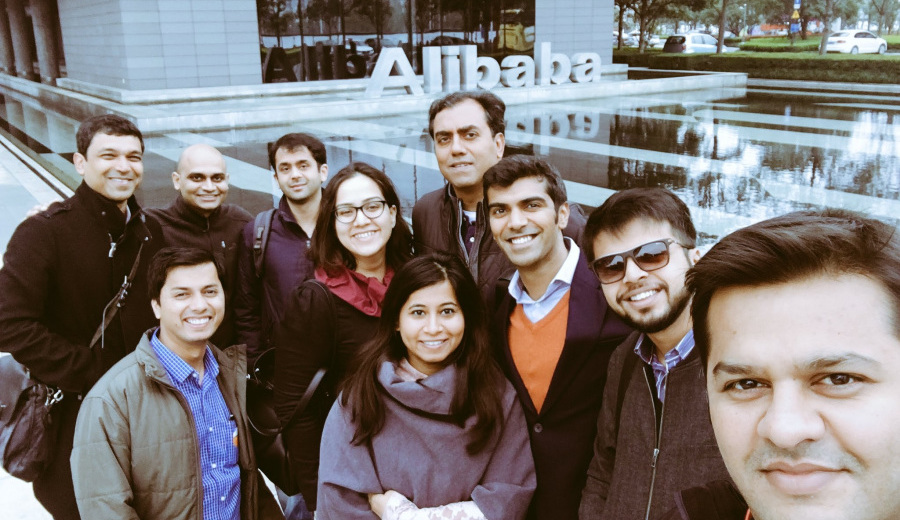
Blume Ventures managing partner Karthik Reddy is at extreme left, while his co-founder Sanjay Nath is the tall one in the middle. Photo credit: Blume.
If you happened to be in Hangzhou on a crisp spring morning in late March, you would have witnessed an unusual spectacle: two busloads of Indian startup founders arriving at Alibaba HQ, posing for group selfies, and taking a guided tour of China’s biggest internet success.
The entourage consisted mainly of startups from the portfolio of Blume Ventures, one of India’s earliest and most active seed-stage funds. They were accompanied by both the co-founders and managing partners of Blume – Karthik Reddy and Sanjay Nath.
Just how unusual this was became apparent in a conversation I had with Karthik in the bus. It was his first visit to China. And he had arrived with the whole Blume gang. So, what’s changed for these Indian investors and founders to make this collective trip now?
If not now, when?

A poster on the grounds at Alibaba HQ in Hangzhou. Photo credit: Tech in Asia.
Karthik and Sanjay founded Blume in 2010 after connecting as fellow Mumbai angels. They had a lot in common: graduating from premier engineering colleges IIT Roorkee and BITS Pilani, going to the US for MBAs at Wharton and UCLA, working for US multi-nationals like American Express and IBM.
They had lived in the US and were now frequent travellers to Silicon Valley – to raise money for Blume which closed its second fund late last year, line up series A rounds for its startups, or find partners for co-investment as they did recently with Draper Venture Network. China wasn’t on the radar.
Chinese companies and investors were so busy making hay in the booming domestic market that they had no time for the large tech ecosystem and market next door either. Their overseas investments were mostly in Silicon Valley. The cash-rich Baidu, Alibaba, Tencent, and JD made 90 deals there worth US$7.7 billion between 2012 and 2016.
It’s only recently, with the domestic market getting saturated and hyper-competitive, that the Chinese have looked over the Himalayas separating the giant neighbors that account for a third of the world’s population.
Alibaba tested the waters by investing in mobile payments and ecommerce company Paytm, while Tencent recently followed up its backing of healthcare startup Practo by leading a US$1.4 billion round for ecommerce player Flipkart.
See: She’s studying Hindi in China with an eye to the future of tech

Chindia connection. Photo credit: Tech in Asia.
Question of trust
Different from the US





Stay updated on the go with our mobile app.
Get latest insights with smoother, more personalized experience through TIA mobile app.