 Paul Bischoff · · 7 min read
Guanxi 2.0: how WeChat groups are changing the game in China’s tech and startup scene
In western countries, separating work from play is seen as a healthy practice. We’ve built our web tools around this premise. You don’t hunt for jobs on Facebook. You have a work email and a personal email. Very few of your LinkedIn references are also contacts in WhatsApp.
But in China, all online communication converges at WeChat. The four-year-old chat app now functions as text messenger, Facebook, Reddit, Skype, IRC chatroom, Meetup, and Instagram – all rolled into one.
If you own a smartphone in China, chances are you’ve got a WeChat account. At last count, Tencent reported 355 million monthly active users globally, the large majority in mainland China.
And now Tencent’s flagship app is blurring the lines between professional and social, taking the place of conference rooms, expert forums, recruitment sites, and, with its recent integration of LinkedIn, resumes.
Five or 10 years ago, a seasoned businessman in China might advise you to grab a pack of classy cigarettes and a bottle of strong baijiu before heading to an important meeting. These days, you’d be naive to go without a WeChat account. It’s not uncommon for WeChat QR codes linked to personal accounts to appear on business cards.
In China, as with much of Asia, success in the business world largely depends on a person’s social capital, or guanxi. Networking is vital, and very few people make it to the top on merit alone. WeChat has brought this very old reality into the internet age. Nowhere is this more apparent than in one of the app’s most basic functions: group chat.
When WeChat was first released, groups were limited to 40 people. In China, unsanctioned gatherings of large groups of people at a physical location are illegal, but WeChat makes such forums accessible in the palm of one’s hand. Now a group can have as many as 100 people. Beyond that, the moderator must obtain special permission from WeChat. The biggest groups are capped at 500 members, but they are far fewer in number.
An exclusive club
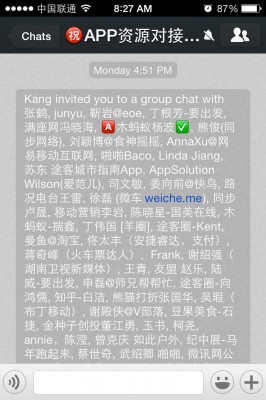 500 Startups venture partner in China Rui Ma says she’s part of 15 to 20 groups that she actively pays attention to. All told, she estimates spending one hour per day on groups ranging from cryptocurrencies to her class alumni at Tsinghua University. Most of the tech-related groups, she says, are organized by verticals like mobile, social, or hardware, and often contain 150 to 500 people each.
“The best ones have one main owner and are pretty moderated,” Ma explains. Those who get off topic will be kicked out.
Many of the groups are quite exclusive, and require knowing an existing member or even the moderator personally to be invited. Other groups just starting out will publish their QR codes in public online. Ma says she spends a lot of time on forum-style threads. “It’s like Twitter in the sense that its people showing photos, articles, and very short conversations,” she says, “but it’s more curated and more targeted than Twitter.”
Ma admits that being in so many groups can get unmanageable at times. She deactivates notifications for most of them, and pins the best groups to the top.
Still, the pros outweigh the cons. Ma says she’s been introduced to several people and potential deals, making it an invaluable tool for local investors. Other people share third-party information, articles promoting their own companies, and job ads.
And because Ma is 500 Startups’ venture partner for all of China, she notes WeChat is “great for bridging geography.” She knows many people living outside of Beijing through WeChat only.

Who doesn’t like red envelopes?
Conflict resolution at light speed
Drowning in the noise





Stay updated on the go with our mobile app.
Get latest insights with smoother, more personalized experience through TIA mobile app.








📅 Upcoming Events
22 October 2026
Payoneer x CSPN Summit 2026