- Premium Content It takes our newsroom weeks - if not months - to investigate and produce stories for our premium content. You can’t find them anywhere else.
 Ardi Wirdana · · 6 min read
Bezos-backed Ula’s winning combo may be commerce and credit
For Ula co-founder and CEO Nipun Mehra, adding a credit product on top of an ecommerce play is a no-brainer.
“Commerce and credit have always gone hand in hand,” Mehra, an Amazon and Flipkart graduate, tells Tech in Asia just days before Ula announced its US$87 million series B round.
For some months, the business-to-business ecommerce startup considered offering different credit products such as working capital loans for its merchant partners. However, buy now, pay later (BNPL) emerged as its top pick.
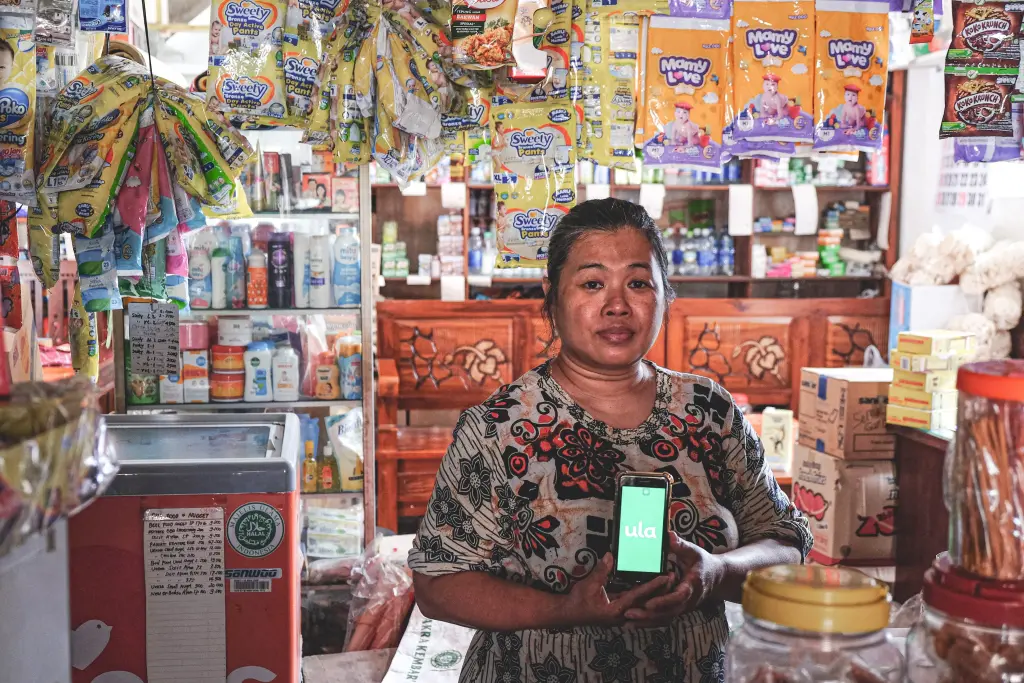
A warung owner in Malang, East Java, using the Ula app / Image credit: Ula
The company has earmarked some of its fresh funding to expand its BNPL product – a move that has received the blessing of its top-notch investors. Among them was Bezos Expeditions, the investment firm of Amazon founder Jeff Bezos, who is no stranger to the ecommerce-lending playbook.
Ula’s timing could prove to be a masterstroke. Over the past year, BNPL has become one of the most popular fintech products in Indonesia, prompting many of the country’s top ecommerce and fintech players to jump on the bandwagon.
Last year, 55% of new ecommerce users opted for BNPL when buying online, according to a report by Kredivo and the Katadata Insights Center. Meanwhile, a survey conducted last year by Research and Markets found that BNPL payment in Indonesia is expected to grow by 76.7% on annual basis to reach US$1.6 billion in 2021.
See also: Behind Ula’s striking takeoff in Indonesia
While Ula will no doubt be riding the BNPL wave, it has a distinct approach. Whereas many BNPL providers target individual consumers, Ula’s product serves small neighborhood retailers in its ecosystem. Locally known as warungs, these retailers generally don’t have access to financial products because it’s costly for companies to serve these segments.
It is also a different approach compared to other ecommerce companies. Instead of partnering with an existing BNPL provider, Ula builds its own tech. However, it does have undisclosed fintech partners to handle other aspects of BNPL.
Ula says it can use more than 50 unique data points to better understand customer behavior, which in turn helps it design a segmented offering of payment terms suited to each business.
The startup does not charge any fees for its BNPL product, so it does not directly make money out of it. However, Mehra says that its impact has been significant: In just a few months, customer demand for the BNPL option increased threefold.
In some places where Ula has piloted, its BNPL product is already powering around 15% of that area’s sales.
Not exactly Udaan
Reaching saturation point?
Stay ahead in Asia’s tech landscape
This is premium content. Subscribe to read the full story.
While Ula’s customer segment is notorious for having high credit risk, the B2B ecommerce player believes that it has the right model and approach.
We know this is not ideal. ⌛ Sign up in 20 seconds. Cancel anytime.
Our subscriber community includes professionals from these companies:





Stay updated on the go with our mobile app.
Get latest insights with smoother, more personalized experience through TIA mobile app.