Josh Horwitz · · 7 min read
One bouquet, in one lifetime, for one person only: meet China’s US$100M flower shop
There are many ways to say “I love you.” Romantic dinners. Jewelery. Chocolates. But when it comes to material expressions of love, it’s hard to beat flowers. They’re memorable, but not lavish. They’re ephemeral, so they never wear out their welcome in the house. They’re also relatively demographic proof – show me the lady who doesn’t like flowers, and I’ll show you the lady who’s just not that into you.
One Chinese ecommerce company is putting a new spin on flower gifting. Roseonly, a Beijing-based startup founded in 2013, sells rose bouquets sourced from premium vendors from Ecuador. Like many Chinese online merchants, it has virtual stores on Taobao, Tmall, and Jingdong – meaning its bouquets are a click away from a pair of discounted Nike sneakers. Customers can pay for goods using Alipay, after which they’re shipped to recipients in over 300 Chinese cities.
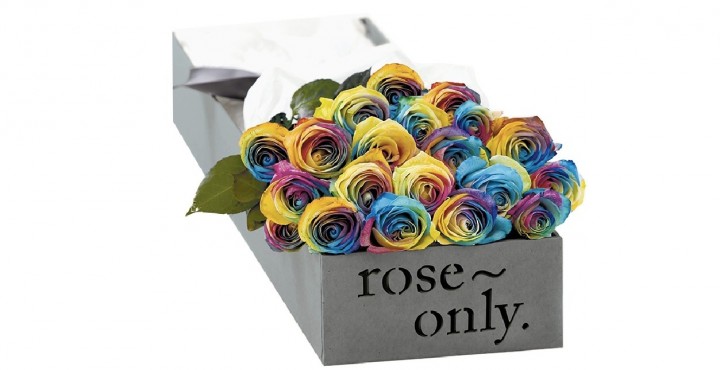
To the average person, Roseonly’s bouquets might look a bit garish, even ostentatious. In addition to the usual crimson arrangements, the company sells jewel-encrusted bouquets packaged in what looks like an engagement ring box. For customers not content to settle on one color, there’s a rainbow bouquet. But Roseonly’s flowers don’t just stand out for their designs, they stand out for their price tag too: the average batch sells for about RMB 1400 (about US$240). Larger arrangements cost twice as much. That’s because Roseonly doesn’t sell roses, it sells the privilege to give someone its roses. The company encourages its customers to purchase bouquets for a single person, just once in a lifetime.
Roseonly requires users to specify the name of the recipient for their purchased bouquet, which can’t be changed after it’s set. In other words, if I purchase an RMB 3999 (about US$650) bouquet to be sent to my wife Susie, Roseonly won’t let me change the name of the recipient if I attempt to make a future purchase.
“If we discover you giving your order to someone else, we cannot guarantee your order will ship to the recipient,” reads the copy for a bouquet that costs RMB 1314 (US$214).
One might suspect that a company that tries to bar its customers from making repeat purchases would be doomed to failure. To the contrary, the company has been growing rapidly. Pu tells Tech in Asia that Roseonly is now the biggest flower vendor on Tmall. The entrepreneur boasts that sales from its online stores and offline retail outlets – three in Beijing, one each in Guangzhou, Shenzhen, Shanghai, Chengdu, and Hangzhou – approach RMB 1 million (about US$160,000) daily, and he expects annual revenue for 2014 to hit RMB 200 million (about US$32 million).
Investors are bullish too. After receiving a small angel round two months after launch, Roseonly went on to rake in a US$10 million investment. Last May, IDG and Accell raised another US$10 million for the company. Pu claims investors have valued the company at US$100 million.
Petal to the metal
How can a flower store be worth US$100 million? Roseonly’s value lies not in its petals, but in its perception. In Pu’s view, Roseonly provides an glamorous but not overly cost-prohibitive service to millions of upper-middle class Chinese consumers, who are hungry for affordable luxury goods.
It’s no secret that much of the growth over the past ten years for expensive lifestyle products has come from the Middle Kingdom. However, Bain recently claimed that luxury spending among Chinese consumers has begun to flatline due to changing consumer tastes and political pressure. At the same time, the company claims that a new segment of products, which Bain has unceremoniously dubbed the “wannabe segment,” will see a surge in growth over the next five years among the nation’s middle class.
Michael Zakkour, principal at Tompkins International and author of “China’s Super Consumers,” says that in recent years, American brands in particular have been able to capture this growing segment in China. “For years in China we knew that there was a market for a US$5,000 handbag, and we knew that there was a market for a US$5 dollar handbag. The question was, ‘Is there a market for a US$500 handbag?’ Increasingly, we’re seeing US brands move up the charts and occupy the space that was occupied by European luxury brands.”
That’s all well and good for the American brands, but where does it leave the Chinese? For a generation of entrepreneurs that came of age in the nineties and 2000s, the value of a powerful brand isn’t an unknown concept. That’s what Pu’s trying to tap into with Roseonly.

A rose by no other name





Stay updated on the go with our mobile app.
Get latest insights with smoother, more personalized experience through TIA mobile app.