
As merchants in Indonesia adapt to selling across different platforms, they have encountered problems with integrating and tracking data coming in from disparate channels. These issues have led to inventory mishaps and missed selling opportunities, which in turn can hinder growth.
The pandemic has made things worse, forcing offline merchants to go online. Meanwhile, merchants taking an omnichannel approach now have to contend with both online and offline issues. Trying to manage and balance operations across various platforms on their own has often resulted in wasted budgets, resources, time, and increased error rates.
Merchants also face another hurdle: With the move to online, the customer-merchant relationship has weakened as competing products and prices are lined up alongside each other, eroding brand identity and presence.
These concerns did not escape the notice of Jimmy Petrus, the founder and CEO of iSeller, a commerce platform that helps merchants grow and scale by simplifying a multichannel approach that’s inherent among small and medium-sized businesses (SMB) in Indonesia.
“I have some friends in multiple areas of selling – in-store and online, as well as on online marketplaces,” he says. “They were looking for a solution that could solve their problems by streamlining all the data from their customers on a single platform.”

Jimmy Petrus, founder and CEO of iSeller / Photo credit: iSeller
Petrus’ background in software development for multinational companies, combined with insights from these merchants, seeded the idea for iSeller, which was established in 2017. Back then, there was no player in Indonesia’s omnichannel sector that did what iSeller seeks to do. With 64 million SMBs across the archipelago, there was a huge gap in the market for iSeller to fill.
The early days
When iSeller launched around four years ago, it was a first mover in the omnichannel software-as-a-service (SaaS) category in Indonesia, Petrus says. The company started with robust point-of-sale (POS) solutions as its first product, before adding retail online store capabilities in the following year.
Developing the product wasn’t daunting in itself, as Petrus came from the tech industry and was able to quickly fill key roles – including chief technology officer – with employees from his previous venture. Bringing customers in, however, was another matter.
“The acquisition of sellers and sales were our biggest challenge at that time,” he recalls.
The success of the fledgling firm depended on getting new and notable merchants – a task that Petrus and his team had little experience in and struggled with initially. To solve this, iSeller centered its recruitment efforts on looking for talented sales staff. Experienced professionals were also headhunted to fill senior level roles.
“With our background in enterprise-grade technology, we were confident in our ability to build a next-generation business platform that would make a difference,” Petrus says. “Once we assembled the right business development team, that really accelerated the acquisition of new merchants and that helped to open the floodgates of growth.”
Another early roadblock was the presence of strong competition in the POS scene, but iSeller got around this by introducing more sophisticated products for more established SMBs. “Larger SMBs need more rigorous performance monitoring, order and customer management, and robust reporting,” explains Petrus. “This is where we found our sweet spot, solving business complexities not served by simpler, off-the-shelf solutions in the market.”
Since then, iSeller has also rolled out services that other platforms didn’t offer, such as digital kiosks and online site builders, and made sure that everything was integrated and supported on a single platform.
Gaining momentum
For two years, iSeller focused on refining its products, acquiring new merchants, and securing additional investments. In 2018, the company received angel funding and onboarded several big-name merchants including Ixobox, a popular hair salon franchise in Indonesia. By providing an integrated POS and digital kiosk system that helps with self-service payment acceptance, iSeller allowed the Ixobox team to concentrate on the customer experience and giving haircuts.
How it worked was simple: Customers would go to an outlet, select the service they wanted, and pay at the kiosk. They would then collect a receipt, wait for their turn, get a haircut from a stylist, and leave when they were done. In short, iSeller’s solutions freed up the Ixobox staff from handling the salon’s backend operations, in this way also significantly reducing the costs of running outlets.
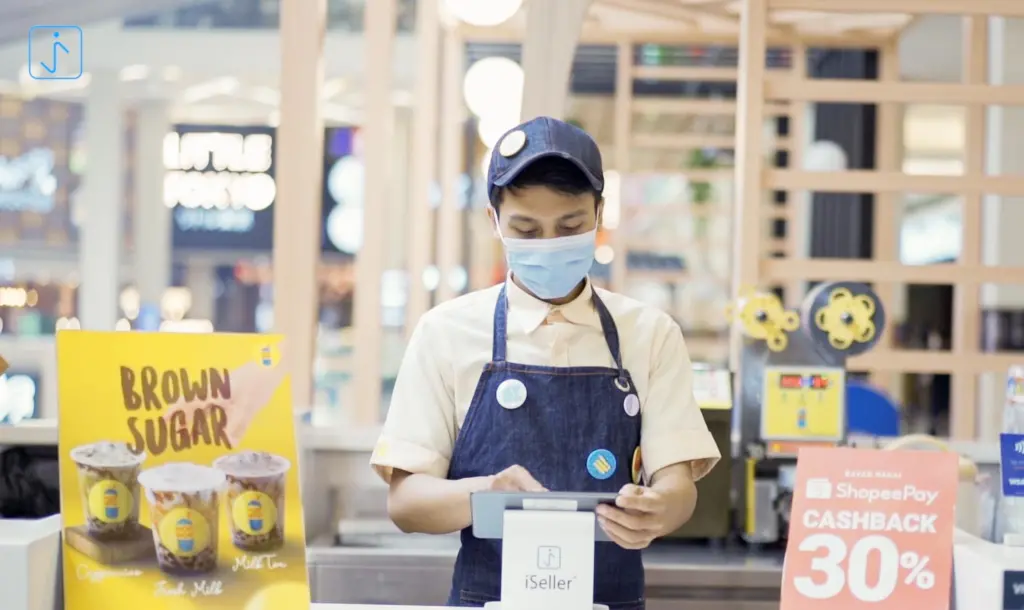
One of iSeller’s merchants, HopHop, serves boba drinks in over 120 outlets across the nation / Photo credit: iSeller
Other merchants that signed up with iSeller include Isla, one of Indonesia’s biggest fashion brands, Mama Roz, a fast-growing cold-pressed juice company, and mall operator ASRI Group, among others. These merchants require online stores that are fully integrated with their offline shops, and this need is effectively addressed by iSeller’s omnichannel offering, which seamlessly combines the POS component and online store in a single backend, as well as providing comprehensive localizations of payments and logistics integration. Petrus adds that this closely mirrors the approach of Shopify, the Canadian ecommerce platform.
Landing major clients and the rapid traction of its unique omnichannel offering started the momentum rolling for iSeller. It was able to secure funding from venture capital firms Mandiri Capital and OpenSpace Ventures in the third quarter of 2020. Through the partnership with Mandiri, iSeller has been able to penetrate the venture capital firm’s network of over 200,000 merchants across Indonesia. Additionally, iSeller also has partnerships with Bank Rakyat Indonesia and digital wallet LinkAja.
The company also constantly innovates to meet the changing needs of its merchant customers. The most recent addition to its product line is a solution that facilitates integration with online marketplaces such as Tokopedia, Lazada, and Shopee, and even food delivery platforms like GrabFood. The feature allows merchants of all sizes to streamline orders, inventory, customers, and price management on these different marketplaces on one interface. Merchants can also integrate this marketplace solution with their POS systems and online stores, providing added convenience.
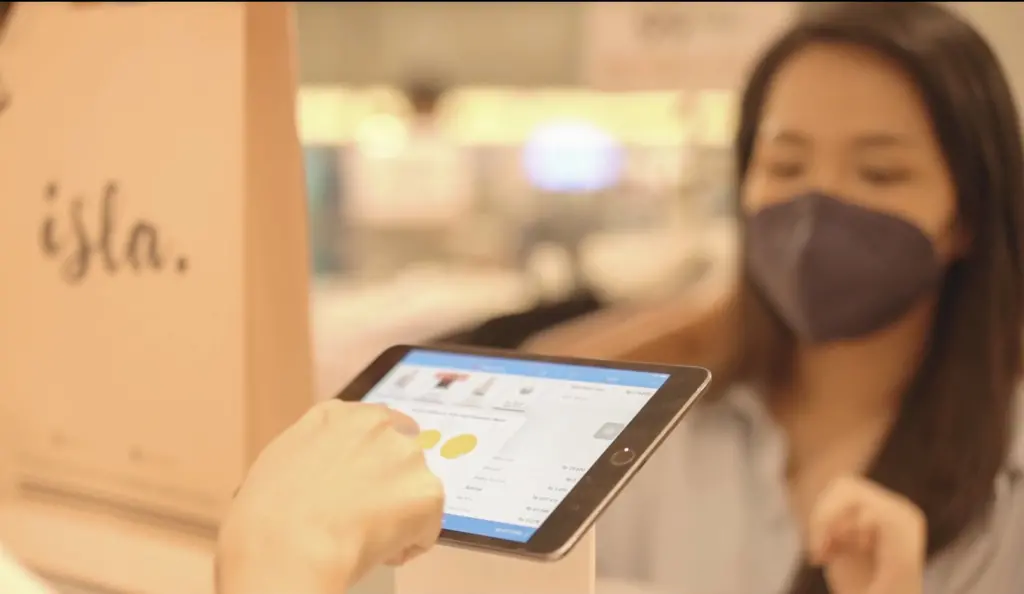
The firm’s retail omnichannel easily streamlines in-store, online, and marketplace sales in one place / Photo credit: iSeller
“In Q1 2020, we added a lot of features and modules to our offering, such as online ordering for the food and beverage industry, enabling diners to place orders easily by scanning QR codes on tables,” shares Petrus. “We’re among the first in the industry to support online ordering along with delivery, takeaway, and pick up.”
Road to market leadership
The company has seen substantial growth in the past few years, and this is likely just the beginning. As the pandemic accelerates Indonesia’s digitalization, Petrus believes that 60% of the retail ecosystem will be shifting to omnichannel in the next three years, opening up more opportunities for iSeller to innovate its offerings.
“We see that in a Covid-19 world, online trading is the one that’s driving business, and we benefit from that tailwind,” the CEO observes.
The startup has seen a gross transaction value growth of 300% year on year. Its online component also increased by approximately 400% over the past year as more merchants moved online to cope with the pandemic.
“Since our founding, we’ve signed up over 30,000 outlets and over 10,000 brands, whilst maintaining high loyalty with an annual retention rate of 90%,” says Petrus.
Omnichannel has been the core of iSeller from the get-go. According to Petrus, the company has plans of further driving its online offerings, focusing on the products that support online transactions such as its marketplace solution and online store builder. Recently, it is also building integrations with Google Shopping, Instagram and Facebook to help merchants display their products on the popular social media platforms.
The firm believes that the most likely future scenario is that the market will consolidate, with everyone using just one platform that disregards the dichotomy between high end and low end. As such, iSeller has taken the multi-tier approach, offering different solutions to different customer levels.
“In the next three or five years, we want to be a super app for merchants,” Petrus affirms.
A comprehensive and affordable commerce platform, iSeller empowers people to run and manage their business with confidence, helping them to grow and scale it efficiently.
Find out more about the company and how it helps merchants on its website.
This content was produced by Tech in Asia Studios, which connects brands with Asia’s tech community. Learn more about partnering with Tech in Asia Studios.
Stay updated on the go with our mobile app.
Get latest insights with smoother, more personalized experience through TIA mobile app.
Recommended reads
 Life’s a game, and AI agents are Animoca’s new play
 Indonesian AI startup goes global
 Forrest Li on scaling Sea, building smarter bots, and founder grit
 An AI assistant that joins sales calls and scores team skills
 Beyond the check: Why VCs need more than capital
 SGX’s CEO says it doesn’t need a unicorn to win
 SMEs want AI too, but not the kind Big Tech is selling
 Oatside’s alt-milk rise hits a profitable gear
 Alibaba’s financial health in 12 charts
 Asia’s telcos bundle AI into mobile plans. Will it pay off?





Editing by Winston Zhang, Nathaniel Fetalvero, and Eileen C. Ang
(And yes, we’re serious about ethics and transparency. More information here.)