C. Custer · · 6 min read
Reflections on Techcrunch Disrupt Beijing: Why China Needs Its Own “Disrupt”
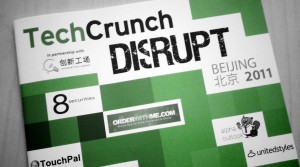 This week, lots of eyes were on Techcrunch as they descended upon Beijing for their first-ever Disrupt conference outside of the USA. I was at the event both days, as were Penn-Olson editors Steven Millward and Willis Wee, and you can read all of our coverage here, or check out a nice-roundup here. We’ve also got more coming, as we took advantage of the event to talk to some China tech CEOs but haven’t had time to sort through all the interviews and photos just yet.
I want to start by saying that all-in-all, Disrupt was a pretty well-put-together conference, especially for a team that was trying to pull off its first-ever China event. And I’m really glad that Techcrunch and other Western media folks are finally starting to pay some attention to what’s happening in Asia.
But — you knew there was a “but” coming — I did have some problems with the conference. Some were big and some were small, but the end result was that I came out of the two-day conference with a rather strange feeling, and I don’t think I was the only one.
Tickets Cost Too Much
The cost was prohibitively expensive. $1000 for a two-day conference in China is leaving a whole lot of people out. There are tons of Chinese start-ups that could have benefited from attending some of these events, but who among them could afford to go? The average young, college-educated white-collar worker in Beijing still makes so little that to buy a Disrupt Beijing ticket, they would have needed to save for three months (and that’s assuming they don’t eat, pay rent, or doing anything else that costs money).
Now, I understand that a conference like this costs an awful lot of money to put on, but my guess is there were ways the costs could have been reduced. For example: during the closing ceremonies, Techcrunch thanked the company that had created the custom musical themes that played during the wait times between conference sessions. Was custom music really a necessary expense? Sure, it was cool to have, but my guess it cost a fair bit, and they could easily have bought some royalty-free music from any number of online sellers and used that for a total cost of between $10-$100.
The Internet Didn’t Work
We had a heck of a time connecting to the wireless while we were at Disrupt, and I know we weren’t the only ones. In fact, apparently access was so limited that the people who actually paid $1000 per ticket didn’t get any wireless access at all. Members of the media were given accounts and passwords if they chased down an event volunteer and asked, but the connection was dicey at best, and it dropped again and again over the two-day conference.
Now, again, I know that trying to prepare a wireless network for the kind of strain a tech conference puts on it is a pretty huge task. And the blame for this failure may ultimately lie with China National Convention Center techs, not the folks at Techcrunch. But still, come on guys. This is a tech conference. You knew in advance exactly how many people were coming; it seems like being sure the wireless could handle that kind of traffic is a total no-brainer. And while our constantly-dropping connection was an annoyance, if I had paid $1000 for a ticket and gotten no internet access for my troubles, I would have been pretty furious.
It wasn’t very Chinese
This is the real problem, and the real reason I bothered to make this post. People bought the tickets, after all, so I guess the market was OK with the ticket prices, and wireless internet is always kind of a pain. But as a China-focused tech writer, I have to say, I was pretty disappointed with how little of China was really on display at the conference.
Sure, we saw a number of China’s big-name players: Kai-fu Lee, Pony Ma, Lei Jun, etc. But despite the many, many Chinese start-ups in existence, the Start-up Battlefield featured a whole bunch of start-ups that weren’t Chinese, and while they all had some connection to China, some of those connections were pretty tenuous. (Being able to say “we make our product in China” doesn’t make you a Chinese start-up). Ultimately, the grand prize went to Order with Me, and while I think they’re a really cool service and they gave a great pitch, it did feel a little odd to watch an American company walk off with the crown of Disrupt Beijing.
Interestingly, we did hear after the event from a reliable source that the final decision about who would win was made by the Techcrunch team, not the panel of (mostly Chinese) judges, after deliberations backstage. I suppose that’s their prerogative as it was their event, but to me it still feels a bit icky.
Now, one response to this criticism would be to say that Disrupt Beijing was just a tech conference in China, not a tech conference about China. That’s fine, and it’s not like Techcrunch owes China anything. But I do wish there were large-scale events like this that could capture the attention of the Western tech press by actually showing off some of China’s innovation and creativity, rather than showing off American tech CEOs talking about the innovation and creativity they’ve seen here. We got a bit of both of those things at Disrupt Beijing, but I could have done without any of the latter.
Late to the Party
Similarly, I heard a lot of excited pronouncements about how China was maturing and coming into its own as a place that produced good tech companies. Finally, the copycats are being replaced by more unique and mature services! I won’t deny that the tech scene here is less mature than that of the US, but there were really interesting and unique things happening here years ago, it’s just that none of you were paying attention. Some of those “copycats” that marked China’s early internet years aren’t really copycats at all when you start learning more about them, and while it’s nice to see them finally getting some credit for it, nothing about those companies has really changed. The only difference is that now more people in Silicon Valley are paying attention (and taking the time to learn a little about them before writing them off as copycats).
Messiah Complex
This is really more of a critique of the whole tech industry, but the point was brought into sharp relief for me during Ben Huh’s talk on how his Cheezburger network of user-generated humor sites can ‘change the world,’ redefining the publisher-reader relationship by allowing the “unwashed masses” to entertain themselves! Viva la revolucion!
It all sounded so grandiose that it might even have fooled a few people into forgetting people have been telling each other jokes for thousands of years. “I Can Has Cheezburger” did not invent P2P humor, nor did it democratize it. It hasn’t changed the world, although it has made Mr. Huh fairly wealthy.
So, to Conclude…





Stay updated on the go with our mobile app.
Get latest insights with smoother, more personalized experience through TIA mobile app.