Winston Zhang · · 5 min read
Business leaders discuss the ins and outs of customer retention

In the startup sphere, a lot of emphasis is placed on a company’s growth trajectory, which usually translates to much discussion, experimentation, and iteration of customer acquisition strategies. However, bringing new customers in by the boatload won’t matter a jot if a company is unable to retain a good portion of them.
Customer retention is critical to a company’s success since repeat customers are more willing to spend more and try new products. Additionally, it can cost up to 5x more to acquire a new customer compared to keeping an existing one on board.
During an online panel discussion hosted by Tech in Asia last December 10, Malay Harsha, vice president of marketing at customer retention platform CleverTap; Vedanarayanan Vedantham, startup and small and medium-sized enterprises business head at digital payments firm Razorpay; and Lorenzo Peracchione, founder and chief operating officer of digital bookkeeping startup BukuKas talked about the best practices that companies should follow when it comes to customer retention.
Significant in a number of ways
By prioritizing customer retention, companies can find a variety of ways to set – and keep – their operations on the right track.
In RazorPay’s case, emphasis is placed on monitoring customer drop-off rates. Monthly customers who’d stop sending or receiving payments through the firm’s ecosystem in subsequent month are considered churn, which is the metric that measures the percentage of customers that stopped using a company’s product or service during a given time frame.
“Churn is something that makes a lot of marketers at software-as-a-service companies like myself wake up in the middle of the night in a cold sweat. It’s pretty frightening,” said Vedantham, who reiterated that retaining a customer is “at least 5x more important than acquiring a new one.”
This multiple is derived from dividing a product’s customer lifetime value (CLTV) by a company’s cost of acquiring a customer (CAC). “The literature – and many experts across the globe – suggest that this multiple needs to be upward of 3x to 5x,” Vedantham said. “If you spend a dollar on acquiring a customer, you need to make sure you get at least five dollars in return from that customer over their entire lifetime.”
For BukuKas, a young company that’s not yet in the monetization phase and with no CLTV or CAC figures to work with yet, retention takes on a different meaning: It serves as a primary measure of the degree of product-market fit.
“Retention is the measure of product-market fit [for us],” explained Peracchione. “We’re introducing a solution that’s relatively new for the segment we’re targeting, so the choice of not monetizing was related to our ability to expand fast.”
Preventing churn and encouraging user stickiness
The key question at this juncture is “what can companies do to reduce churn and improve customer retention?” The first thing to recognize is that there are many external macroeconomic factors that can cause customers to drift away from a firm’s products through no fault of the firm. One hundred percent retention is not a realistic target.
As for things that companies do have some control over, Harsha pointed out that the product itself is a key tool for gathering data on customer behavior that can be used to develop marketing strategies. “If you’re able to ensure that throughout the user journey, there are minimal friction points and you are able to provide super personalized engagement, the richer the data gets,” he explained. He also recommended analyzing data collated from various sources instead of working on them in their separate silos.
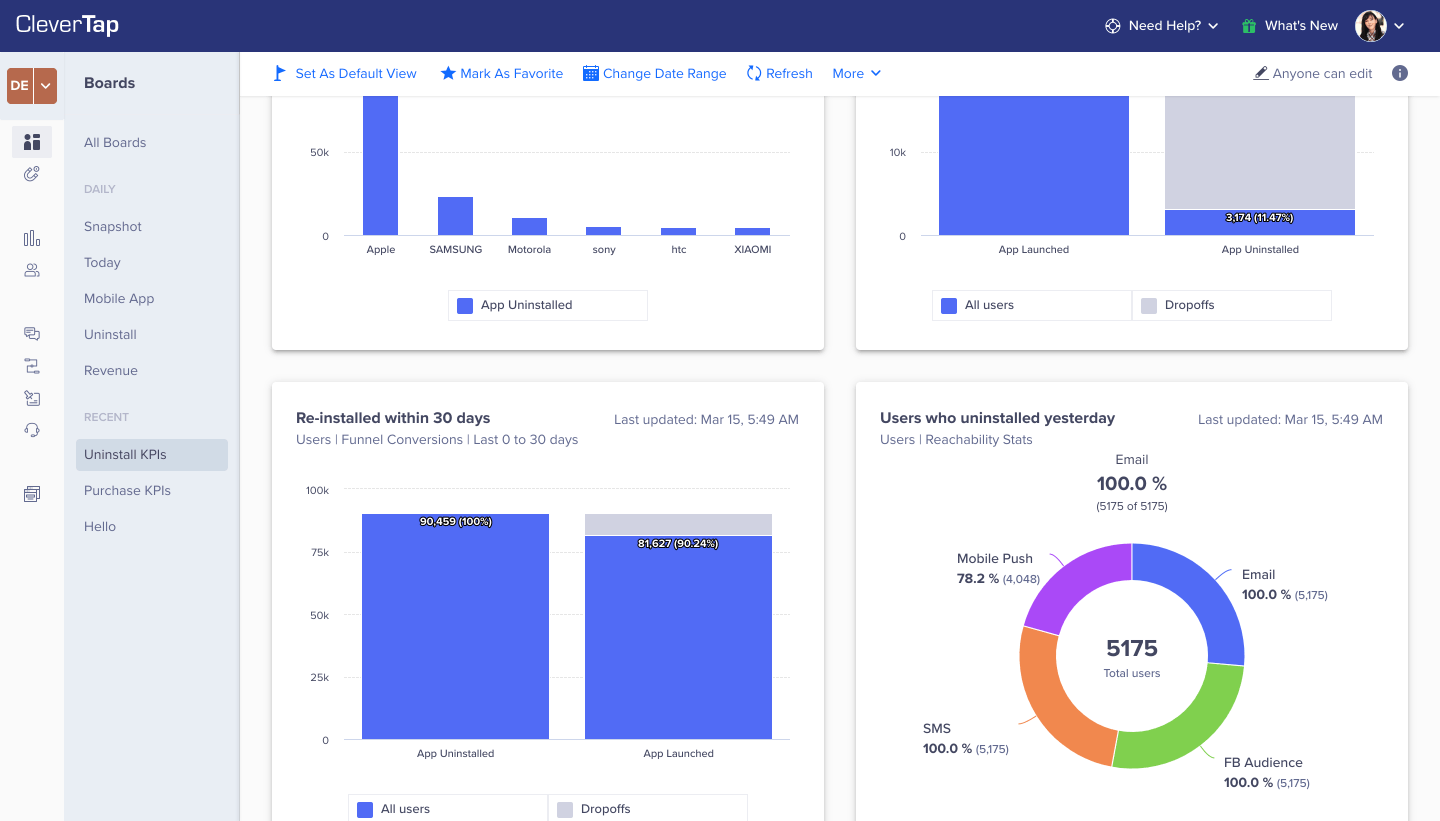
Photo credit: CleverTap
RazorPay uses a spinoff of this concept of using the product as a tool for customer retention. “One of the things we’ve found out is that if you deepen your relationship with your customer by selling multiple products to them, it makes it harder for them to leave you,” Vedantham said. “That’s something we consciously work on as a means to pre-empt churn.”
The head of business also pointed out that cultivating these kinds of deeper relationships with customers also ensures that valuable resources are spent on the ones with the right intent, instead of on fly-by-night bargain hunters that were attracted by promotional campaigns.
The payments firm also uses a grading system that gives it advance information on customer churn risk levels. Customers are tagged with green, yellow, and red flags based on the number of products they’re actually using, as well as other variables such as the amount of money they process through the RazorPay ecosystem.
“If we notice that a customer has processed a significant volume last month and that has materially dipped this month, that is a yellow flag customer who could churn the subsequent month,” Vedantham explained. This is when the firm takes action by pitching other products, altering pricing, or getting an account manager to intervene to try and keep the customer in its ecosystem.
Start the process early
The panelists all agreed that retention should be an early priority. “The measurement of retention needs to happen as early as possible,” insisted Peracchione. “What has really helped us is identifying [the profile of] our champion users, and for us, the focus was a lot on expanding [this set of users].”
“In our experience, you have to have retention processes in place beforehand,” Harsha concurred. “Unless you are capturing that data, you don’t really know how a user actually transforms into a champion user. You have to capture those data points, and from there begins your journey to engagement.”
Ultimately, customer retention helps a firm maintain a solid foundation of key customers even as it expands and takes on new, greater risks.
“The temptation and risk with marketing [is that it can affect] the quality of your acquisition: The more you scale the more it deteriorates,” Peracchione said. “And maybe those initial efforts made in getting a good product out are going to be nullified, because you begin targeting audiences that aren’t a good fit with your product. So retention is one of the most important metrics.”
CleverTap helps companies build valuable long-term relationships with customers by giving them access to real-time behavioral analytics and a platform with which companies can engage users on the right channels, at the right time, and with a message that resonates.
Find out how you can jumpstart your customer retention efforts by getting in touch with CleverTap and scheduling a demo.
This content was produced by Tech in Asia Studios, which connects brands with Asia’s tech community. Learn more about partnering with Tech in Asia Studios.
Stay updated on the go with our mobile app.
Get latest insights with smoother, more personalized experience through TIA mobile app.
Recommended reads
 Life’s a game, and AI agents are Animoca’s new play
 Indonesian AI startup goes global
 Forrest Li on scaling Sea, building smarter bots, and founder grit
 An AI assistant that joins sales calls and scores team skills
 Beyond the check: Why VCs need more than capital
 SGX’s CEO says it doesn’t need a unicorn to win
 SMEs want AI too, but not the kind Big Tech is selling
 Oatside’s alt-milk rise hits a profitable gear
 Alibaba’s financial health in 12 charts
 Asia’s telcos bundle AI into mobile plans. Will it pay off?





Editing by Nathaniel Fetalvero and September Grace Mahino
(And yes, we’re serious about ethics and transparency. More information here.)