 Imran Khan · · 5 min read
How Australia is providing an alternative option for early stage funding


Photo credit: frankieleon
In America, publicly listing your company is often the pot of gold at the end of your startup journey rainbow. It’s the de facto dream of most founders. Start, scale, exit, get rich.
Support from the exchange for early stage startups is a very Australian way of doing business.
Australia is different. The Australian Securities Exchange (ASX) had over 25 tech IPOs in 2015, raising US$1.13 billion in the process. But the IPOs have not been about the founders wanting to exit because the company has reached maturity.
Many smaller companies are using a listing on ASX as a method to raise funds, effectively replacing VCs. These companies don’t see themselves as mature just yet.
From mining to tech

Photo credit: GotCredit
Support from the exchange for early stage startups is a very Australian way of doing business. According to ASX, it’s a tradition that has persisted since the early days of Australia’s primary industries, especially mining.
For over 150 years, ASX has been raising capital for junior mining explorers. The culture this has fostered over the years is reflected in how business is done today – a significant portion of higher risk capital in the country is invested in the stock market rather than privately.
It’s not difficult to understand why this is so. Mining is a high-risk and speculative business. Explorers pick areas to mine based on geological data and other analysis, but the size and quality of the deposits are still very much unknown. The only way to find out is to drill.
Drilling is expensive, and requires large amounts of capital to be pumped into a company at a very early stage, where the returns are far from guaranteed. Developing a mine, generating revenue, and finally turning a profit is a long-term game. Investors who put money into projects like these have, by default, a high tolerance of risk. These same investors are taking this culture with them now that they are starting to look at the tech sector.
According to ASX, investors in Southeast Asia tend to show more interest in mature businesses and those paying dividends. Australia, being a larger economy than all of the ASEAN nations, also has one of the largest pools of investable funds in Asia (US$1.6 trillion assets under management). A large amount of internal capital is available to support the startup ecosystem earlier in their company cycle.
Growth depends on raising funds
Despite the regional differences as to when startups typically decide to exit, one need is universal: startups need to raise funds to grow. And apart from the usual methods, startups can do the same through a public listing.
The average age of a tech company at IPO in the United States in 2000 was six years; and jumped to nine years in 2015.
What’s the reason startups don’t usually use this method? The consensus seems to be one of size – the American philosophy of listing once you are big enough is something that Southeast Asian startups also seem to follow. It explains why the average age of a tech company at IPO in the United States in 2000 was six years; and jumped to nine years in 2015.
In the 2014-2015 period, the average market cap of a US tech IPO was US$673 million, with US$127 million of capital raised. In Australia, the numbers were much lower; market cap average was US$61 million, with US$16 million of capital raised.
These differences illustrate how much earlier companies tend to list in Australia as compared to the US, and, by extension, other markets as well.
Migme, Netccentric, iCar Asia, and iProperty Group (the last two of Patrick Grove fame) have found a home down under. One unique story is that of Xero, a New Zealand-based accounting software firm. It decided not to go down the venture capital funding route, opting instead to list on the NZX in 2007, and dual list on the ASX in 2012. In 2015, after growing to a market cap of US$1.4 billion, US-based Accel Partners invested US$100 million in them.
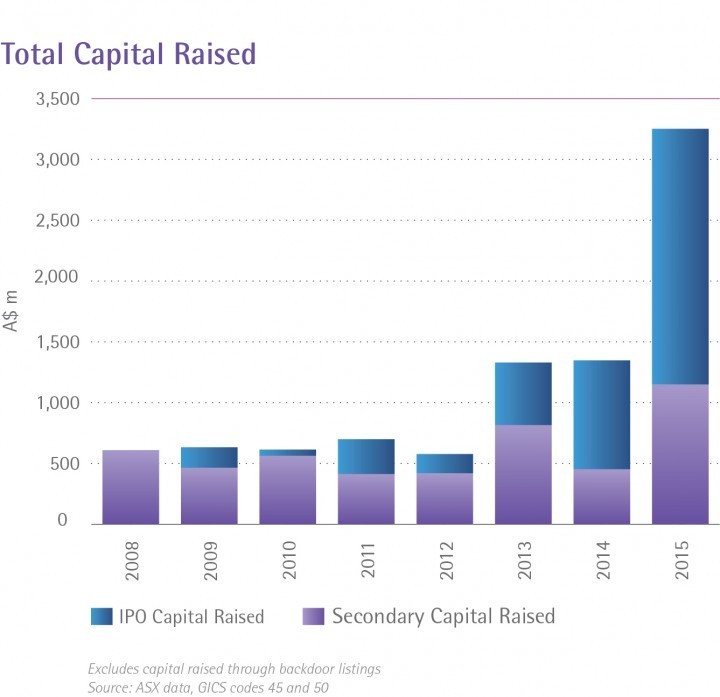
Capital raised (for tech companies only) on the ASX over the years.
With the above chart showcasing the capital raised (for tech companies only) on the ASX over the years, it’s obvious that an IPO does not necessarily have to be the endgame. With a growing number of startups looking at more robust and creative ways of raising money to fuel their growth, publicly listing your company might mean doing it much earlier than when you think you’re big enough for Nasdaq. Exits can either be partial, or a liquidity event for early investors. Fulfilling listing requirements isn’t particularly difficult either.
On the ASX, for example, it’s quite common to see companies list at US$20 million post-money market capitalization, with no requirement for profitability or revenue.
There are options available for entrepreneurs to raise capital without having to separate themselves from their beloved startups. With so much flexibility on offer, listing your company is a viable option to raising funds for the future.
Want to know more? Register for ASX’s exclusive luncheon at Tech in Asia’s Singapore conference, on April 12th.

ASX operates at the heart of Australia’s financial markets. It is among the world’s top 10 exchange groups and is a global leader in A$ and NZ$ financial markets. We are a fully integrated exchange across multiple asset classes – equities, fixed income, derivatives and managed funds. We service retail, institutional and corporate customers directly and through Australian and international intermediaries. We provide services that allow our customers to invest, trade and manage risk. These include listings, trading, post-trade services, technology, and information and data services.
We operate and invest in the infrastructure that promotes the stability of Australia’s financial markets and is critical for the efficient functioning of the nation’s economy, economic growth and position in the Asia Pacific region. We advocate for regulations that support end-investors, grow and promote the integrity of the market, and strengthen Australia’s global competitiveness.
More information about ASX can be found at www.asx.com.au/listings
Stay updated on the go with our mobile app.
Get latest insights with smoother, more personalized experience through TIA mobile app.
Recommended reads
 Japanese 🍺 startup drinks to $615k seed funding
 Malaysian wealth management app secures 8-figure funding
 Lazada-backed TNG Digital struggles to meet its potential
 As SPACs target Tokopedia and Traveloka, here’s what you need to know
 Singaporean digital assets exchange Zipmex rakes in $6m in new funding
 East Ventures, AC Ventures co-lead $4.5m round of Indonesian oral care firm
 Indian financial services firm rolls out $25m innovation fund
 How valuable is VC money for Indonesia’s profitable bootstrapped startups?
 Clime Capital raises $127m in first close of new greentech fund
 Fintech and ecommerce lead the way in SEA’s turbulent tech year




Editing by Nivedita Bhattacharjee, Terence Lee, and Steven Millward
(And yes, we’re serious about ethics and transparency. More information here.)




