Nothing is true, everything is permitted. That’s the motto of the Assassins; the titular creed on which the Assassin’s Creed series is based. But it might also be the mission statement of Black Flag developers Ubisoft Montreal. Just what the hell does that mean? Let’s dive right in.
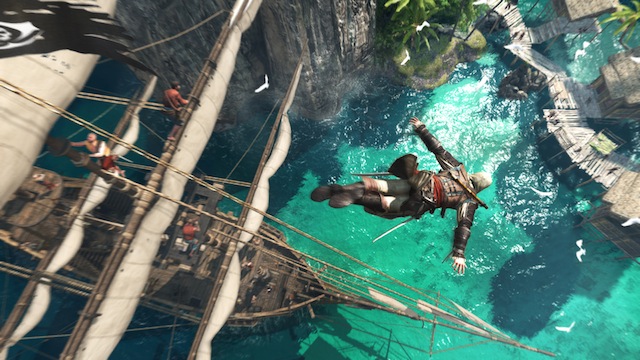
h4>Story: nothing is real
Those who’ve played the previous games will not be surprised to learn that once again, Assassin’s Creed IV isn’t really a game about an 18th century pirate, it’s a game about a modern-day adult who’s reliving the memories of an 18th century pirate via a sophisticated machine called the Animus. In the series, the common thread between these two worlds is the eternal struggle between the Assassins and the Templars, two rival factions that have been vying for control of the world since ancient times.
In the first Assassin’s Creed, this approach worked because there was a lot of mystery — why does this game about an ancient assassin keep cutting to some guy in a modern office building? — and because the Animus was a pretty clever conceit that allowed the developers to explain all the video-game-y aspects of the game (like saving, dying and restarting, etc.) in a way that actually fit into their narrative world. In that sense, nothing is true is a very literal statement; none of the things you’ll do in Black Flag as a pirate are actually real. They’re all just re-played memories extracted from DNA by a machine.
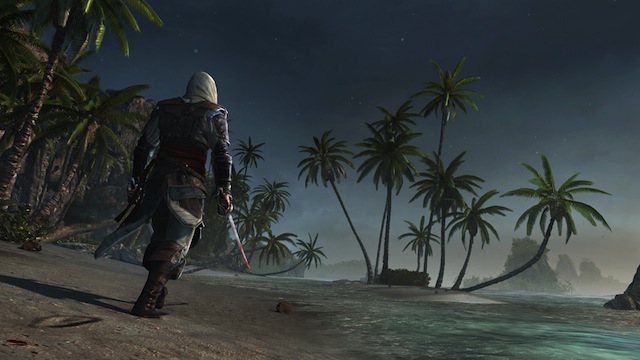
I’ve never felt that was a necessary aspect of the games; after all, isn’t being a deadly parkour expert traversing the rooftops of history’s most famous cities a cool enough premise for a game? I could live with in in the first game, but by Black Flag, we’re six major games into the series and it has clearly become more of an anchor than a cool twist that makes the games more interesting. Most of the time, it’s just unnecessary. The Carribean open world Ubisoft has created, and the characters they’ve populated it with, are interesting enough on their own! I can’t help but feel like the mandatory Assassins-vs-Templars missions probably prevented them from implementing some other more pirate-y things and making this a more unique game than it currently is.
It doesn’t help that the increasingly-complicated backstory is so difficult to keep straight that even the characters don’t seem to know what they’re doing anymore. At one point in the game, the player character asks an Assassin friend what the Assassins’ cause is, and her response is:
To be blunt…we kill people.
It’s enough to make you wonder if even the developers are still taking this stuff seriously, and to be fair to them, Black Flag is by far the lightest game in the series. It’s good to see that Ubisoft is slowly taking its foot off the gas of the Assassins-vs-Templars nonsense, but I wish that they would do it faster. What frustrated me most about Black Flag‘s story is that if the Assassins thing had been dropped wholesale, Ubisoft would have been free to focus on the world of 18th-century piracy, and I think the results would have been fantastic. As it is, they’ve made what is arguably the best game about pirates ever so perhaps it’s unfair of me to complain. But I just have to say it: I still wish they had made a game that was only about pirates.





Stay updated on the go with our mobile app.
Get latest insights with smoother, more personalized experience through TIA mobile app.