Michael Tegos · · 3 min read
Redmart is still losing money. But its revenue is growing fast.
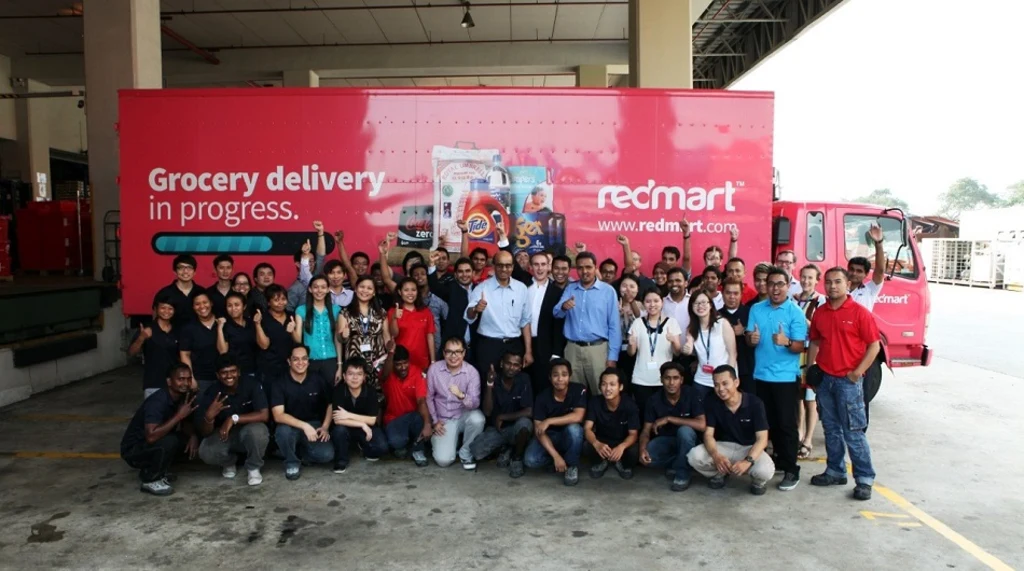
Photo credit: Redmart.
Online groceries in Singapore has been mostly dominated by local startups Redmart and Honestbee. As services, they’re valuable – I’ve made frequent use of them both, resulting in so much time saved. Most importantly, they’ve kept me coming back, making me a “sticky customer.”
But is the grass green on the business side? Redmart’s recent financial statement shows that the company is still losing money, but its revenue grew 267 percent from 2014 to 2015.
While financial statements obtained by Tech in Asia showed a net loss of US$70.8 million for the annual period ending June 2015, Redmart clarified that over 70 percent of that figure has been attributed to non-cash losses.
“Non-cash losses are expenses on the P&L statement that have zero cash impact, for example, depreciation or fair market value adjustments. Similar to depreciation, fair market value adjustments for derivative instruments (like our preference shares) show up as expenses on the P&L but are added back to calculate cash flow from operations,” said Vikram Rupani, co-founder of Redmart.
As such, Redmart’s operating loss for 2015 is US$21 million, It’s operating loss margin is 78 percent, which was maintained from 2014.
Redmart also had US$126 million in total liabilities, which is basically debt. However, the company says that most of it is attributed to preference shares (which is registered as a liability due to anti-dilution clauses) it gave out to investors.
The company’s revenues have been climbing since 2013, from US$1.5 million to US$9.6 million in 2014, to 2015’s US$27 million figure. Redmart expects to be self-sustainable by mid-2017.
The company is rumored to be raising a US$100 million round. Redmart declined to comment on that.
Most startups in a high-growth stage have figures that look like that.
Other investors say figures like these are not by themselves cause for concern. East Ventures’ Willson Cuaca, who is an investor in Redmart, tells Tech in Asia that for the type of service Redmart offers, these costs are inevitable. “I think they are building a solid business and tech,” he says.
(Disclosure: East Ventures is also an investor in Tech in Asia. See our ethics page for details.)
Most startups in a high-growth stage have figures that look like that, an unnamed investor who did not invest in Redmart tells Tech in Asia. “They’re burning capital in order to gain market.” It’s not much different from what Uber is doing (at its own, insane scale obviously).
It’s perhaps a problem unique to startups, businesses that focus more on growing rapidly and worrying about profitability later. “Once they do have the market, services like [Redmart] become a habit,” the investor adds. “You keep coming back, you use them regularly.”





Stay updated on the go with our mobile app.
Get latest insights with smoother, more personalized experience through TIA mobile app.