Terence Lee · · 4 min read
The rare startup that wants to put Singapore on the medical robotics map
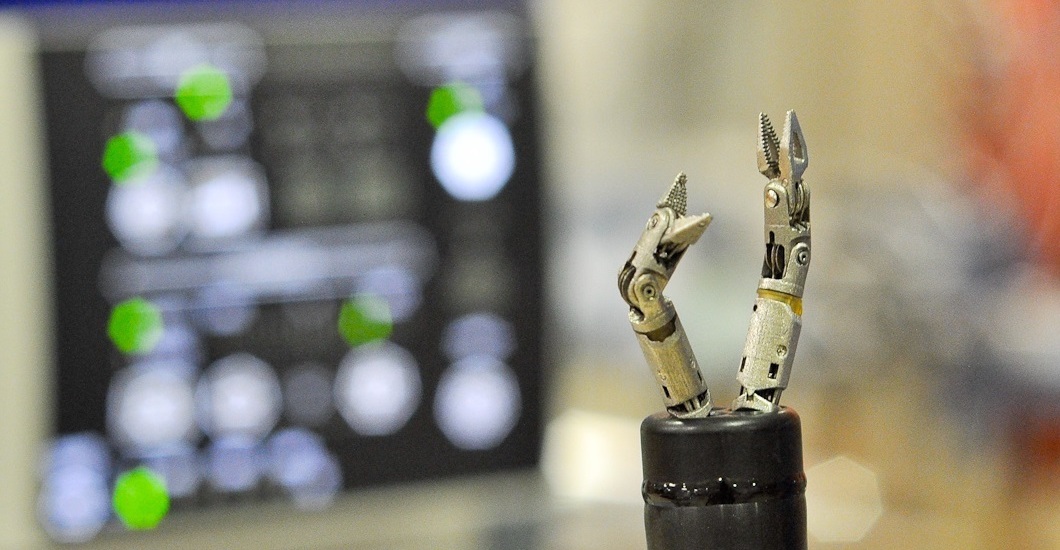
EndoMaster’s robot. Photo credit: EndoMaster.
EndoMaster is a unicorn. No, it’s not worth a billion bucks, but it’s a rare and promising medical devices startup in Singapore.
It has oodles of ambition. While many startups focus on disease detection, EndoMaster wants to get into the surgical room and the bodies of patients.
EndoMaster claims to be the closest in the world to commercialize a robot that can remove cancerous tumors from your stomach and intestines – without cutting you open.
The company has raised US$14.6 million in a series B round, enough to see it through to end-2018, when it’s aiming to release its product.
It’s in a field with little margin for error, where malfunctions could cost lives. But EndoMaster is up for the challenge.
I get a sneak peek at its latest prototype, housed in its research lab with a “no photography” sign.
There’s a chest-high computer rack housing the software and hardware. A black tube extends out of it, which is meant for insertion into the patient’s gut through the mouth or anus. Right at the end of that tube are a camera and two tiny arms – more dexterous than a surgeon’s and smaller than a toddler’s fingers.
Finally, there’s a control interface with two joysticks and a screen – similar to an arcade machine.
The resemblance is intentional, says Colin Tan, COO of EndoMaster. “It’s meant to be like playing a computer game.” Doctors will only need a week to learn the system, get certified, and start performing live surgeries.
Training for an equivalent manual surgery would take three to six months. It’s a huge boon for hospitals who won’t need to send their doctors away for so long.
Reducing the need for surgery
Aren’t there a lot of surgical robots out in the market, I ask Tan and the CEO, Goh Seow Ping, in EndoMaster’s office.
Yes, says Goh. But these robots are meant for keyhole surgery, which still requires poking holes in the body.
EndoMaster is built on top of an endoscope, which is an instrument that doctors push down the patient’s throat to look at the gut.
A marathon





Stay updated on the go with our mobile app.
Get latest insights with smoother, more personalized experience through TIA mobile app.