Peter Rothenberg · · 3 min read
These investors share how to be successful in Japan and Asia

From left: Allison Baum, Jay Onda, Shin Iwata, and Teruhide Sato.
International startup event Pioneers Asia took place last week in Tokyo. The event featured 250 startups, numerous speakers, flashy lights, and DJs, as well as a traditional Japanese drum show. One of the panel discussions at Pioneers Asia was with four venture capitalists on investing in Japan and Asia.
It’s not a world where the big eat the small. It’s a world where the fast eat the slow
The guests were Allison Baum of Fresco Capital, Teruhide Sato of Beenext, Jay Onda of Yamaha Ventures, and Shin Iwata of Atomico. The talk got off to a start with what it means to go global.
Be global
Being global does not just mean focusing on an international market, it means connecting outside your ecosystem. “It’s not a world where the big eat the small. It’s a world where the fast eat the slow,” quoted Jay from Jason Jennings and Laurence Haughton’s best-selling book.
Allison feels that while Asia is becoming more developed, there is a problem with global awareness. “In Asia everyone is reinventing the wheel,” she says. “You hear things that could very easily be dealt with if people were able to connect with mentors outside their ecosystem.”

Allison discussing Japanese startups.
In particular Allison mentioned that Japanese startups are not looking abroad enough. “Can you be a global business?” she asks. “Global businesses have more diversified access to revenue, more later stage investment opportunities, and more potential exits.”
Keys for going global
According to Teruhide, the keys for going global are the right team and the right partners. The panelists agreed that hiring locally is important. “There are many cultural nuances of doing business,” says Jay.
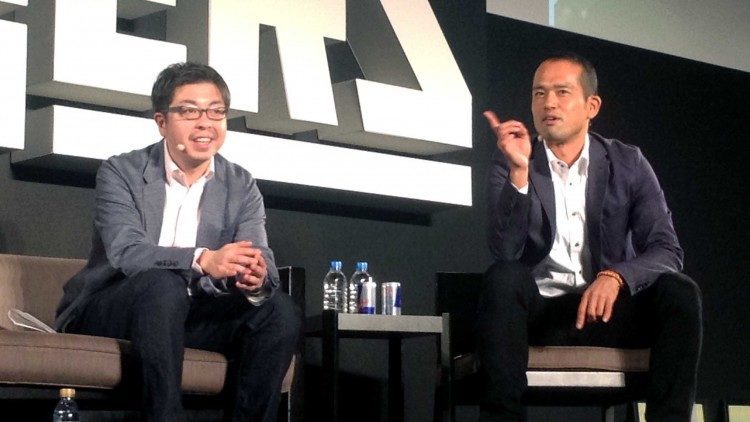
Shin Iwata (left) of Atomico and Teruhide Sato of Beenext discussing the importance of local teams.
Shin thinks that failure to understand local culture can be disastrous, especially for people who have had success in other markets. Jay commented on eBay’s famous exit from Japan where it failed to localize.
At the time, eBay was the number one auction site in each of the 18 countries it operated in. Although eBay entered the Japan market late, it insisted on charging commision where local companies did not. It also required users to register a credit card, even though credit card usage was very low in Japan.





Stay updated on the go with our mobile app.
Get latest insights with smoother, more personalized experience through TIA mobile app.