 Michael Tegos · · 4 min read
IMDA launches, announces new programs in Singapore’s Smart Nation roadmap

Photo credit: tykhyi / 123RF.
Early this year, it was announced that Singapore government bodies Infocomm Development Authority (IDA) and Media Development Authority (MDA) would merge. The new entity, IMDA (Infocommunications and Media Development Authority), officially launched last Friday.
At the launch event, Singapore’s Minister for Communications and Information Dr. Yaacob Ibrahim announced a number of fresh initiatives the new body will oversee and provided an update on ongoing programs that used to be under the purview of its predecessor, IDA.
These are the initiatives announced at the event:
VR technology will be used for clinical training
Using virtual reality (VR) and augmented reality (AR) technology, the project will help medical students by recreating clinical scenarios where they can apply teachings and rehearse procedures without risking the lives of actual patients.
Existing medical data can be integrated into the system to enable greater accuracy and further practical application of the technology.
For this project, IMDA will work with the Asia-Pacific arm of Canadian software company Side Effects, which developed visual effects and 3D animation platform Houdini.
VR in the classroom too
Local production house Beach House Pictures will collaborate with IMDA and an unnamed VR technology company to create VR experiences for schools. Students will be able to take “virtual trips” to cultural and historic sites around Singapore with the help of additional multimedia elements like videos, annotations, and images.
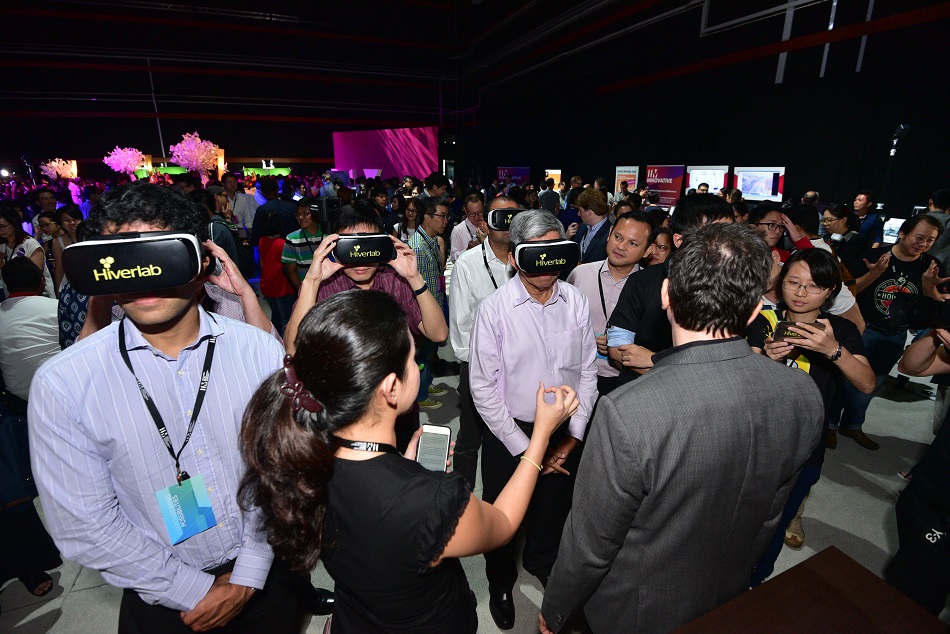
Singapore Minister for Communications and Information Dr. Yaacob Ibrahim tries on a VR application for clinical training at the IMDA launch event. Photo credit: IMDA.
Digital tech for lower-income households
In collaboration with Singapore’s National Council of Social Service, IMDA wants to give underprivileged parts of the population, like low-income households and the elderly, access to social apps and government online services. Funded by national fundraising and volunteer program Care & Share Movement, the program aims to provide people with tablets and instructional starter kits so they can benefit from Singapore’s digital infrastructure.
The Home Access program was launched two years ago and provides homes with a basic mobile computing device (i.e. a tablet) and internet connectivity for US$4 per month.
Doubling down on IoT for healthcare
IMDA wants to make it easier for healthcare professionals to use internet of things (IoT) products applications in their everyday work. To that end, it has partnered with The Good Life Co-operative and SATA Commhealth, a couple of nonprofit organizations that work with Philips Healthcare and Napier Healthcare Solutions respectively to develop technology-enabled assistance for senior citizens and patients.
For example, Philips will build health monitoring stations and self-help kiosks in residential areas and community centers. Napier makes connected home devices for monitoring vital signs and providing remote consultation.
Improved logistics services for shopping malls
A@IMDA will build media startups with Mediacorp’s incubator





Stay updated on the go with our mobile app.
Get latest insights with smoother, more personalized experience through TIA mobile app.











📅 Upcoming Events
22 October 2026
Payoneer x CSPN Summit 2026