
Step into a Stryv store and you will find compact hair dryers tailored for Asian markets – premium products sold at competitive prices. Browse Dododots’ online store and you will see acne patches shaped like hearts and butterflies – turning a treatment for visible acne into something users no longer feel compelled to hide.
Both brands were created to address issues their founders saw in the market: the lack of Asian-centric personal care products in the market, the high prices caused by multiple layers of distributors, and the generic designs of acne patches. And instead of competing on branding alone, the companies reworked the fundamentals of how such products are created, manufactured, and sold.
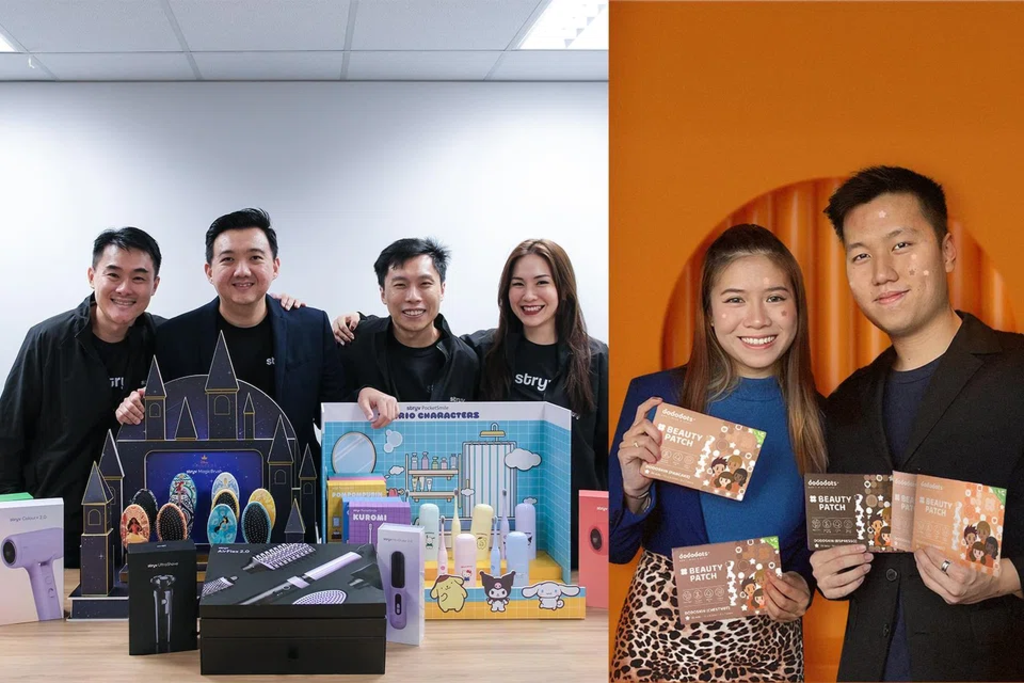
(From left) Evo Commerce CFO Tan Wen You, CEO Roy Ang, COO Teoh Ming Hao, and CMO Vanessa Tan; and Esther Erin and Ethan Wong, co-founders of Dodo Ventures / Photo credit: Evo Commerce, Dodo Ventures
Evo Commerce, which owns Stryv, worked directly with the same manufacturers as global personal care brands, allowing the brand to offer comparable quality at lower prices. Meanwhile, Dodo Ventures, which runs Dododots, invested in in-house design and rapid product iteration using real-time social media feedback. This helped the company stay ahead in a crowded market where product concepts and designs can be quickly replicated.
This combination of tight operational discipline and product differentiation has helped both firms achieve profitability and expand beyond Asia. They are now among the winners of the 2025 Emerging Enterprise Awards, jointly organized by The Business Times and OCBC.
Closing the gap in Asia’s personal care market
Evo Commerce did not start to build just another personal care brand. Its founders saw a gap: Many grooming tools sold in Asia were designed for Western consumers yet priced at a premium once distributors and retailers took their cut.
To address this, the Singapore-based company created Stryv in 2023. It’s a brand built specifically for Asian consumers, with products designed for the region’s climate, lifestyles, and beauty needs. The goal was to offer high-quality personal care tools that were both relevant and accessible.
Instead of relying on distributors, Evo built Stryv as a direct-to-consumer brand. This gives the company full control over pricing, product development, and customer experience. Its in-house designers and engineers develop products based on local consumer preferences, while partnerships with leading global manufacturers ensure consistent quality.
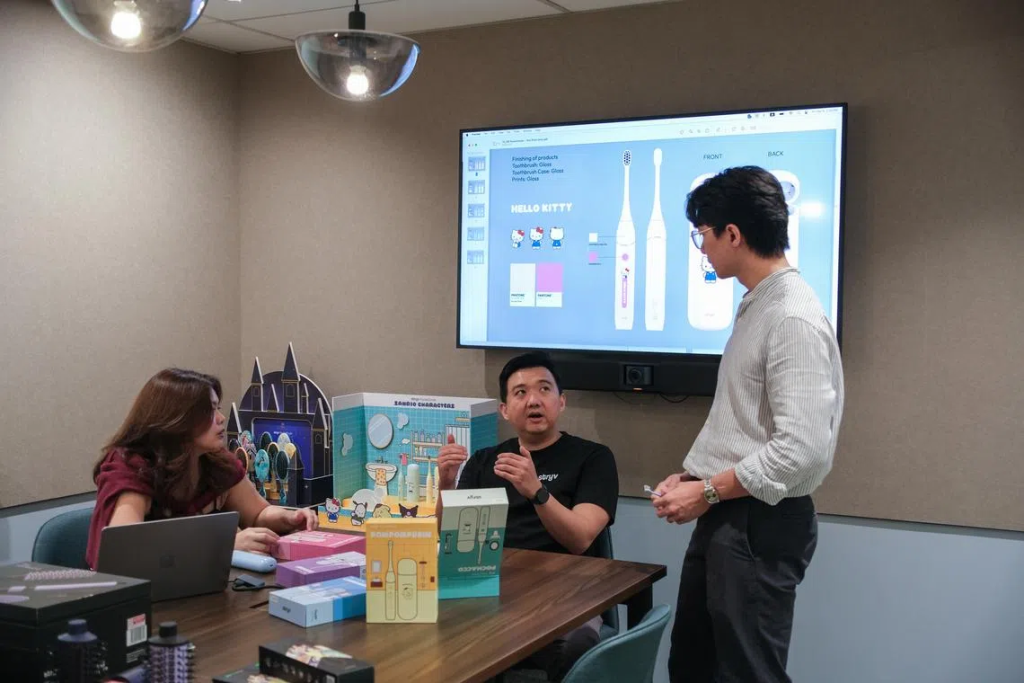
Ang (center) with Evo Commerce product design lead Ong Yuan Qi (left) and product manager Wong Jing Han, part of the team behind Stryv’s locally designed products / Photo credit: Evo Commerce
“We pride ourselves on building premium, affordable personal care products,” says co-founder and CEO Roy Ang. “We use really big factories from all across the world. We have our own designers and engineers, and our products are very locally designed for local customers.”
Today, Stryv’s products range from hair dryers and stylers designed for smoother hair textures to shavers, oral care devices, and hair treatment solutions.
The strategy has delivered strong growth. Evo achieved its first full-year net profit in 2025, with its eight-digit revenue after sales growing between 70% and 80%. The company now employs close to 200 people across Singapore, Malaysia, Hong Kong, and Indonesia.
More recently, Evo has begun expanding beyond personal care. In March 2026, Stryv acquired Singapore-based home appliance brand Sterra, adding a portfolio already used in more than 200,000 households. The move reflects Evo’s ambition to build a broader ecosystem of design-led consumer products across Asia.
This momentum also earned Evo wider recognition, including the Emerging Enterprise Award.
Ang says the accolade marked a “major milestone” for the company, supporting its next phase of growth.
“The recognition gave a boost to our confidence, as well as a lot of our partners’ confidence in us,” he recalls. “That is something that you can’t actually get elsewhere.” Looking ahead, Evo plans to expand into Taiwan, supported by new partners and investors, as well as potential acquisitions and product launches.
Redefining acne treatment through design
When Ethan Wong and Esther Erin founded Dodo Ventures in 2021, they drew on something personal: Both had struggled with acne and knew first-hand that existing patches, while effective, were designed to go unnoticed rather than stand out.
The Malaysia-based company took a contrarian approach, reimagining acne patches as statement pieces instead.
Now, Dododots produces medicated patches made from hydrocolloid, a clinical-grade wound dressing material commonly used in healthcare settings. But instead of conventional transparent dots, Dododots introduced hearts, butterflies, and other novelty shapes.
While production of the patches is outsourced, product design is kept in-house, allowing the company to respond quickly to digital trends and youth culture.
Dodo invests heavily in social media engagement, using real-time customer feedback to guide product development and stay ahead of competitors. This direct connection with consumers helps the company refine its designs and strengthen customer loyalty.

Dododots acne patches, which come in playful shapes, have been featured in collaborations with global brands like Netflix, particularly in the series Emily in Paris. / Photo credit: Dodo Ventures
Since its launch, the brand has established a strong presence across Southeast Asia, Hong Kong, and China. The company employs about 25 people and generates revenue in the tens of millions of Malaysian ringgit, operating profitably.
While the brand built its following online, much of that traction has translated into commercial success. Most of Dododots’ sales currently come from offline retail channels, including health and beauty chains such as Guardian and Watsons and pharmacies like Caring in Malaysia.
The company plans to expand into new markets, including the US, Canada, the UK, and Australia, while steadily growing sales through its own digital channels over time.
“Currently, we are still very much focusing on expanding as fast as possible, so basically just knocking on every single door, making ourselves as accessible as possible,” says Wong, who serves as the company’s COO. “And then, later on, once we’ve built up a very, very solid base of customers, we can start considering bringing them in through our own channels.”
Winning the Emerging Enterprise Award has reinforced Dododots’ growth ambitions. He shares that the recognition has encouraged Erin and him to “dream a bit bigger.”
The S$200,000 (US$157,000) interest-free loan from OCBC, which comes with the award, will support further investment in marketing and channel development as the company expands internationally.
Recognizing bold ambition
Now in its 19th year, the Emerging Enterprise Awards, a joint initiative by The Business Times and OCBC Bank, continue to champion the innovation, resilience, and excellence of businesses under 10 years old. The awards celebrate emerging businesses from across Asia, reflecting a sustained commitment to highlighting entrepreneurial talent far beyond Singapore.
The Emerging Enterprise Sustainability Awards honor enterprises that embrace opportunities in the green economy, whether by embedding sustainable practices in their operations or leveraging tech and innovation to drive the transition to low-carbon economies.
Additionally, the Most Promising Sustainability Startup Awards laud businesses with unique, commercially viable ideas and significant long-term potential.
The application for the 2026 Emerging Enterprise Awards is opening soon. Learn more about the submissions here.
This story was republished with permission from The Business Times. It was moderately edited to reflect Tech in Asia’s editorial guidelines.
This content was produced by Tech in Asia Studios, which connects brands with Asia’s tech community. Learn more about partnering with Tech in Asia Studios.
Stay updated on the go with our mobile app.
Get latest insights with smoother, more personalized experience through TIA mobile app.
Recommended reads
 Alibaba’s capex isn’t the full story
 Forget startups. Buy the business running on Excel
 Life’s a game, and AI agents are Animoca’s new play
 Indonesian AI startup goes global
 Forrest Li on scaling Sea, building smarter bots, and founder grit
 An AI assistant that joins sales calls and scores team skills
 Beyond the check: Why VCs need more than capital
 SGX’s CEO says it doesn’t need a unicorn to win
 SMEs want AI too, but not the kind Big Tech is selling
 Oatside’s alt-milk rise hits a profitable gear





Editing by Mina Deocareza
(And yes, we’re serious about ethics and transparency. More information here.)






