Josh Horwitz · · 6 min read
Citiesocial, once a Taiwan Groupon clone, is filling the island’s high-end ecommerce gap

Within the global technology industry, Taiwan is best known as a maker of laptops and handsets. But the island is also home to a thriving, US$30 billion ecommerce industry, with incumbent marketplaces competing alongside promising startups. One such company is Citiesocial, a site that sells well-designed, functional knick-knacks through flash-sales.
Parsing through Citiesocial’s listings, users can find an range of products that one would ordinarily have difficulty getting in a department store or a street-side shop. There’s an air filter that resembles a light-saber, a pillow that wraps around your head, and a US$100 toothbrush. Like Fab and Gilt, the company carefully curates its catalog in hopes of reaching design-minded, aspirational consumers.
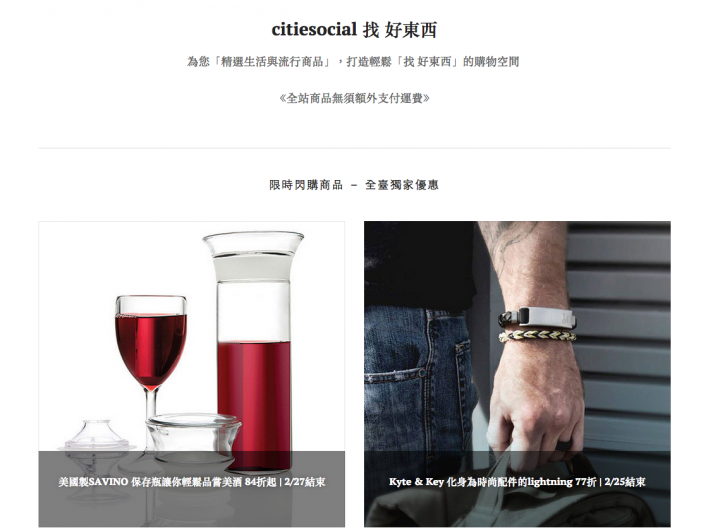
Even though Citiesocial’s premise is not new, it fills the right niche in Taiwan, where marketplaces like those on PCHome and Yahoo! Taiwan have given way to a new breed of specialized ecommerce startups. But despite filling a comfortable space in an otherwise crowded market, Citiesocial’s domestic stability has been hard-won.
Like many founders, Citiesocial founder Eric Wang first realized his startup ambitions while working his first corporate gig. At Towers Watson, a leading human resources consulting firm, Wang worked on the firm’s international expansion and strategy team, where he traveled the world assessing the company’s next move.
While the work was dynamic, the urge to jump ship and start something new remained strong. Regular brainstorming sessions with a college classmate tilted him towards the group-buying ecommerce model, which was red hot in 2010 thanks to the success of Groupon.
“One of my classmates launched one of the first Groupon clones in Australia,” says Wang. “We called him up on Skype, and he said it was growing well – we just needed to find a market where it doesn’t exist and then figure it out later.”
For Wang and his college friend, that market was Taiwan – where Wang had family, and his buddy had a girlfriend (though this friend quickly shifted to an advisor role). After months of work on nights and weekends, Wang left Towers Watson in July 2010 and launched his group-buying site – titled Letsgou – just days later.
According to Wang, Letsgou closely followed Groupon’s business model, wherein deep discount vouchers for goods and services are sold to consumers. In an effort to build out a credible brand, Wang and his team aimed for deals with the best-quality products, restaurants and spas they could find in Taiwan.
“It’s not that we targeted people that had more money, we were just selecting restaurants that we felt like were of higher quality,” says Wang. “We partnered with some lifestyle magazines and credit card companies, rather than just posting ads on Yahoo. That was kind of how we distinguished ourselves.”
The strategy worked, but only up to a point. On the one hand, Wang says that margins were at 30 percent – about 10 percent higher than that of his competitors – and says the company became profitable within several months.
On the other hand, like many other markets, Taiwan quickly became home to a glut of group-buying companies, including Groupon itself. Gomaji, which received funding from Yahoo (and IPO’d in Taiwan this year), marked one of Letsgou’s more formidable competitors. It also was pit against corporate-backed plays from ecommerce incumbents like PCHome, independent startups, and mainland Chinese companies flexing their muscles across the straits. The competition drove margins down. But more importantly, Wang says that the group buying model ultimately didn’t favor companies that aimed for differentiation.
Scaling down to scale up
Global ecommerce from Taiwan?





Stay updated on the go with our mobile app.
Get latest insights with smoother, more personalized experience through TIA mobile app.