Sumit Chakraberty · · 7 min read
Why sliding – and not walking – is the future of VR
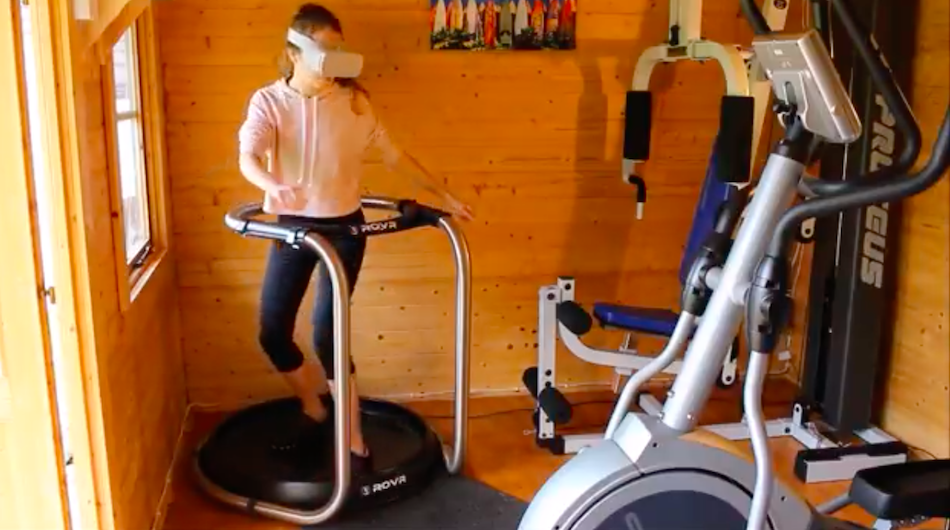
The Wizdish Rovr VR treadmill being used in a gym. Photo credit: Wizdish
Vincent Van Gogh sat up three nights in the fall season of 1888 to paint The Night Cafe – an all-night haunt for down-and-outs in a southern French town. Now a virtual reality game lets you go into the painting and move around for a closer look at objects from different angles.
Most people would do this by wearing headsets while seated or standing. This can cause motion sickness after a while because of a mismatch between what you’re seeing through the headset and what your body is experiencing in its relatively static state. And this is one reason for VR failing to live up to its promise.
Hundreds of millions of dollars has gone into trying to replicate walking in VR. What we’ve done is to simulate walking by sliding.
My experience of wandering into Van Gogh’s world of vivid colors was more realistic because I had to move my feet to go towards an object, such as ambling across to the pianist in a corner and peering over his shoulder.
I was on a VR treadmill on display at the Startup Festival in Seoul. I had handrails for support and wore headsets. But it’s the pair of shoes I wore that was really unique.
The shoes were made of a special material that enabled them to slide with minimal friction on the treadmill, which acted more like the trackpad of a mouse. Sensors picked up the sliding motion of the shoes to let me move towards any object I saw in the painting. After a while, I felt like I was walking, even though I was actually slip-sliding about.
To slide and not to take steps makes a big difference, explains Charles King, co-CEO of Wizdish, maker of the Rovr VR treadmill I tried out. “Hundreds of millions of dollars of effort has gone into trying to replicate walking in virtual reality. What we’ve tried to do is to simulate walking by sliding.”
Why slide and not walk
Walking involves lifting a foot for the next step. And that requires balancing momentarily on one foot, which is an unstable state. That’s why we topple over as toddlers before we learn how to balance ourselves while walking.
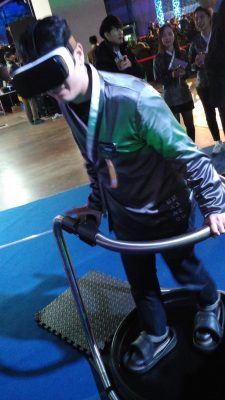
A visitor to the Startup Festival in Seoul tries out the Wizdish Rovr VR treadmill. Photo credit: Tech in Asia
There are VR treadmills that mimic walking, like the Kat Walk made by Chinese startup KatVR which raised US$149,278 on Kickstarter in 2015. It created new mobility to make VR more realistic and counter the problem of motion sickness. But because walking with special shoes on a treadmill is unstable, Kat Walk requires a bulky contraption with a harness going around the waist and crotch to prevent users from falling.
Hence the idea of sliding to simulate walking – and Wizdish has a US patent for its implementation. It aims to provide stability without the need for a harness. This enables a lighter-weight ensemble and a less intrusive experience than being strapped to a harness.
After a few minutes of sliding about in the Van Gogh painting, I only needed to place my hands on the circular handrail for reassurance rather than support. Knowing that I was sliding on the same spot also took away the fear of bumping into something while I “walked” with a VR headset strapped on. At the same time, my brain got cues from my feet that I was moving and related it to what I was seeing in the headset.
A mouse for VR
Will this be the year of VR?





Stay updated on the go with our mobile app.
Get latest insights with smoother, more personalized experience through TIA mobile app.