
Summary:
- As fraudsters exploit advanced AI and deepfake technologies, it’s become harder for companies in the Asia Pacific to protect against fraud.
- To combat this, businesses are implementing rigid security measures that could inadvertently lock out legitimate users, a problem known as “digital exclusion.”
- Instead, companies need a multilayered strategy that combines continuous, adaptive fraud monitoring with inclusive verification technologies.
- Learn the secrets to balancing security with accessibility by signing up for Sumsub’s event.
There’s no way around it: The Asia Pacific is falling behind in its battle against fraud.
According to the 2025 Global Fraud Index by global verification and anti-fraud firm Sumsub, APAC has dropped from third to fourth place globally in fraud protection, trailing Europe, the Middle East, and the Americas.

Photo credit: Shutterstock
This decline is reflected in the rankings of some of the region’s leading digital economies.
Singapore, which was the global leader in fraud protection in 2024, has plummeted to 10th place. Other nations have fallen even further: Malaysia dropped 52 spots to 86th place, and Indonesia slipped 11 places to rank at 111.
“This points to a critical challenge for the region,” says Penny Chai, vice president of APAC at Sumsub. “The accelerating pace of digital growth is outstripping the implementation of effective fraud prevention strategies, putting both businesses and individuals at greater risk and eroding trust throughout APAC and beyond.”
The widening cracks in APAC’s defenses
With a growing arsenal of cheap, accessible, and sophisticated tools, fraudsters are now better equipped to “exploit gaps in security and compliance to trick systems and commit fraud,” Chai explains.
She notes that deepfake fraud alone jumped 194% year on year in APAC, with the average global business losing US$300,000 per fraud incident in 2024.
This technological arms race between fraudsters and firms – combined with the fragmented and inconsistent defense infrastructure across the region – has created a perfect storm for malicious actors.
The hidden cost: digital exclusion
As companies rush to tighten security, they inadvertently create another problem: digital exclusion.
This isn’t just about a lack of internet access; it’s an invisible barrier that locks millions of legitimate users out of the digital economy.
Learn how to balance security with accessibility at WTF Summit
Sumsub’s Greenflag white paper reveals that over 627 million people globally are excluded from essential online services due to stricter security measures.
With that number, this group could form the world’s third-largest “country,” representing an untapped economic opportunity worth over US$1.7 trillion.
According to the study, 70 million people are excluded simply because of their country of origin, due to country-based rejections. Meanwhile 96 million people face challenges because their physical appearance has changed from their official ID photos. Another 243 million have issues because their identity documents are non-standard or outdated.
According to Chai, companies tend to use one-size-fits-all risk models and legacy technologies, and these fail to reflect real-world scenarios such as demographic diversity, evolving identities, and the realities of local documentation.

Penny Chai, vice president of APAC at Sumsub / Photo credit: Sumsub
“As such, many businesses default to ‘reject first, ask questions later,’ prioritizing fraud prevention over inclusion, and thus leaving entire communities out,” she notes.
The human cost of this exclusion can be devastating. The Greenflag paper shares the story of Jesus, a man from Spain who was locked out of his brokerage account after a car accident permanently altered his face, denying him access to his own urgently needed funds.
The platform he was trying to access had a rigid facial recognition system that failed to verify his new appearance against his old records.
“To truly close this gap, we need to shift from fear-based approaches to inclusive, adaptive verification that welcomes every genuine user without sacrificing security,” Chai says.
Building inclusive and resilient defenses
To combat fraud without widening the digital divide, companies must adopt a multilayered and adaptive strategy.
Chai advocates for “cyber-fraud fusion,” where cybersecurity and anti-fraud teams collaborate to share intelligence and build resilience.
LEARN HOW AT SUMSUB’S WTF SUMMIT
This is critical, as 76% of fraud occurs after a user has been onboarded, making continuous monitoring essential, she says.
Regulatory pressure is also mounting. Singapore’s Protection from Scams Bill, for example, will soon require platforms to take more responsibility for user losses. That means robust risk management will become a necessity.
At the same time, companies must prioritize inclusion. Advanced technologies like document-free verification can help bridge the gap for individuals who lack conventional IDs.
Sumsub’s Non-Doc verification solution, for instance, requires users to log in using document numbers or their bank accounts. Then they just need to pass a liveness check, which is used in facial recognition to determine if the face being presented belongs to an actual, live person.
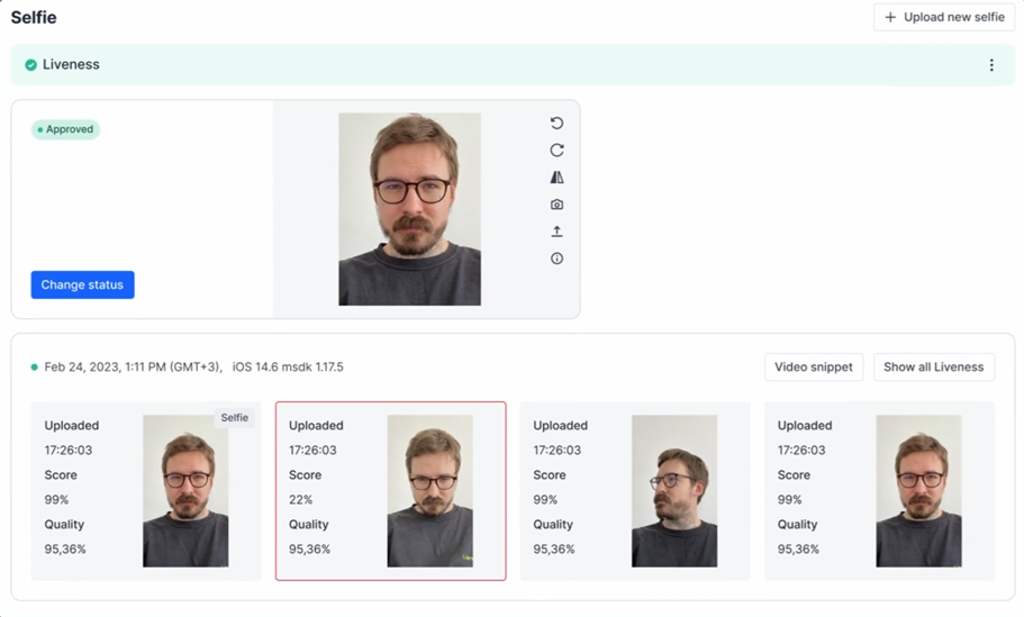
A screenshot of the dashboard for the liveness check function / Photo credit: Sumsub
After that, Sumsub verifies the information against secure, government-authorized data sources to confirm identities in as little as 4.5 seconds, faster than the 30 seconds it takes for typical document-based methods.
This approach has been shown to reduce processing time by up to 53% and improve customer pass rates by 35%.
Still, “building a safer and more inclusive digital infrastructure requires continued collaboration among policymakers, businesses, and verification providers,” she says.
Future-proofing the fight against fraud
To stay ahead, business leaders must embed an anti-fraud mindset across their organizations.
This involves moving beyond simple compliance checklists to embrace continuous, hands-on learning.
“Ensuring anti-fraud strategies succeed begins with clear leadership and fostering collaboration across cybersecurity, compliance, and onboarding teams,” Chai says. She recommends routine cross-functional drills that simulate real-world attacks and investing in expert-led educational programs.
As fraud tactics continue to evolve, the strongest defense will be a proactive one rooted in collaboration, adaptability, and a commitment to both security and inclusivity.
“Fraud is always advancing,” Chai emphasizes. “The strongest teams stay ready by investing in both people and intelligence.”
Sumsub is at the forefront of helping businesses navigate the dual challenge of sophisticated fraud and digital exclusion with its full-cycle verification platform.
For a deeper dive into these critical issues, Sumsub will be hosting its WTF Summit in November 2025. Join the panel discussion, “Finance for All: Driving Inclusion Through Regulation and Innovation,” to gain first-hand insights on how to build a digital ecosystem that is both secure and accessible for everyone.
To register for the event, click on this link.
For a special 15% discount exclusive to Tech in Asia readers, click here.
This content was produced by Tech in Asia Studios, which connects brands with Asia’s tech community. Learn more about partnering with Tech in Asia Studios.
Stay updated on the go with our mobile app.
Get latest insights with smoother, more personalized experience through TIA mobile app.
Recommended reads
 SG minister highlights AI adoption pitfalls in SEA
 ASEAN gets a tailored risk tracking tool
 Indonesia’s corruption laws cast shadow over Grab-GoTo merger
 Anthropic CEO sees AI fuel growth, not employment
 A Mythos quest? SEA fighting AI threats with obsolete security
 Info-Tech flagged for ‘inappropriate marketing’; firm says it’s compliant
 Tokocrypto to launch futures trading as competition grows
 Google denies bribing officials of Indonesia’s Ministry of Education
 Stablecoins quietly shaking Asia’s financial foundations
 Indonesian prosecutors seek 18 years for Nadiem Makarim





Editing by Jonathan Chew, Stefanie Yeo, and Jaclyn Tiu
(And yes, we’re serious about ethics and transparency. More information here.)