 Ummi Amran · · 6 min read
TIA Conference: How we produced a Product Stage people stayed for
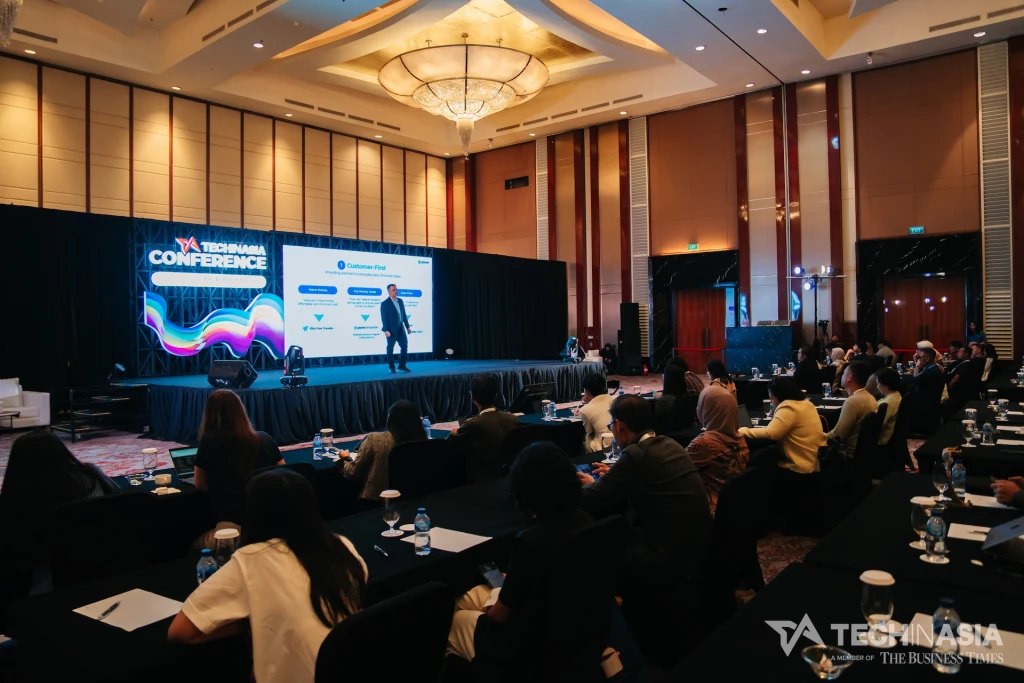
Sudhanshu Raheja, President of GoTo Financial, closing out the Product Stage on the final day of Tech in Asia Conference 2025. / Photo credit: Tech in Asia
There’s a big difference between an AI panel that draws polite interest and one that has people standing at the back of the room, taking notes, and refusing to leave.
At last year’s Tech in Asia Conference, we hosted an AI- and product-focused stage that achieved the latter. Every seat was taken, And people came and stood wherever there was space. It wasn’t just because AI is a buzzword. It was the format of the stage—built for where the tech ecosystem actually is right now: post-hype and impatient and hungry to learn how AI actually works.
Behind the scenes, our content team had a simple hypothesis. As Jonathan Chew, who was part of the Tech in Asia Conference 2025 content team, puts it: “If most of the audience at the product stage are CTOs and developers, the easiest way to deliver value is hands-on practice, not just talking strategy.” Less “future of AI,” more “open your laptop. Let’s try this.”
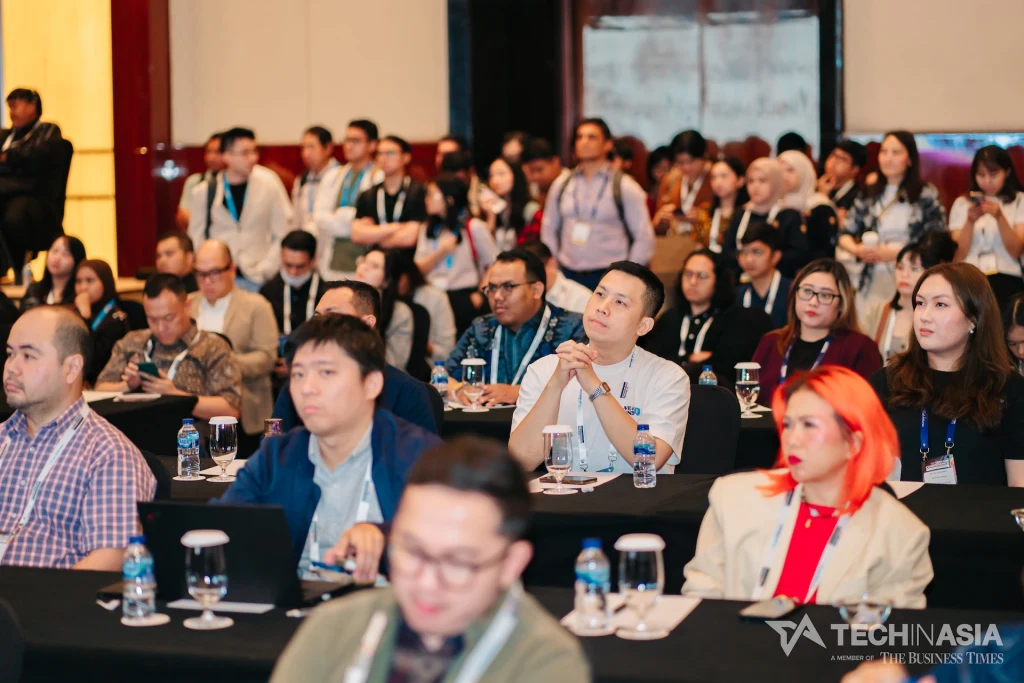
The Product stage was packed to the brim, with attendees standing throughout sessions. / Photo credit: Tech in Asia
Day one set the tone. Topics like “The future belongs to people who do things” eased people in. Then workshops like “The key to no-code solution development as a team & automated QA testing with AI” and “Automate without code: unlocking n8n for everyone” addressed the hows of optimizing with AI.
Beyond “What is AI?”: The post-hype expectations
For the past few years, AI conversations used to involve grand visions, abstract disruption, and slides that could apply to any industry, anywhere. That era is over.
The Product Stage crowd wasn’t there to be sold on the importance of AI. They already knew that. What they wanted was:
- Concrete use cases they could implement in the next quarter
- Honest breakdowns of what failed, not just what succeeded
- Peers who looked like them—operators, founders, and heads of function—sharing the messy truth of building with AI
In other words, they weren’t buying the “what.” They were buying the “how.”
Day two got specific. There were sessions like “The importance of incorporating AI in the product design workflow,” “Making your product truly omnichannel,” and “Using AI to rapidly understand user needs.” Then it went deeper: “The essential role of AI as a corporate product manager” and “How GoPay designs features that keep customers coming back.”
But it couldn’t just be workshops all day. “You still need variety,” Chew says. “Workshops deliver, but sometimes you want inspiration or a case study to learn from.” That’s the mix: demos, panels, and case studies. Something for everyone.
What made this format different
We didn’t set out to build a viral stage. We set out to build a useful one. In hindsight, four elements made the difference:
- No sales pitches
- Speakers weren’t allowed to spend 20 minutes on product decks or vision slides. Their mandate was simple: show us exactly what you did, how you did it, and what you’d do differently now.
- Peer-led, operator-first speakers. Instead of only platform vendors and consultants, we prioritized practitioners:
- Sherry Jiang, CEO and co-founder of Peek, and Agrim Singh, co-founder and CTO of Niyam AI, demonstrated how they vibe code to build new tools and AI-driven workflows to effectively maintain and build products.
- Aurelius Ivan Wijaya, AI engineer of Invenio Potential, showcased how teams can integrate external tools and databases to automate previously manual workflows via n8n, without coding.
- Abhilash LR, founder and CEO of Jellybean AI, covered the common pitfalls of AI outputs and how to turn them into clear, actionable product decisions and workflows.
- Attendees were hearing from people who owned P&L, KPIs, and teams.
- Specific problems over broad themes, making the conversations immediately relevant
- Each session was anchored to one concrete question. For example:
- How do you use AI to shorten your sales cycle without spamming prospects?
- What does a realistic AI content workflow look like for a lean marketing team?
- How do you introduce AI to non-technical teams without creating chaos?
- Each session was anchored to one concrete question. For example:
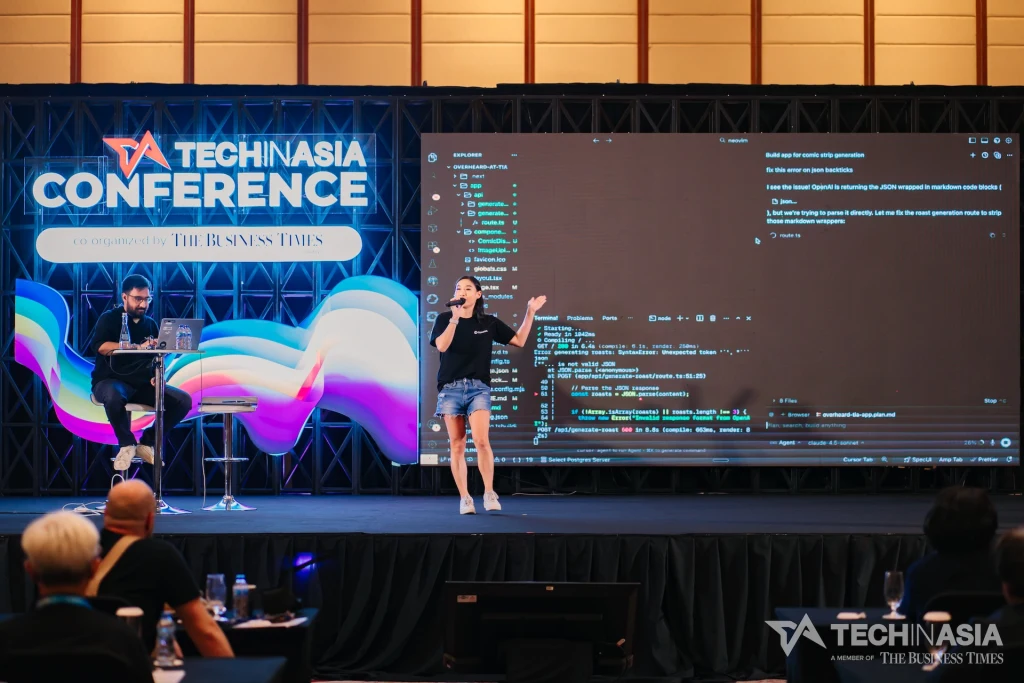
Sherry Jiang, CEO and co-founder of Peek, and Agrim Singh, co-founder and CTO of Niyam AI, demonstrating how to build an AI comic generator using Cursor. / Photo credit: Tech in Asia
But what was the “it’s working” moment? “During the vibe-coding workshop, when I saw attendees with laptops open, actually trying prompts, that’s when I knew they were learning something useful,” Chew says.
As for the next iteration of the Product Stage, he’s thinking of setting a higher bar. “More domain-specific experts and scenario-based practice, since attendees will have higher AI skill baselines this year,” he notes.
What the packed room is really telling us
Standing-room-only attendance is a nice vanity metric. But what matters more is why the room was full and why people stayed.
The feedback we heard again and again—from founders, product leaders, marketers, and engineers—was along the lines of:
- An AI session that didn’t feel like a pitch.
- Actually knowing what to try next week.
- How they felt like they were listening in on other teams’ internal experiments.
The pattern is clear: the market has moved past the “What is AI?” hype cycle. A sophisticated tech audience now expects:
- Educational, enabling content
- Peer-to-peer learning
- On-the-ground application
If you want to engage them, you can’t just sell vision. You have to show the work.
Why this matters for your brand growth
If you’re running events, webinars, or content programs in this environment, this shift has real implications:
- A big-name keynote isn’t enough if the content is generic.
- A flashy topic won’t land if it doesn’t translate into something people can actually do.
- Audiences remember who helped them solve a problem, not who talked about disruption the loudest.
For brands and teams in the tech ecosystem, this is both a challenge and an opportunity. The challenge: you can’t hide behind buzzwords anymore. The opportunity: if you can consistently deliver practical, honest, and peer-led content, you can become a trusted resource in your niche.
How this connects back to Tech in Asia Studios
For us at Tech in Asia Studios, this Product stage wasn’t just a one-off success. It was a live feedback loop. It reinforced what we’ve been seeing across our work with clients:
- The most effective B2B content and events are the ones that teach, not just tell.
- High-intent audiences congregate where they feel they’re getting “un-Googleable” insight—things you only hear if you’re in the room.
- Structured, peer-led sessions can do more for trust and authority than any polished sales deck.
That’s why our Studios work focuses on helping companies show up in these high-trust environments—whether that’s on stage at a flagship event, in a case study, or through a content series that goes beyond surface-level commentary.
We don’t just ask, “How can we get you in front of more people?”
We ask, “How can we help you be the most useful voice in the room?”
Because in a post-hype AI ecosystem, usefulness is what people remember. If this is the kind of event experience and conversations you’d like to lead, connect with us below as we ramp up preparations for this year’s Tech in Asia Conference:
This content was produced by Tech in Asia Studios, which connects brands with Asia’s tech community. Learn more about partnering with Tech in Asia Studios.
Stay updated on the go with our mobile app.
Get latest insights with smoother, more personalized experience through TIA mobile app.
Recommended reads
 SEA financials tracker: Moladin’s revenue rises 6% in 2025
 Flipkart’s costly late push into quick commerce and food delivery
 Inside Singapore’s government team that kills its own products
 Once an IPO hopeful, SCI Ecommerce nears collapse
 Who’s betting big on ChatGPT ads? Not Asian brands
 VC tracker: Granite Asia launches US$50 million fund
 GCash trims IPO ambitions to meet market realities
 Igloo CEO eyes global M&A: ‘We have an appetite to grow more’
 Why SBI paid a premium for Ajaib amid a tough market
 OpenAI warns building for today will cause technical debt





Editing by Jonathan Chew and Jaclyn Tiu
(And yes, we’re serious about ethics and transparency. More information here.)



📅 Upcoming Events
22 October 2026
Payoneer x CSPN Summit 2026