- Premium Content It takes our newsroom weeks - if not months - to investigate and produce stories for our premium content. You can’t find them anywhere else.
 Melissa Goh · · 7 min read
The Amazon-Visa stand-off: What’s the endgame?
In the tussle between retailers and all-powerful payment networks, who stands to lose the most?
In November, Amazon took a swipe at Visa by imposing a ban. The payment giant’s UK-issued credit cards won’t be accepted on the ecommerce juggernaut’s local platform (amazon.co.uk) starting January 19, 2022, as it aims to encourage consumers to use better, lower-cost payment methods.
Photo credit: 123rf.com
The move is the latest escalation of a years-long sticking point between merchants, payment networks, and banks. It comes after Visa raised fees for cross-border credit and debit card transactions between the UK and European Union. Amazon, however, said the ban was not about any one rule or fee, and that high costs of payment acceptance are a global problem that isn’t exclusive to the UK.
“The cost of accepting card payments continues to be an obstacle for businesses striving to provide the best prices for customers. These costs should be going down over time with technological advancements, but instead they continue to stay high or even rise,” an Amazon spokesperson tells Tech in Asia.
The fees in contention are known in the industry as interchange fees, or what a customer’s card-issuing bank charges a retailer for every transaction. This is just one – though significant – component of the merchant discount rate (MDR), which refers to the fees shouldered by retailers for processing card payments.
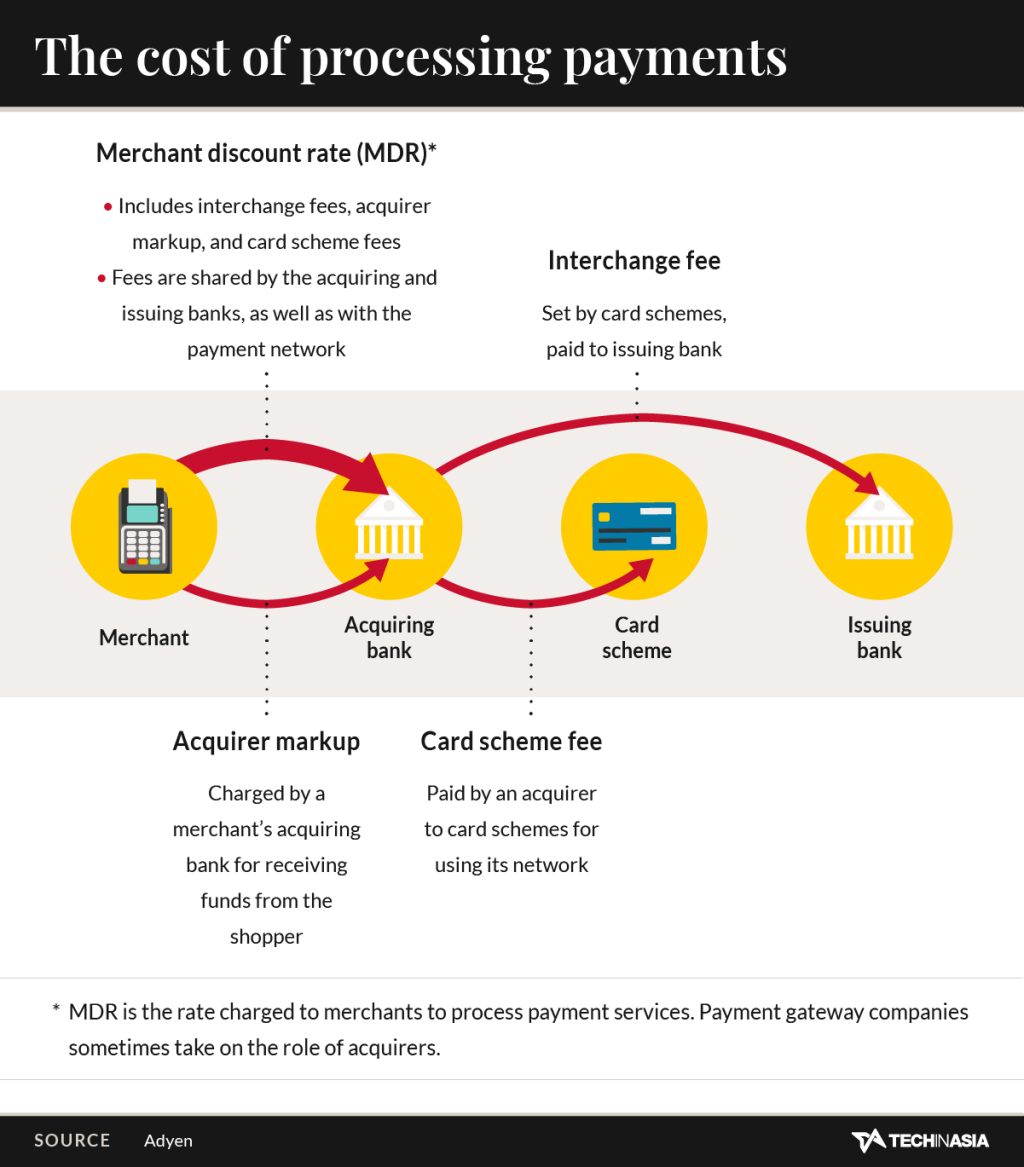
Image credit: Timmy Loen
See also: Visual: The hefty cost of credit card payments
Players in the Asia Pacific are reacting to the fee revisions more subtly. In Singapore and Australia, Amazon customers who shop on local sites have to pay a surcharge when they use Visa credit cards at checkout.
Beginning in October, GrabPay users in Singapore who make top-ups to their e-wallet via Visa credit cards have to pay extra after Grab imposed a surcharge of S$1 (US$0.73) on such transactions. (For top-ups worth over US$292, the super app absorbs the fees.)
The Amazon-Visa stand-off, however, is significant for a few reasons, though it’s unclear why the payments firm was singled out. In an interview with the Financial Times, Visa CEO Al Kelly said it was “inaccurate” to call the cost of accepting payments in the UK as high and described the Amazon ban as “odd.” Fellow payment titan Mastercard reportedly also charges similar fees in the UK.
Amazon holds considerable sway by virtue of its size: It commands 25% of the UK ecommerce market – or US$29 billion in volume, according to Euromonitor estimates. However, that figure is just 0.26% of Visa’s total.
This scuffle also comes at a time when alternative payment methods such as digital wallets and buy now, pay later programs are growing popular.
The popular vote
Opaque fees
Is the end of credit cards nigh?
Stay ahead in Asia’s tech landscape
This is premium content. Subscribe to read the full story.
Amazon’s ban on Visa credit cards in the UK is a sign that the power balance between merchants, banks, and payment firms is shifting.
We know this is not ideal. ⌛ Sign up in 20 seconds. Cancel anytime.
Our subscriber community includes professionals from these companies:





Stay updated on the go with our mobile app.
Get latest insights with smoother, more personalized experience through TIA mobile app.








📅 Upcoming Events
22 October 2026
Payoneer x CSPN Summit 2026