Stefanie Yeo · · 5 min read
3 tips for businesses entering Hong Kong’s strong startup scene

Klook, Gogovan, and 9Gag are all successful startups in different industries, but they have one thing in common: they were all founded in Hong Kong.
Hong Kong has been touted as an ideal place for fledgling businesses, boasting a total of 2,625 startups in 2017.

Photo credit: leungchopan / 123RF
That number is set to rise, along with growing local assistance. In 2017, the Hong Kong government launched an Innovation and Technology Venture Fund worth US$256 million, which aims to work with selected venture capital funds to support startups in the city.
Other funds such as the Cyberport Creative Micro Fund, which gives nearly US$130,000 in seed funding to selected startups, are also available.
On top of this, the area is attractive to startup accelerators like Entrepreneur First and Antler. Furthermore, the capacity to tap on the Hong Kong-Guangdong-Macau market is appealing to both entrepreneurs and investors.
Despite a robust startup landscape, entrepreneurs looking to Hong Kong still face all the usual woes when trying to get a business off the ground, such as gaining funding and finding the right talent.
For those looking to Hong Kong as a place to start a company, here’s how founders and business owners can get more acquainted with the city’s startup landscape.
1. Explore alternatives to traditional banks
Aside from obtaining funding, the next biggest money-related problem many startups face is sorting out their banking arrangements.
Traditional banks in Hong Kong require copious amounts of detailed paperwork and take a long time to review and process applications – many of which may end up in rejection because startups tend to lack a track record. Additionally, many banks have high international transfer fees.
But the rising number of fintech startups in the area means entrepreneurs – even those not based in Hong Kong – can easily find alternative banking solutions.
Neat, a Hong Kong-based fintech startup, is one company that provides a solution, specifically geared toward entrepreneurs. The company enables users to open a business account online within 10 minutes.
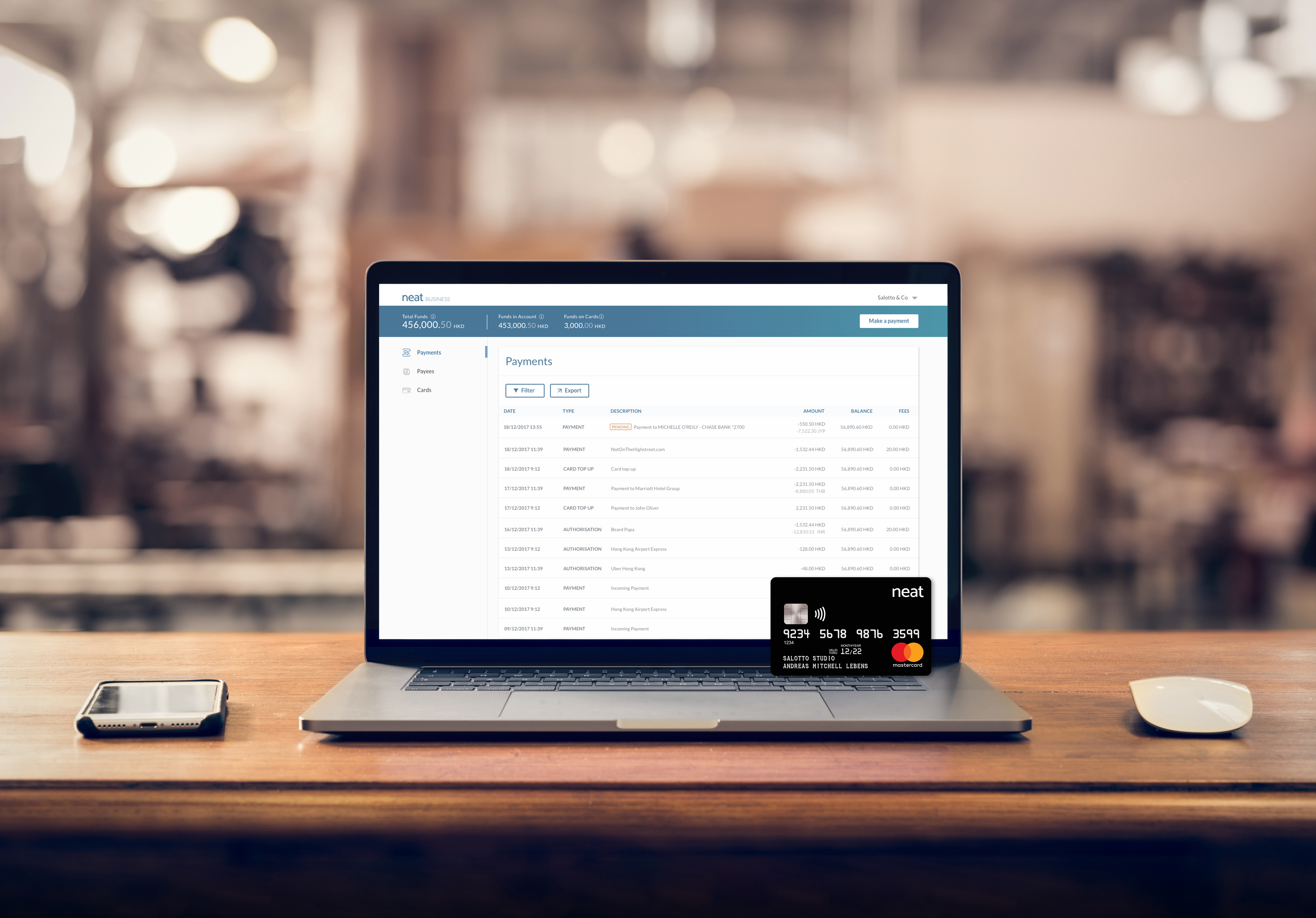
Photo credit: Neat
Founded by David Rosa and Igor Wos, Neat helps startups incorporate in Hong Kong, providing them with a local business account, a corporate Mastercard, and the ability to transfer and receive money from all over the world at a lower rate than traditional banks.
“Neat is easier, faster, and cheaper,” says Mario Peng, founder of venture builder Peng Ventures. He adds that he has used Neat’s services across all the eight companies under his umbrella and says that they go a long way in helping entrepreneurs save both time and money in terms of their banking needs.
2. Know your market and know it well
According to Peng, the primary concern entrepreneurs should bear in mind is satisfying the customer and solving their problems. If these two issues are addressed well, then “everything else will follow.”
An example of how important knowing your market is can be seen in Klook, a travel-booking platform that offers preferential rates and access to tourist attractions and services in various cities all over the world.
In an interview with the Hong Kong Economic Journal, Klook co-founder Eric Gnock Fah revealed that one of the company’s initial challenges was learning to listen to the market.
The platform started out with travel activities in destinations like Nepal and Latin America – locations which the founders themselves found exciting. However, visiting these countries was too expensive for a large proportion of its mostly Asian customer base. Klook then had to learn to tailor its offerings to the needs of its users based on market analyses of consumer behavior.
The company’s research found that Southeast Asian tourists, for example, were more likely to book day trips and tours to new destinations. As a result, users from that region would get more recommendations for such activities.
Klook’s research findings also showed that mobile apps were important to the Asian market, leading the startup to put a lot of effort into developing its mobile platform.
By taking the lead from its consumers and tailoring its offerings accordingly, Klook has become a successful startup.
3. Be realistic about funding
Despite the government’s efforts and an increasing interest in Hong Kong as a startup hub, many companies in the city struggle to get middle-stage funding.
In 2017, there were no series C deals made in Hong Kong, even though series A and B financing rose from US$2.66 million in 2015 to US$12.1 million in 2017.

Photo credit: jimbophotoart / 123RF
Moreover, investors in Hong Kong tend to target certain industries, according to data by local research platform Oddup. Enterprise and finance companies accounted for almost 40 percent of startup funding in the city, and 92 percent of fresh funding was split among only 14 companies.
To earn their share of the funding pie, entrepreneurs need to be proactive in landing new investors through networking and having detailed action plans, as well as a real product to show investors just where the money is going.
The boost in government support may herald an improvement in middle- and later-stage funding for startups in Hong Kong. But in Peng’s view, entrepreneurs still need to have realistic expectations about funding and plan accordingly.
Getting your startup off the ground
Despite the hurdles in attaining middle-stage funding and incorporating a business in the city, there are many benefits for businesses looking to break into Hong Kong’s startup scene.
On top of its low business tax rates and uncomplicated incorporation process, the city is ranked fifth in the Asia and Oceania region by the 2018 International Property Rights Index, which takes into account factors such as the local perception of intellectual property, patent, and copyright protection – a valuable consideration for any tech company.
With the many solutions available from alternative banking solutions to venture builders and mentorship programs that serve to support new businesses, it’s no question that entrepreneurs looking to Hong Kong who do their research and plan accordingly are bound to have their businesses up and running in no time.
Neat is a modern alternative to banks based in Hong Kong that helps meet the needs of businesses that are looking to jump into the city’s robust startup ecosystem.
To find out more about Neat, visit its website.
Stay updated on the go with our mobile app.
Get latest insights with smoother, more personalized experience through TIA mobile app.
Recommended reads
 Life’s a game, and AI agents are Animoca’s new play
 Indonesian AI startup goes global
 Forrest Li on scaling Sea, building smarter bots, and founder grit
 An AI assistant that joins sales calls and scores team skills
 Beyond the check: Why VCs need more than capital
 SGX’s CEO says it doesn’t need a unicorn to win
 SMEs want AI too, but not the kind Big Tech is selling
 Oatside’s alt-milk rise hits a profitable gear
 Alibaba’s financial health in 12 charts
 Asia’s telcos bundle AI into mobile plans. Will it pay off?





Editing by Nathaniel Fetalvero, Eileen C. Ang, and Charmaine de Lazo
(And yes, we’re serious about ethics and transparency. More information here.)