 Steven Millward · · 5 min read
Hyperlocal, hyperfast: this startup is helping Alibaba in the on-demand economy

(Photo by Stavos)
Local, on-demand web services are booming in China right now – as indicated by last month’s US$630 million funding for the nation’s biggest food delivery startup, Ele.me.
Today, a rival delivery startup called SHBJ revealed that it has secured an undisclosed series C round of funding from ecommerce titan Alibaba.
This news comes less than three months after Alibaba threw US$1 billion at web-connected local services to bolster its ecommerce offerings. Alibaba set up a joint venture called Koubei to create a marketplace for these O2O services – everything from food delivery to home manicures or housekeepers. A few weeks after that move, Alibaba put the new marketplace in its Alipay mobile wallet app in a bid to gain traction among the app’s 400 million annual active users. The SHBJ investment is the first funding designed for the Koubei joint venture, made in the name of the Alibaba spin-off Ant Financial, which runs the Alipay service.
Hyperlocal, hyperspeed
Xu Weihao co-founded SHBJ in 2010 and serves as the CEO of the Beijing-based startup. He says the delivery service now has 2,000 employees – mostly riders who deliver the food – and over 30,000 daily orders across 10 Chinese cities.
The delivery team is split between full-time and part-time staff. The full-time crew is directly employed by SHBJ, while the part-timers fill in the gaps during peak hours, Weihao explains. That’s quite different to the Uber model that many on-demand startups employ – including arch-rival Ele.me, which leads the China market for food ordering. “The market we are competing in is driven by user experience, so outsourcing delivery cannot properly guarantee delivery service quality, so we are more inclined towards direct employment of our delivery team to improve oversight, employee compliance, and maintain quality standards,” Weihao tells Tech in Asia.
The plan is to expand to 30 cities by the end of the year. But Weihao doesn’t want to stop at hot meals.
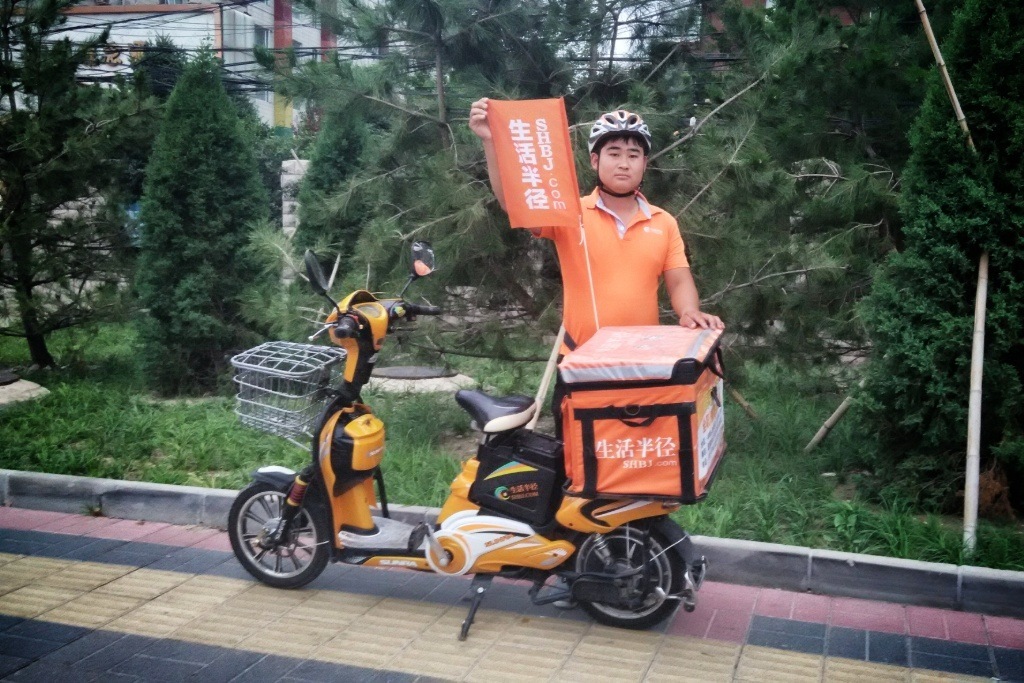
A SHBJ deliveryman with his electric scooter.
“From the first day we opened doors, we knew that to be successful, we would have to do more than just deliver meals. That’s why we are planning to expand to include groceries, convenience store items, fruit, vegetables, fresh flowers and other products in our offerings,” he says.
“Food delivery was just an entry point into the business model and the easiest way for us to get started. The reasoning behind this is that for food delivery, it has the highest volume, and is the most stringent in terms of delivery time. We start with the most demanding service and gradually expand to others that complement our core business and roll out from there to create a community lifestyle delivery platform.”
He goes on: “I know companies like Grubhub and Doordash take a different approach to logistics, but for the China market, the big question our industry is facing is whether to directly employ a delivery team or outsource it. We think that direct employment of a delivery team is the best way to guarantee service quality and positive user experience. Of course, outsourcing has its benefits, but outsourcing also has many problems.”
Weihao cites food safety as one of those potential problems. If there’s an issue with the food a restaurant has served up, he reckons a directly employed biker is more likely to care about the order and do his or her best to fix it.
Alibaba boost
The startup makes money by securing deals from restaurants, meaning consumers pay the same price for home delivery that they would if they went out to eat – aside from a delivery fee of RMB 5 (US$0.80). So if Burger King sells a multi-person RMB 100 (US$15.70) set menu to SHBJ for RMB 85 (US$13.35), and then the startup charges the hungry customer RMB 100 plus the small delivery fee. It covers a three-kilometer radius around a user’s location.
New wave





Stay updated on the go with our mobile app.
Get latest insights with smoother, more personalized experience through TIA mobile app.










📅 Upcoming Events
22 October 2026
Payoneer x CSPN Summit 2026