 Jonathan Chew · · 5 min read
This AI platform launched on Reddit. Now it has 2m users

Ever heard of a software development platform that was launched to the public through Reddit?
That’s what the two co-founders of app development startup FlutterFlow did, posting about their new platform on the r/FlutterDev subreddit.
It became the top post on the subreddit, and the product took off, gaining hundreds of sign-ups within just a few days. “There was even a waitlist to test our platform,” adds co-founder Abel Mengistu.

Abel Mengistu, co-founder of FlutterFlow / Photo credit: FlutterFlow
FlutterFlow has since grown to serve millions of users and raised a US$25.5 million series A round led by Google Ventures.
When one door closes
While the FlutterFlow platform started off the blocks, it wasn’t Mengistu’s first idea for a startup.
He and his co-founder, Alex Greaves, had previously worked on Google Maps as machine learning developers before they decided to use their knowledge of mapping to build their own company, Taste Inc.
Built off the Flutter codebase, Taste Inc. was a recommendation platform based on users’ food preferences that launched in 2020 during the pandemic.
“We tried to pivot but couldn’t and ultimately had to shut down,” Mengistu says. That was four and a half months of development down the drain.

Photo credit: Shutterstock
Later that year, while analyzing their experience with Taste Inc., the two founders realized that they took too long to launch and iterate on feedback to improve the product, a problem they found many other app developers faced.
“We were sitting on this thought for a while when it hit us: We’d previously built a landing page for Taste Inc. really quickly using coding tools – why not do it with Flutter?” Mengistu shares.
And that’s when the idea for FlutterFlow was born.
Finding their flow
In a nutshell, FlutterFlow lets developers build apps using AI-powered visual tools, rather than traditional coding.
Think of it like Canva but for apps instead of graphic designs.
“Let’s say you want to code haptic feedback into your app as part of the user experience,” says Mengistu. “Ordinarily, you’ve got to go through multiple steps. But on FlutterFlow, you just need to select it from a drop-down menu and it generates the code for you.”
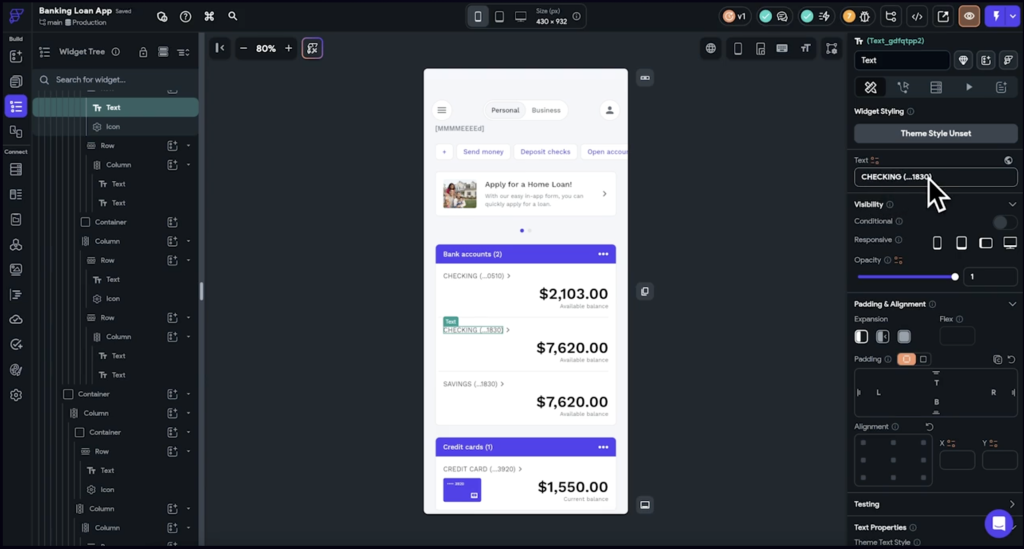
An example of how to build a banking app on the FlutterFlow platform / Photo credit: FlutterFlow
He adds that the team decided to use the Flutter framework because of its cross-platform capabilities. No matter which operating system the end user is on, an app built using Flutter would be efficient and fast, performing on a similar level as native apps.
“That’s the holy grail,” Mengitsu says. ”Writing your code once and being able to run it everywhere makes developers so much more productive.”
Evolving the platform
In 2022, FlutterFlow became one of the first platforms to natively integrate AI tools within its software, starting with a predecessor to OpenAI’s GPT-3. By the first quarter of the year, the team had rolled out an integration that allowed users to add custom code a lot quicker.
“You can make a request in natural language, and the large language model will assess your code and generate what you need,” Mengistu explains.
He and his team also added automatic API integration. According to the co-founder, users can upload an API specification – which details how the API should work – onto FlutterFlow, and the platform’s AI would scan through it, identify which parts of the API could be incorporated, then go ahead and do it.

Photo credit: Shutterstock
This would usually be applied to cases where developers want to add features like a check-out page for online shoppers, for instance.
Mengistu wanted to ensure that FlutterFlow could be scaled up for use across an entire enterprise. To that end, the team added functions for collaboration so that at any point in time, all the developers, product managers, and designers working on a project would see the same updated code.
The visual tools help with this too. Having a visual layer makes it a lot easier to identify which parts are responsible for each of the app’s components. This makes it easy for new developers on the team to get up to speed even when dealing with millions of lines of code.
“Rather than being just thrown in, it allows more people to come in and see how things work, lowering barriers to access the code,” Mengistu says. “As a large company, it’s so important to have a single design system so that you can keep everyone and everything at the same level.”
Looking forward
According to Mengistu, once developers are accustomed to the platform, they can build apps about 3x to 5x faster than if they were coding traditionally.
This has proven to be appealing for its audience, with the firm recently crossing 2 million users after four years in the market, according to Mengistu.

The FlutterFlow team at the company’s New York City office / Photo credit: FlutterFlow
But the co-founder isn’t close to being done. He and his team recently launched a product called DreamFlow, which enables users to build fully deployable apps – such as for shopping or workout tracking – in minutes, using AI prompting.
“We see AI as a tool, and if we want customers to have the best products, we need to make sure they’re leveraging the best tools,” Mengistu says.
The IMDA Spark Programme is aimed at addressing the key challenges and supporting the growth of promising Singapore-based infocomm and media startups through selected government grant tools as well as the creation of a vibrant, collaborative ecosystem and network. To find out how IMDA Spark can grow and accelerate your business, click here.
FlutterFlow is a visual, AI-powered platform that can help developers build high-quality, customized apps, enabling companies to build for scale and iterate faster.
Sign up for a free trial here.
This content was produced by Tech in Asia Studios, which connects brands with Asia’s tech community. Learn more about partnering with Tech in Asia Studios.
Stay updated on the go with our mobile app.
Get latest insights with smoother, more personalized experience through TIA mobile app.
Recommended reads
 Flipkart’s costly late push into quick commerce and food delivery
 Inside Singapore’s government team that kills its own products
 Once an IPO hopeful, SCI Ecommerce nears collapse
 SEA financials tracker: Funding Societies grows revenue by 24%
 Who’s betting big on ChatGPT ads? Not Asian brands
 VC tracker: Granite Asia launches US$50 million fund
 GCash trims IPO ambitions to meet market realities
 Igloo CEO eyes global M&A: ‘We have an appetite to grow more’
 Why SBI paid a premium for Ajaib amid a tough market
 OpenAI warns building for today will cause technical debt





Editing by Winston Zhang and Jaclyn Tiu
(And yes, we’re serious about ethics and transparency. More information here.)




