 Jum Balea · · 5 min read
Affordable health insurance for the self-employed now a reality, thanks to this new startup
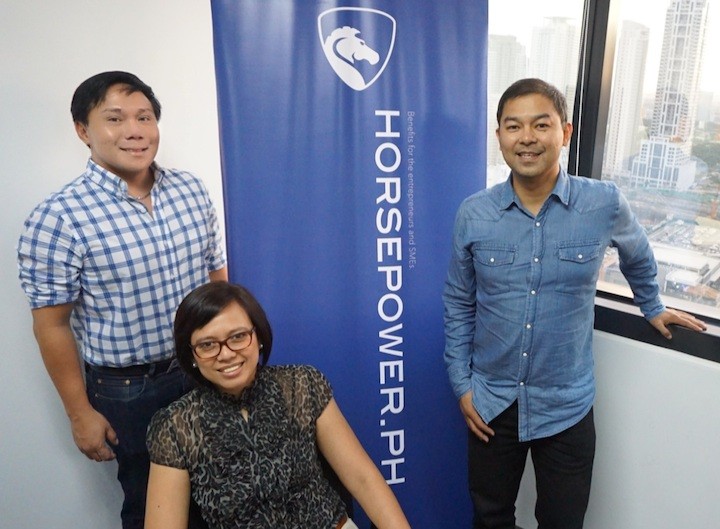
Horsepower’s co-founders from L to R: Diego Jose Ramos, Hannah Crisostomo (C), and Jojy Azurin
How often do you hear about people who gamely talk about quitting their jobs to be their own bosses but then stop cold at the thought of losing the benefits that corporate life bestows on them? For most people holding back from taking the leap from employee to self-employed, one valuable benefit seems especially hard to let go of: health insurance.
Companies in the Philippines, particularly large ones, subsidize their employees’ insurance premiums. Outside this system, many self-employed individuals find that insurance is simply beyond their means.
Jorge “Jojy” Azurin knows this well, being a serial entrepreneur and Freelancer.com’s Philippine head and director for continental Asia. Azurin has been receiving feedback from many of the company’s millions of users about the need for affordable health insurance. He saw this as a red flag: how do you ensure the well-being of a sector that’s increasingly becoming a driver of the economy?
This motivated Azurin and co-founders Diego Ramos and Hannah Crisostomo to create a startup named Horsepower, which provides affordable health insurance packages for the self-employed and small- and medium-sized enterprises (SMEs).
A first of its kind in the Philippines, Horsepower is one of the new startups to watch out for this year.
Better than corporate rates
Health insurance is just one of the services Horsepower offers, but it’s perhaps the most valuable.
This is especially true in the context of the Philippines, where healthcare is paid for largely “out-of-pocket.” According to Ramos, a large portion of the population has no health insurance. Why? It’s expensive. Individual HMOs (health maintenance organizations), the most common type of insurance plans, are 50 to 100 percent more expensive than corporate rates. One prominent HMO, for instance, charges clients in their mid-20s up to PHP40,000 (US$895) annually for a plan. Those who do have HMOs often still need to shell out cash if they come down with a critical illness or need prolonged treatment.
“Until now, a lot of these services – ambulatory to convalescence, primary to tertiary – are still out-of-pocket because healthcare costs are just too high,” Ramos notes.
Latest data from the Philippine Insurance Commission and government and private health institutions support Ramos’ statement. The numbers show that in 2011, Filipinos spent over PHP430 billion (US$9.6 billion) for hospital expenses. Of the amount, the private sector accounted for 63.1 percent; government, 27 percent; and social insurance and grants, 9.9 percent. Of the private sector spending, 53 percent was out-of-pocket payments by households, while HMOs covered six percent; private establishments, two percent; and schools and other insurance plans, one percent each.
Ramos points out that their service “encompasses primary to tertiary care, including dental and cosmetic procedures, which are not offered by leading HMOs.” He claims that members can have 20 to 70 percent discounts on consultations and clinical and medical diagnostic procedures.
It took the team a year to come up with an actuarial model for health insurance. “A lot of our earlier models were rejected by healthcare providers. But last November, we finally formulated a model that’s even better than those offered to corporate workers,” says Ramos.
Ramos did not provide further details, saying all packages will be published on their site once they formally launch in two months’ time. “We’ll have tables of our healthcare packages on the website. Currently, we have more than 300 healthcare providers on our HMO, and we will end 2015 with 400.”





Stay updated on the go with our mobile app.
Get latest insights with smoother, more personalized experience through TIA mobile app.








📅 Upcoming Events
22 October 2026
Payoneer x CSPN Summit 2026