Nadine Freischlad · · 6 min read
These 4 Aussies are leading the way with underwater drones
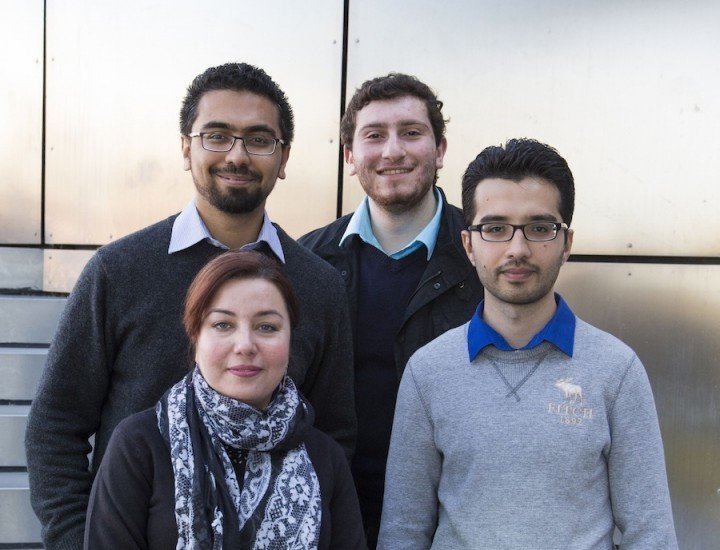
Team Abyss: Nasir Ahsan, Abraham Kazzaz, Masood Naqshbandi, and Hina Ahsan. (Clockwise from top left).
Just when we got used to the sight of drones in the sky, capturing stunning aerial views, it’s time to get a grasp on a new idea: drones underwater.
Like its airborne cousin, an underwater drone is released to fulfill a mission on its own. It follows a pre-programmed path, captures images and other data, and delivers them back to base. Intelligent aquatic drones could even make autonomous decisions, like changing course to avoid obstacles, or identifying areas of particular interest. At least that’s the idea.
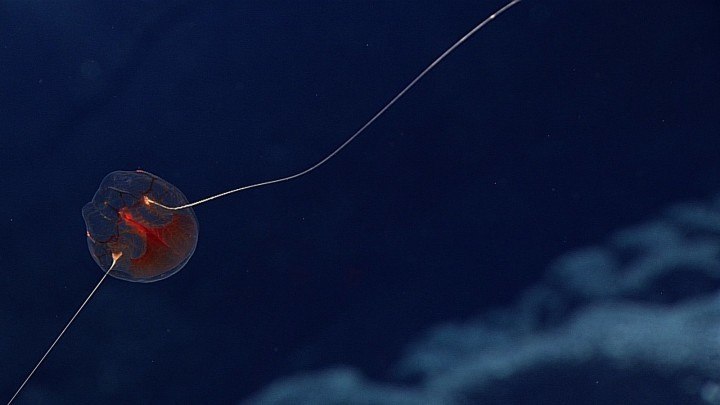
A ctenophore with long tentacles found at the bottom of the Pacific Ocean. Photo credit: NOAA Ocean Explorer
Himalayan lakes
Underwater drones are a very new concept, and a team of four young scientists in Australia is at the forefront of pushing its boundaries. They formed a startup called Abyss, operating out of Sydney.
Before getting into the details of Abyss’s product, it’s worth taking a moment to appreciate the team’s qualification. It’s a fairytale story of Australian immigration.
In his life as a researcher, he’s handled everything from small autonomous vehicles to multi-million dollar remotely-operated underwater vehicles.
At the helm of Abyss is CEO Nasir Ahsan, a Pakistani who holds a PhD in marine robotics.Co-founders include his wife Hina Ahsan, who holds a master’s degree in data analytics; Masood Naqshbandi, a sensor technology expert from Afghanistan; and Abraham Kazzaz, a civil engineer and Australian of Lebanese descent. They’ve known each other for a while, crossing paths in academia and as friends. Abraham is the only “true Australian,” Nasir jokes — but all four are Australian citizens now.
Nasir grew up near the high-altitude Himalayan lakes in Pakistan. This, he says, instilled in him a longing for underwater exploration. “Nobody has ever mapped them, exposed the depths of these,” he says.
It took a while for everything to align so that Nasir could turn his youthful fascination into a career. Starting out with computer science, he became involved with artificial intelligence, applied this to autonomous systems, then stumbled upon the emerging field of underwater robots. Here, all of his interests came together, and he’s now one of a handful of specialists worldwide.
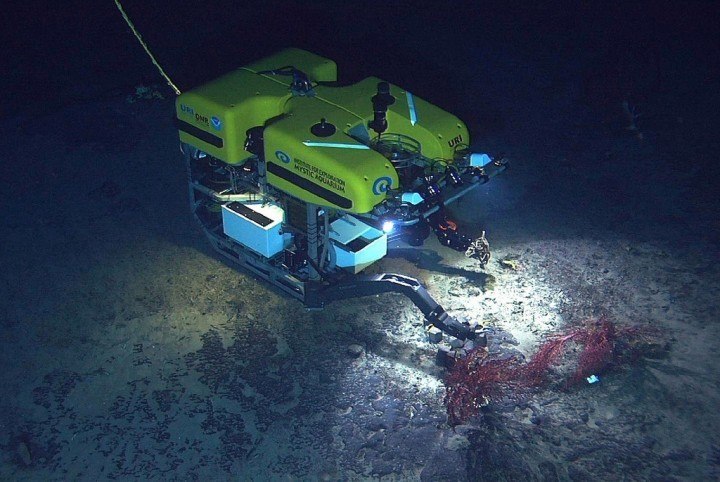
In his life as a researcher, he’s handled everything from small autonomous vehicles to multimillion-dollar remotely operated underwater vehicles (ROVs). He’s even been on board ocean exploration vessel MS Nautilus on a mission to explore hydrothermal vents in the deep sea.
“On the Nautilus, I was the navigator for the Hercules ROV, which is equipped with powerful high-definition cameras. We saw a lot of wonderful things there,” he says.
The limits of academia
The working prototype
The future of robots at sea





Stay updated on the go with our mobile app.
Get latest insights with smoother, more personalized experience through TIA mobile app.