 Grace Priscilla Teo · · 6 min read
A16z cofounder Andreessen on AI’s next big shift
This article summarizes an episode of a16z’s video series featuring its cofounder, Marc Andreessen.

Marc Andreessen, cofounder and general partner at a16z / Photo credit: Andreessen Horowitz (a16z)
Marc Andreessen, cofounder of a16z, sees AI as a foundational technology shift. He compares it to electricity or the microprocessor, arguing it begins a long cycle of innovation where human-like reasoning matters more than raw computation.
The cost of intelligence is dropping fast
AI companies are generating record revenue, but their costs are rising just as fast. This imbalance is putting pressure on them to find sustainable long-term business models.
The market has big swings
The rush to meet demand is pushing companies to build large amounts of new computing infrastructure. This spending creates recurring pressure, leading to sharp swings between supply and demand. Andreessen says, “We’re just seeing this new wave of AI companies growing revenue…at an absolutely unprecedented takeoff rate. The number one cause of a glut is a shortage, and the number one cause of a shortage is the glut.”
The cost of AI is falling fast
Andreessen explains, “The price of AI is falling much faster than Moore’s law. All of the inputs into AI on a per-unit basis, the costs are collapsing…that is driving a more than corresponding level of demand growth with elasticity.”
Companies are changing prices from cost to value
This drop in cost created a new priority. Companies must now change from charging based on use to charging for the value they provide.
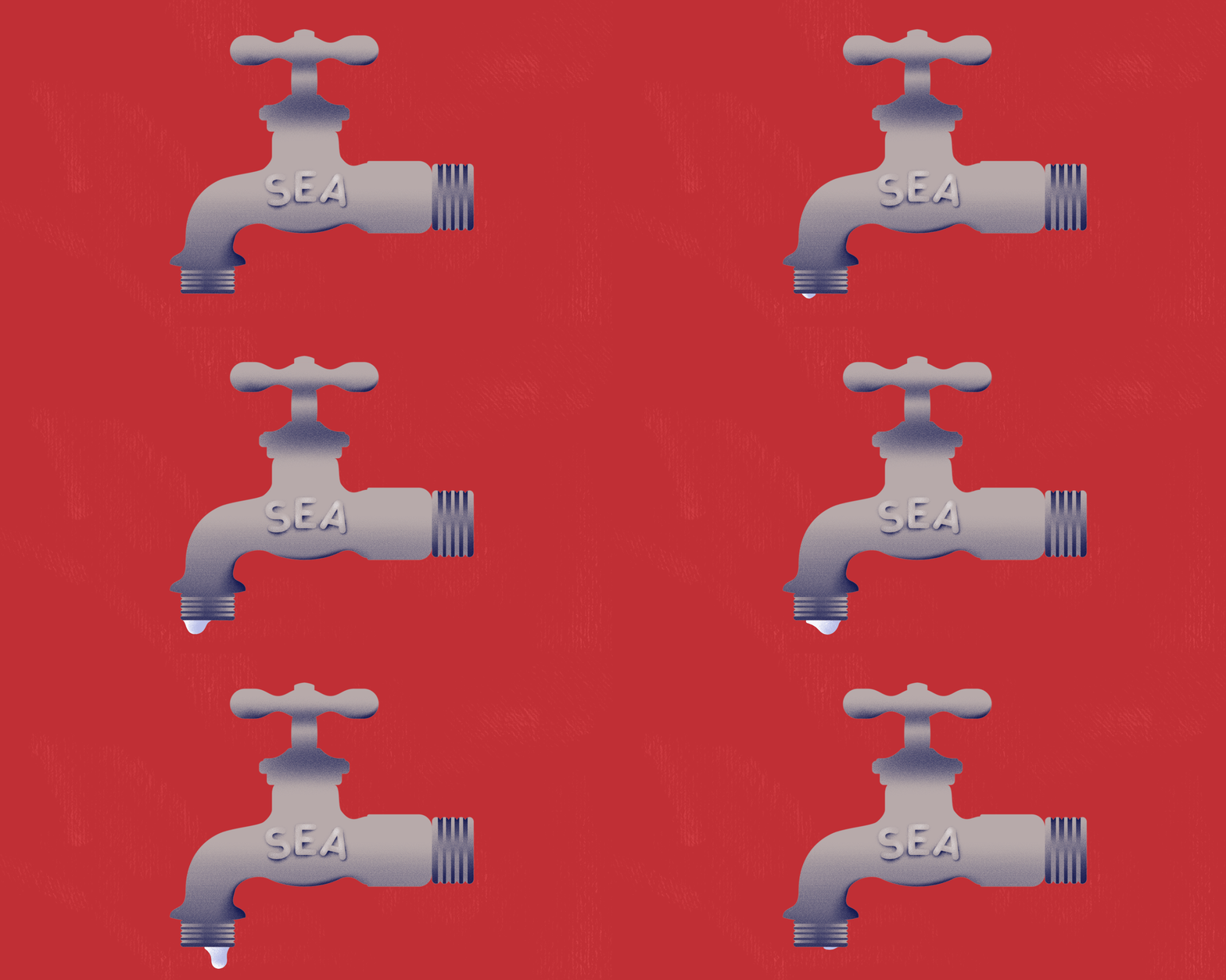
AI is now sold like electricity
Basic AI capability has become a commodity, sold like electricity or water. These systems are priced by usage and are available to anyone with a credit card.
Andreessen notes, “The core business model is basically tokens by the drink. It’s sort of tokens of intelligence per dollar. It’s this marvelous thing where the most magical thing in the world is available by the drink.”
The problem with pricing a common product
If basic AI is a cheap, usage-based resource, companies building on top of it face a hard choice. Competing on price will not work, so they have to rethink how they charge customers.
Andreessen argues, “A core principle of pricing is you don’t want to price by cost if you can avoid it. You want to price by value…if the AI can do the job of a coder or a doctor…can you price by value?”
Why expensive AI can be better for customers
“Higher prices are often good for the customer,” Andreessen says, “because a higher price means that the vendor can make the product better faster. Companies with higher prices and higher margins can actually invest more in R&D.”
Small AI systems are catching up to big ones
The lead held by large, single AI systems is shrinking. This change gives new companies a chance and changes how companies compete.
New inventions are happening faster
For years, winning in AI meant being the biggest. The largest systems had an advantage that felt impossible to challenge. That lead is fading as smaller, more focused systems catch up fast.
New companies are becoming real tech companies
China is using free AI as a weapon
America’s mix of state laws is a weakness





Stay updated on the go with our mobile app.
Get latest insights with smoother, more personalized experience through TIA mobile app.








📅 Upcoming Events
22 October 2026
Payoneer x CSPN Summit 2026