Harsimran Julka · · 4 min read
What if you change your yes-but mindset to a yes-and one, asks Google Innovation head
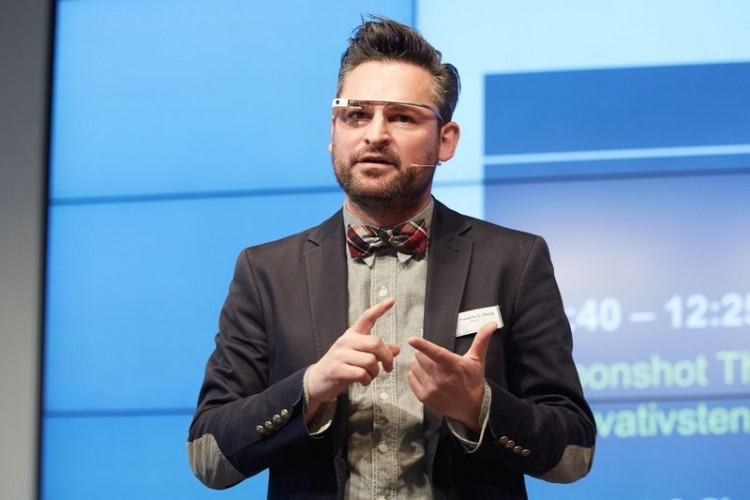
Dr Frederik Pferdt – head of creativity and innovation programs at Google Inc, Photo credit: Ravensberg.de
It is the world’s largest internet company, with over 70,000 people and a US$500 billion valuation. It still tries to retain the culture of a startup. Every Thursday, the top leaders of Google, including CEO Sundar Pichai and co-founders Sergey Brin and Larry Page, gather at the on-campus Charlie cafe. Here Googlers are encouraged to ask any questions to the top leaders or throw an innovative idea at others. They are also briefed on the new things that Google is developing and innovations in the industry.
Dr. Frederik G. Pferdt, head of Innovation and Creativity programs at Google and co-founder of The Garage – a maker space to build things on campus – gives us a download on what prevents humans from innovating and why ‘startups’ such as Google have been able to change the world.
Why many ideas fail
Frederick was recently visiting his hometown of Berlin, where a lot of refugees from Syria were arriving. He and a few friends tried to come up with ideas that could ease the lives of the migrants in a new unfamiliar country.
All ideas except two failed. One was about designing suitcases that the migrants could carry easily, and the other was to buy the newcomers free museum or train tickets to help them integrate in the new country.

Bicycles painted in Google colors at Googleplex, California. Photo credit: Tech In Asia.
“The suitcase is often their only identity, which they carry to a foreign land,” he says. “Ideas fail when you don’t think about the consumer. The most powerful principle of innovation is empathizing with the user and seeing the problems from their point of view,” he says.
Frederick also teaches at the Stanford University and he says it’s a common myth that people in Silicon Valley love to fail.
“During my interactions with hundreds of people here in the Silicon Valley, I have found not a single person who wants to fail. [But] they want to learn fast about what works and what doesn’t,” he says.
The Google way, according to him, is to develop a prototype and experiment.
How to build a ’10X idea’
Frederick gives us a sheet of paper (I am in a workshop with about 30 people). He asks us to write “What if ideas” on a sheet of paper and pass it to our neighbors.
He then asks others to build on that idea instead of rejecting it. I write: “What if we can remove all the traffic and pollution in the world?”
I pass it onto my neighbor and she passes further on. We build an idea around a sustainable business model and in no time, we had a team that was passionate enough to take that idea to its conclusion.
20% time policy at Google
Changing yourself to ‘Yes-And’ mindset
The “what if?” question





Stay updated on the go with our mobile app.
Get latest insights with smoother, more personalized experience through TIA mobile app.