 Elaine Ramirez · · 10 min read
Huge Korean demo day ends with 500 Startups bagging calendar app
Korea’s startup scene threw an extravaganza of a demo day in Seoul on Wednesday after 40 startups spent a month of training for the pitchoff.
The K-Startup Global Engine, a government-initiated project to match global-bound local startups with top-notch international accelerators, was impressive in scale and ambition. It culminated with 35 surviving startups pitching to judges from eight top accelerators and seed funds – 500 Startups, Techstars, Seedcamp, HAX Accelerator, Chinaccelerator, Startup Bootcamp, Alchemist, and Open Network Lab.
And for the grand finale, 500 Startups invited Day2Life, maker of calendaring app June, to join its January batch. This comes days after the venture capital firm raised a seed fund for another Korean firm, K-beauty ecommerce startup Althea.
But after the show, the gloves came off. Chinaccelerator’s William Bao Bean started pouring the soju, the judges revealed their favorite startups and whether or not they’d invest, and everyone said what they really thought about Korea’s place in the global startup scene.
Here were the judges’ top eight picks from K-Global Startup Engine 2015:
8. Day2Life
Loved by: 500 Startups, Alchemist, Chinaccelerator

Day2Life’s June
Day2Life’s product June is a calendar-meets-to-do-list app that puts mobile first with features like drag-and-drop and task alarms. It syncs with popular calendars like Google, Outlook and Apple as well as Facebook and Evernote with a sleek user interface in an aim to make time management seamless for users.
Founder Wonil Park, a former robotics research engineer for LG Electronics, said he’s been working on this idea for the past four years. The team dumped its first product, which didn’t take off well with Americans, two years ago and micro-pivoted when it realized that the major platforms didn’t have great mobile interfaces.
That is certainly true with Naver Calendar, the main calendar in Korea and a buggy piece of s*** that users have grown frustrated with. Locals gave June 220,000 downloads without any marketing during its year of testing, with 81,000 monthly active users and an 80 percent retention rate, according to Wonil. With the global launch this year, the calendar app is available in English, Korean, Chinese, and Japanese on both iOS and Android.
June’s success hinges upon the bet that those major players like Google and Outlook won’t develop something cooler before the app really takes off. “I think we’re early to the market and are validating the hypothesis” that a mobile scheduling solution is needed, he tells Tech in Asia. “We want to focus on solving the core problem.”
After a month of meetings, 500 Startups scooped up Day2Life for its January 2016 batch, which Wonil hopes will help it grow really, really fast before fundraising.
“We chose that startup because it really focused on mobile calendar management, and I think there is room for mobile calendar management,” says Haley Kim from the firm’s Seoul office, which opened in April. “We think there’s room for disruption, and they’re really good at product.”
7. Moving Key
Loved by: Chinaccelerator, Alchemist, Techstars
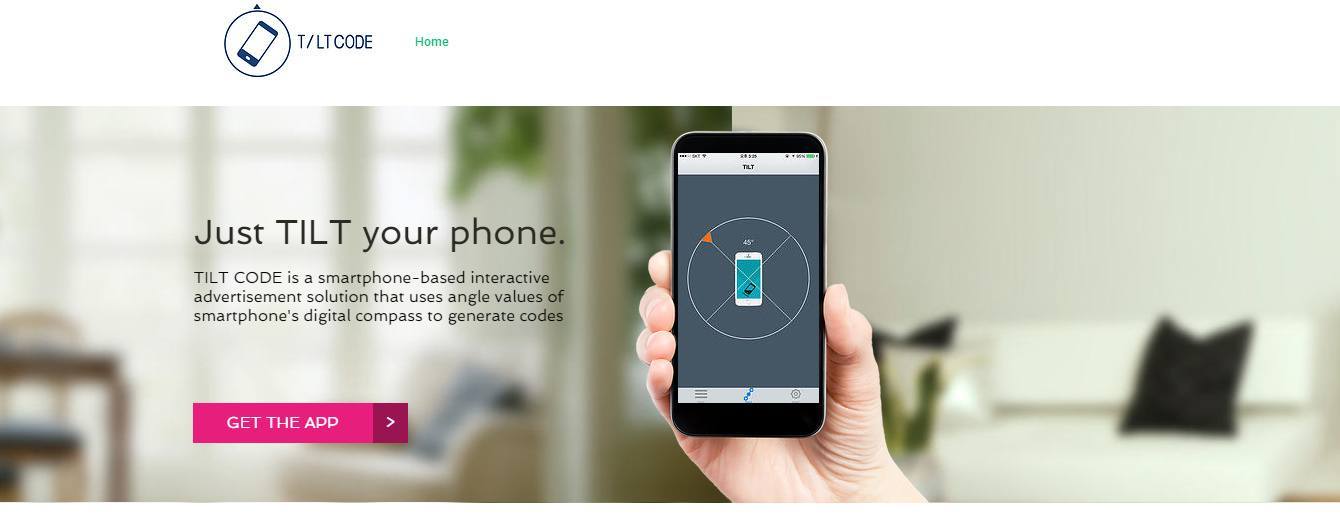
Moving Key’s Tilt Code lets you tilt your phone to capture ads.
Moving Key makes Tilt Code, an ad-tech app that makes getting coupons fun for the user by using the smartphone’s digital compass to engage outdoor ads. Instead of QR codes or near-field communication, users tilt their phones to a certain angle to capture and interact with the ad.
Founder William Seo used to work for KT, Korea’s largest telecom company, and the startup is backed by Samsung.
“It’s a different way for advertisers to interact with consumers outside of QR codes, which I always felt were annoying,” says Amanda Zamurs from Techstars in Boston. “I thought it was an interesting innovation and something I hadn’t seen before, using the gyroscope in that way.”
Ravi Belani from Alchemist in Silicon Valley thinks it’s so quirky that it just might work. “The QR codes never really took off … but I think it was because the user interface didn’t work,” he says. “I like the idea of having it be just a physical tilt … because it showed they were thinking differently, so I thought it was a really neat and possibly powerful thing.”
Chinaccelerator will do a final-round interview with Moving Key.
6. Memoirs Inc
Loved by: Open Network Lab

Memoirs Inc’s My Memoirs
Memoirs had its heartwarming beginnings after co-founder Jason Min-kee Kim worked with cancer patients who wanted to reminisce about their lives in their last days. While millennials have their lives digitized on social media, older generations still needed a platform to keep and retell their stories in a way that was organized and visually appealing.
Memoirs’ service My Memoirs has users send in their DVDs, VHS tapes and other story materials to digitize so they can pass their legend on to their kin. The startup didn’t make it past the first round of the demo day, but earned a $1,000 runner-up prize and was the personal favorite of Open Network Lab’s Shida Schubert.
“I just think there’s a need for that. The grandparents, at least from my generation, are gone already. I don’t know much about what they did, I don’t know much about their life. It’s something that I wish was there because that becomes part of who you are,” Shida says.
But enough to take in the startup?
“I personally like the startup because of what they are trying to do. Whether they are investable or not is the question.'”
5. Hello Mission
Loved by: Chinaccelerator
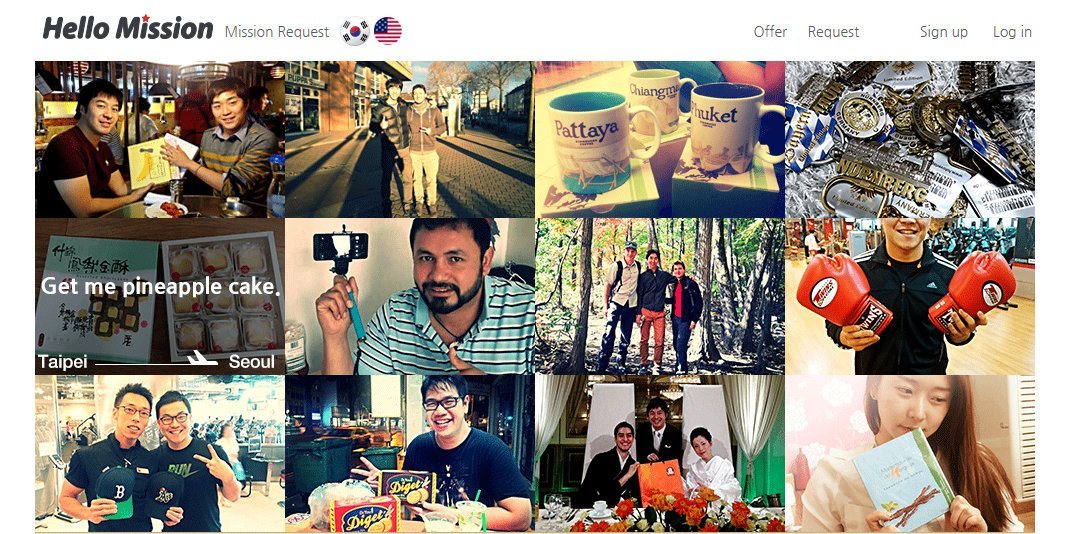
Hello Mission
Say you just came back from a sweet trip to Japan and realize that you forgot to buy a kimono. Or something. You’ve found out that a complete stranger from Osaka is visiting your town – would it be dickish to ask him to bring one for you?
Not at all, with Hello Mission’s new platform, which connects people who have such international requests with travelers who are coming to their town. It creates a social platform that lets strangers become friends and also does away with the logistical issues of getting goods and services from abroad.
“I think they have a serendipity about them,” says Chinaccelerator’s William. He has a soft spot for travel ideas, having worked in travel for 12 years. He helped Expedia’s Chinese subsidiary Elong go public in 2004 and personally funded seven travel startups since then. “They have some very small traction, and they need to put in some safety features, but the idea where people can go across borders, meet somebody, do cultural exchange without spending money is inspiring.”
4. 3.14
Loved by: Startup Bootcamp
3.14 makes KamiBot, an interactive paper robot that can be controlled by a smartphone. It aims to make computer programming fun for kids to learn by teaching them the basic skills to control the robot’s actions. Users can print their own robot skins from a collection of papercraft templates.
KamiBot is currently on Indiegogo.
Norbert Sommer from Startup Bootcamp in Barcelona likes the uniqueness, but bringing the startup to its European accelerator might shake up its whole strategy. “It has a bit of everything – educational software, software for children, they can even tailor to their own needs, how they want it,” he says. “So it might be interesting for us. We’re considering to take them on to our program. We’re just not sure right now if this is the right time for them or not.”
3. Attocube
Loved by: HAXLR8R
Another ed-tech startup, Attocube, takes a set of classic wooden blocks and smartens it up. The blocks, with different geometric patterns painted on each surface, interact with an app so the young user can match the shapes on the blocks with the picture on the screen to develop their cognitive and motor skills.
The Shenzhen-based hardware accelerator HAX has invited Attocube to a final-round interview. General partner Benjamin Joffe likes the combination of simple hardware and a good software education platform.
“I think it’s effective at leveraging the combination of tablets and simple traditional toys, so behaviors that people already have. A lot of startups try to introduce new behaviors,” he says. “I think a big trend in hardware and IoT is basically reinventing what’s already there or making it smarter in a useful way, in a better way. I think they were effective at doing that.”
Attocube is also on Indiegogo.
2. 3Claps
Loved by: Seedcamp

3Claps
3Claps is an ecommerce startup that has seized the kids’ fashion market by helping parents find trendy clothes that fit their fast-growing children. It partners with local independent childrenswear designers and has grown très popular with social media-savvy moms.
“I think there’s no online fashion brand that has really targeted that segment of kids’ fashion,” says Sia Houchangnia from Seedcamp in London. “They can tap into the local independent Korean retailers and I think that’s a pretty interesting angle, because if you have this relationship with the actual manufacturers, you can build a pretty big online brand.”
1. Baum
Loved by: Alchemist, Open Network Lab, and basically everyone
Baum
The hands-down crowd favorite was on the opposite end of the spectrum – Baum, a startup that has developed advanced software to help semiconductor and system-on-a-chip designers analyze power consumption in their products. Founder Steve Yi envisions a world where a smartphone needs to be charged once a week instead of twice a day.
His B2B software, called PowerBaum, is reportedly 300 times faster than current methods, which will be a godsend for smartphone chip engineers. And it is ready to hit the market.
Steve came across the problem of slow power analysis when he was designing chips at Samsung, and did research on it when he became an assistant professor at Kwangwoon University in Seoul. Then he and two of his PhD engineering students launched Baum in 2013. He earned a “King of Stage” award for making the highly technical power management solution easy to understand – at his second pitchoff ever, no less.
Alchemist’s Ravi, who freely admits he likes “the unsexy startups,” appreciates when founders are solving problems that they’ve experienced.
“He’s building software that he needed when he was designing chips at Samsung. So I love that, and it’s also something that’s very difficult for somebody to compete with because he has decades in that,” he says. Plus, as a Stanford prof he feels a soft spot for other teachers who want to found companies. Steve and Ravi are now in talks for Alchemist’s accelerator program.
Dubbing Baum the most “investable” of the batch, the judges nonetheless are concerned about Baum’s viability because Steve loves teaching too much to quit his day job. We’ll come back to PowerBaum in a future post.
Korea on the radar
K-Global Startup Engine was all part of the government’s “creative economy” drive to foster the startup ecosystem. The judges themselves — most of whom had never eyed Korea before — said even if they were not ready to invest right now, the event put Seoul’s startup scene on their radar. Those who are already familiar with Korea said the program was a huge improvement compared to years past.
“The products were really strong, and I almost feel like the presentations gave a false impression of how deep the technology was,” says Alchemist’s Ravi. “Everybody was so nice that they were actually underselling how deep the products and technologies were.”
Judges seemed impressed by how fast the scene has developed. Three years ago, startups were a foreign concept, but now startup investments are reaching record highs.
“I’ve never seen so much so quickly. It feels like it was a full-forced push very quickly. What’s been impressive is how broad and deep it’s been in such a quick time,” Ravi adds.
William from Chinaccelerator says Korea is a latecomer to government support for startups, compared to big programs in China and Singapore, but he thinks the Korean approach of matching and international promotion is far ahead of other countries in East Asia.
“I would say this is leaps and bounds ahead of where the Korean startup scene was a year ago. It’s a vast improvement and in large part, I think, for the fact that the government is putting significant funds to work in a pretty rational way” to build an environment for local startups and global investors, he says.
Global language of commerce
But there is only so much the government support can do. A huge barrier for these startups to go global was evident at the demo day, where over half the companies had to hire a presenter to do the pitch.
“I think the biggest issue that the startups here will encounter is their inability to speak English and go global,” he says. “If they’re going to go global, they need to speak the global language of commerce, which is English.”
500 Startups’ Haley, who talks to Korean startups every day, was not too impressed, either. She says it was very awkward for accelerators to meet presenters instead of the founders, and it “almost never happens” that over 50 percent of the startups would outsource the pitch to a presenter. Many of the others struggled through the pitch in English themselves.
“If they were to present it in Korean, I suppose they would have presented much better, but because it has to be in English, some of them were reading the script,” she says. “(The problems are) first, the language issue, second, lack of practice. I think if those two things are (overcome), I think Korean pitching will be much, much better.”
What should a global-bound startup do if none of the founders speak English?
Stay updated on the go with our mobile app.
Get latest insights with smoother, more personalized experience through TIA mobile app.
Recommended reads
 Who’s investing in India’s fintech startups?
 VCs, now you can have your say on Glasswall
 SG biotech startup snags $4m seed funding from Elev8, Seeds Capital
 Regional Founders Meetups: how it went and what’s next
 Addressing First Frontier Borneo Capital’s response to our article
 Singapore AI startup obtains $5m in Square Peg-led seed round
 Mastering the art of virtual pitching at our TIA Live event
 50 rising AI startups in Asia
 Stop spoonfeeding your AI
 A $150m giant you’ve never heard of





Editing by Charlie Custer and Nadine Freischlad
(And yes, we’re serious about ethics and transparency. More information here.)



📅 Upcoming Events
22 October 2026
Payoneer x CSPN Summit 2026