 Lam Ka-sing · · 4 min read
Everybody’s rushing for a Shenzhen address as tech investments rise in the area
Eric Ng runs an IT startup in Hong Kong but he operates a back office in Shenzhen’s IT cluster of Nanshan. He pays 12,000 yuan (US$1,790) a month in rent for a 30 sqm office in the almost 20-year-old Keyuanxi Building – 40 percent more than the going rate in Futian – as he wanted to be in the same neighborhood as tech giants Tencent and Huawei.
Here, Ng employs a staff of six for back-end programming and web development for his food takeaway app called Goforeat, which, he says, caters to nearly 10,000 users in Hong Kong’s central district.
For Ng, setting up in Nanshan was a no-brainer.
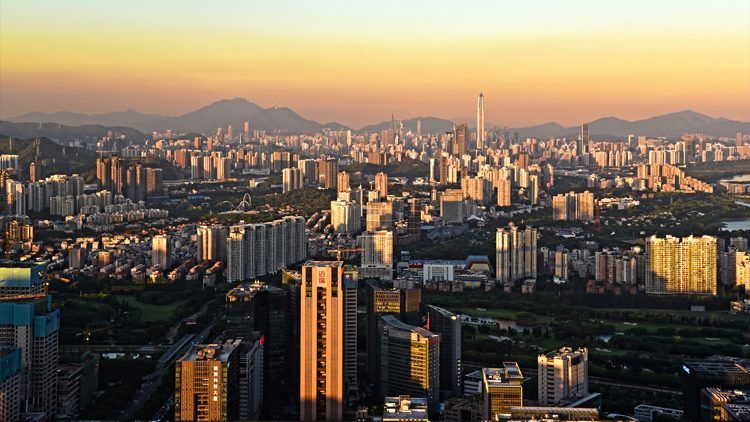
Skyline of Shenzhen, China / Photo credit: Simbaxu via Wikipedia
“Nanshan is the center of IT development in Shenzhen, so it was easy to recruit tech experts,” said the 25-year-old entrepreneur from Zhongshan, Guangdong province.
The salary for a computer programmer in Nanshan is about HK$10,000 (US$1,273) per month, 64.8 percent lower than the HK$28,448 (US$3,624) offered in Hong Kong, according to data from recruitment website JobsDB.
In a little over 20 years, Nanshan has evolved to become a thriving district with trendy cafes and restaurants, housing the country’s most innovative firms in glass-walled skyscrapers that were once empty land.
The area’s accessibility also has improved immensely after the opening of the high-speed railway – a major infrastructure in the development of the Greater Bay Area – that connects Hong Kong to 44 cities on the mainland.
The Greater Bay Area is Beijing’s blueprint to transform Hong Kong, Macau, and nine Guangdong cities – including Shenzhen – into an innovation and technology powerhouse, rivaling Silicon Valley and the Tokyo Bay Area.
Ng says that he would increase the frequency of his travel to his Shenzhen office from his home in Hong Kong from twice a month to twice a week, as the high-speed train saves him two hours on travel.
But surging demand for office space and improved connectivity has kept prices of luxury homes relatively high in Nanshan at 77,537 yuan (US$11,569) per sqm, according to online property platform Anjuke.
Andy Lee Yiu-chi, chief executive for southern China at property agency Centaline China, said housing prices could rise by about 5 percent in the coming two years, though excessive growth will lead to more regulations from the government.
According to the Outline Development Plan for the Guangdong-Hong Kong-Macau Greater Bay Area released on February 18, Shenzhen, which has technology as one of the four pillar industries, should “strive to become a capital of innovation and creativity with global influence.”
Property consultancy JLL said that because of new tech companies setting up in Shenzhen and expansion needs of existing companies, demand for prime office space in the city will double to about 1.4 million sqm on average every year from 2020 to 2022.





Stay updated on the go with our mobile app.
Get latest insights with smoother, more personalized experience through TIA mobile app.











📅 Upcoming Events
22 October 2026
Payoneer x CSPN Summit 2026