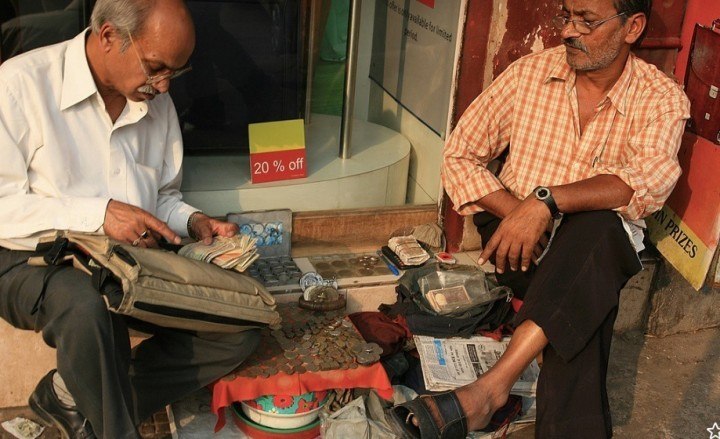
Roadside banking in Chandni Chowk, Delhi. Photo credit: carol mitchell.
There’s a battle brewing to capture offline payments in India.
Earlier this week, Indian bank HDFC partnered with ToneTag, a Bangalore-based “proximity identification” startup. ToneTag allows people to pay using sound waves or near-field communication (NFC). Each tone goes through multiple levels of encryption and communicates card details through “tokens”.
While other offline payment services like ApplePay also use NFC, they all require smartphones. The difference with ToneTag is that it only needs the two transactors to have phones that can detect sound (read: have a microphone.)
See: This Indian startup is everyman’s Apple pay
Before this, HDFC tied up with money transfer app Chillr. The partnership meant that an HDFC customer could use the app to transfer money directly from their bank account to any person within the country. HDFC charges US$0.05 plus service tax per transaction.
This trend of banks trying to change their image has been gaining momentum in India. Last year, the Reserve Bank of India (RBI) relaxed the regulations it had on physical transactions under US$29.
This allowed for technology that would take advantage of the proximity that came with real life customer-merchant payments. For example, ICICI released a card that enabled people to pay by waving their card within a 4-centimeter distance from a machine.
None of these took off, though, and the marginal increase in convenience that came with being able to wave a card didn’t seem to be attractive enough to adopt the technology.
Who will win the offline payments battle?

India still pays mostly with cash. Photo credit: Nick Ares.
Although the ToneTag-HDFC matchup is a big step, it still requires merchants to have a swipe machine. The hardware issue is where payment wallets – working off of the fact that nearly everyone has some sort of a mobile phone – come into play.
Earlier this week, Paytm made offline payments free, meaning that customers would only have to scan the appropriate QR code at the merchant’s store in order to deduct money from their wallet.
Payment wallets have the malleability and the singularity of focus to innovate fast, so it will be important for banks to pair up with startups in order to capture the new wave of cashless customers.





Stay updated on the go with our mobile app.
Get latest insights with smoother, more personalized experience through TIA mobile app.










📅 Upcoming Events
22 October 2026
Payoneer x CSPN Summit 2026