- Premium Content It takes our newsroom weeks - if not months - to investigate and produce stories for our premium content. You can’t find them anywhere else.
 Apoorva Dutt · · 6 min read
4 problems with China’s state-led high-tech development
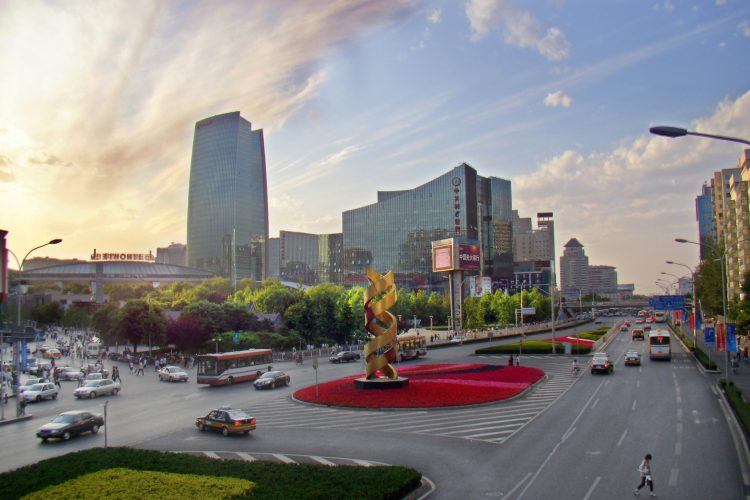
Zhongguancun (or Zhong Guan Cun) is a technology hub in Haidian District, Beijing, China. / Photo credit: Wikipedia
The following is an edited excerpt from Innovation in China: Challenging the Global Science and Technology System (China Today) 1st Edition by Richard P. Appelbaum, Cong Cao, Xueying Han, Rachel Parker, and Denis Simon. The excerpt was provided by China Today Publishing. You can buy a copy here.
In its burgeoning period, China’s high-tech development was mostly chaotic but bottom-up and spontaneous. Back in the early 1980s, seeing the high-tech proliferation in Silicon Valley and along Route 128 in Massachusetts in the US, some of the earliest returnees wanted to explore means of technology diffusion in China.
Universities and R&D institutes started to spin off enterprises with their research achievements, especially in information technology, in Beijing’s Zhongguancun, where there is a concentration of talented scientists and students. Such a bottom-up effort combined with the political leadership’s modernization drive leads to a reform of the S&T system that could better serve the nation’s economic development.
The first science park started to take shape in Zhongguancun, which, as noted previously, gradually became known as China’s “Silicon Valley.” Now, high-tech development seems to be more top-down – orderly but caring more about mature enterprises in Zhongguancun as well as in China’s other 167 high-tech parks, where it is easier to find a first-rate infrastructure than to nurture a first-rate high-tech startup, let alone genuine entrepreneurial spirit. China’s innovation and, indeed, its economic growth has been state-led.
Such a state-led model of technological development has its merits in concentrating and mobilizing resources to fulfill certain goals. For example, it did help China to develop its strategic weapons programs in the 1950s onward. So, time and again China has followed in the footsteps of its past success, and the MLP was formulated exactly with this model in mind.
However, there are some inevitable problems associated with China’s state-led innovation model.
- First, much of the government’s intervention in China is not about basic science and research on public goods but about innovation, mostly in the domain of enterprises. To put the Chinese case in perspective, debates have gone on in many countries for some time about the utility of national, state-led programs of innovation, in contrast to the belief that decentralized, market-responsive approaches are far more successful. Governments invest in R&D because of the “public good” nature and out of concerns about market failure. With its long-run horizon for returns and uncertainties, R&D, especially basic research, receives less attention and investment from enterprises, thus making intervention from the state necessary. The “entrepreneurial state” also tends to take risks by creating a highly networked R&D system for the national good over a medium- to long-term time horizon (Mazzucato, 2013). Indeed, there is a need to recognize a proper role for the state in promoting new knowledge and techniques, but determining what is “proper” remains contentious and varies from country to country.
- Second, the Chinese government is involved in picking winners, prioritizing industries, and betting on manufacturing stars. High-tech firms have to be certified by the government, which in turn grants preferable policies toward them. As a result, some of the so-called high-tech enterprises are just “high-tech” in name – rather, they are government’s pet priorities. Instead of using invisible hands to promote innovation, governmental efforts have been project-oriented and have supported and evaluated enterprises according to economic but not necessarily innovative indicators. Consequently, the majority of enterprises do not choose to be innovative for the sake of their own development, but rather to respond to the government’s policy incentives. Enterprises that receive funding as subsidies from government may not have the pressure to innovate, since innovation may not be their spontaneous and independent choice. Therefore, government funding often results in wasted money rather than significantly innovative outcomes, and vicious cycles of bubble and burst.
- Third, with local governments fiercely grabbing land for developing various “parks,” including high- and new-tech ones, it is not uncommon that these “parks” see concentrations of manufacturing products that are high-tech in name but low-end and low-tech in reality. As the end-users of such products are not necessarily located in China but in developed countries, any changes in the policies in terms of tax credits and subsidies elsewhere have influenced the production far away in China with widespread overcapacity just being one of the consequences. The development of the solar photovoltaic (PV) industry in China is one such example. Because of higher oil prices, there was worldwide expectation building around solar and wind energy, which led to what then-Premier Wen Jiabao referred to as the “blind expansion” at the 2012 annual session of the National People’s Congress. But in the aftermath of the global financial crisis, Chinese solar PV companies saw their stock value plunging – some even went bankrupt – as a result of the overcapacity and change of policies toward the industry elsewhere. The new concerns are whether robotics, big data, and cloud computing, among others, which the state has anchored in “Made in China 2025” and other policy initiatives, could become a new battlefield for the competition for resources and government support, although it is predicted that this time is different as there has also been much private investment.For instance, at present, there are already several hundred various kinds of “parks” focusing on new energy, LED, advanced manufacturing, and dozens of high-tech parks for big data and cloud computing, which again unfortunately are mainly engaged in assembly rather than manufacturing based on advanced and sophisticated innovation. The government’s policy guidance for innovation – indeed, bureaucratic intervention – may well prevail over enterprises’ awareness of the best practice in which to innovate.Given the state’s performance evaluation orientation, high-tech parks still mostly embrace FDI since it will generate GDP and employment far more rapidly than Chinese firms’ entrepreneurial efforts at indigenous innovation.
- Fourth, the state has yet to formulate coherent policy measures specifically geared toward the development of high-tech parks and enterprises within parks; it therefore lacks the power to consistently and effectively intervene in such efforts. For example, in the early stage of designing the development strategy for national high- and new-tech zones, some scholars proposed schemes from complete laissez-faire to complete government control, with selective support to big cities such as Beijing and Shanghai and others in between. They favored small-scale experiments in a few Chinese cities to first test the Silicon Valley model (framed, of course, as having “Chinese characteristics”). But before a decision had been made as to what scheme to introduce, high-tech parks had already been built throughout the country, making it virtually impossible to reverse the trend. Many of the national high-tech parks have been used as vehicles to attract FDI and projects on the state’s priority list in order to meet the need of the local economy rather than clustering truly innovative startups. Policies and approaches that have served other economies well have proved unsuitable for China – and, importantly, policies that served China well during its catch-up period may not necessarily do the same in its efforts to leapfrog to the forefront of innovation.Once policies are made, they tend to become embedded; policies that are no longer applicable are seldom officially scrapped, thus furthering confusion and uncertainty. It is probably from this perspective that Xu Guanhua, an avid champion of the state-led innovation when he was China’s minister of science and technology, lamented that the premise of the model is wrong and enterprises with the mentality of responding to government promotion policy are likely to be just mediocre (JRJ, 2012).Other S&T administrators have had similar strikingly different views toward China’s S&T and innovation policy, both when they were on the job and after their retirement. In sum, although innovation is now officially a top priority and a key driver of China’s next stage of economic development, at the same time the government’s top-down approach puts innovation into an institutionally uncertain environment, where innovators have to skillfully and tactically chart their development trajectory, mindful of any possible policy change all the time.
Such an environment also tends to favor state-owned enterprises (SOEs), mature enterprises, and foreign-invested enterprises, while private small and medium-sized enterprises (SMEs) and startups are facing challenges not only in attracting talent and capital, among others, but also in an unpredictable policy environment. The state actively channels public resources to embark on strategic development initiatives, while retaining controlling stakes in the enterprises that dominate strategic and resource sectors.
This has been at the expense of the largely market- and private-sector-driven development in the coastal provinces, resulting in a strong disincentive for SMEs to innovate. As a result, there is a weak environment in support of innovation at the enterprise level. The recent development of “SOEs advancing and non-SOEs retreating” is just one example of the dilemma confronting China’s high-tech development.
Editing by Charmaine de Lazo
(And yes, we’re serious about ethics and transparency. More information here.)
Stay ahead in Asia’s tech landscape
This is premium content. Subscribe to read the full story.
China’s innovation and, indeed, its economic growth has been state-led.
We know this is not ideal. ⌛ Sign up in 20 seconds. Cancel anytime.
Our subscriber community includes professionals from these companies:





Stay updated on the go with our mobile app.
Get latest insights with smoother, more personalized experience through TIA mobile app.













📅 Upcoming Events
22 October 2026
Payoneer x CSPN Summit 2026