This is a part of our TechCrunch Disrupt 2011 event coverage.
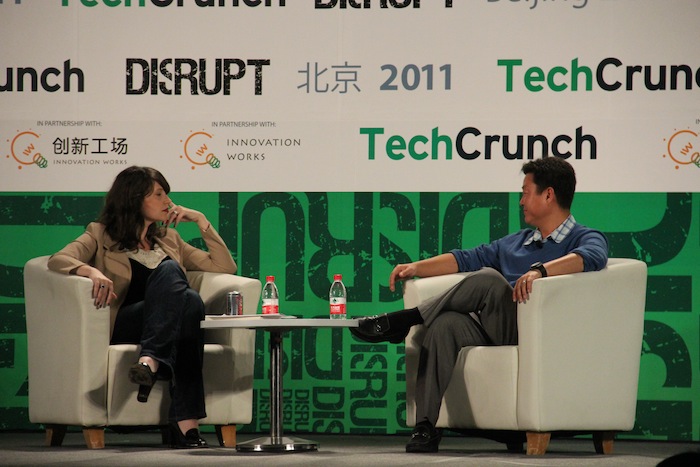
This afternoon, Brian Lee of ShoeDazzle took the stage for a “fireside chat” — sans the fire — with Sarah Lacy of Techcrunch to talk about ShoeDazzle, celebrities, and working in and with China.
On Celebrities
Lee has launched multiple companies in cooperation with celebrities. His partner in ShoeDazzle, the latest, is Kim Kardashian. She may not be the sort of co-founder you’d expect to see in a tech start-up, but Lee said, “I’m a big believer in the use of celebrities to start companies.”
Sarah Lacy pointed out that many companies have tried — and failed — using this approach, but Lee emphasized that “you have to have a true partnership with the celebrity” and that “it has got to match perfectly. When you start attaching Ashton Kutcher to a travel site […] it’s not that authentic.” On the contrary, if it’s a good match, the celebrity can bring a lot of traction and interest to the company, Lee argued.
As far as Kardashian, he says she’s not just a figurehead. “She really is a cofounder,” he said, and she tweets about her favorite styles every week.
On China
“Our business would not have been possible without China,” Lee said. In the “fast fashion” industry, the speed, volume, and turnaround time that China’s relatively advanced factories can achieve — at low price points — is essential. ShoeDazzle’s shoes are all designed in the US but they’re manufactured in China.
Knowing China can be a competitive advantage, Lee said, especially for them as they’ve been in China for longer and have relationships with local factories. Lacy asked if a Chinese ShoeDazzle copycat could work, and Lee replied “Absolutely!” He stressed that he expects to see a Chinese copycat, and that they could do even better than ShoeDazzle because they wouldn’t have to worry about customs duties and tariffs eating into their profit margins.
As far as the cultural differences are concerned, Lee doesn’t see that as a problem. “Business is business,” he said, “if you have a great working relationship then it will work out in the end […] I haven’t seen really too much cultural difference in what we’re trying to accomplish and what they [Chinese companies] are trying to accomplish.”
Lee also noted that Silicon Valley may not be the center for innovation it once was. Facebook and Twitter came out a while ago, and Lee said, “I haven’t actually seen anything really cool come out of Silicon Valley in quite a while.”





Stay updated on the go with our mobile app.
Get latest insights with smoother, more personalized experience through TIA mobile app.








📅 Upcoming Events
22 October 2026
Payoneer x CSPN Summit 2026