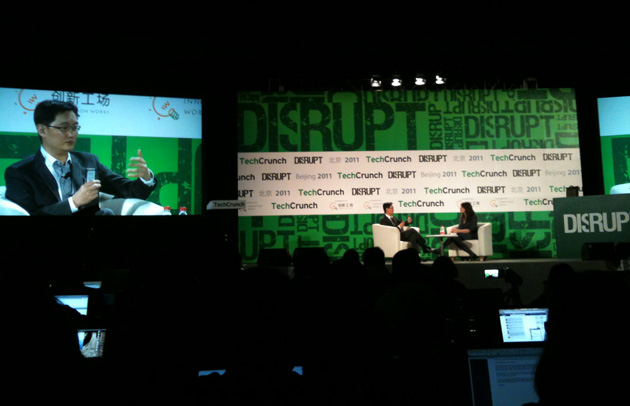
This is a part of our TechCrunch Disrupt 2011 event coverage.
TechCrunch Disrupt kicked off with Tencent founder Pony Ma on stage with Sarah Lacy. One point that interested me is about the reputation Tencent has built in China. Lacy says that in China, entrepreneurship means “life, death, or Tencent,” as many Chinese start-ups hope to get acquired by Tencent.
And the common death knell in China could come from any one of the big boys — Tencent, Baidu — who have the ability to introduce (copy) products so quickly that it forces entrepreneurs out of the business. Lee Kai-Fu made the same point last week at Qinghua University.
There are no shortage of complaints that Tencent isn’t an “open” company but Ma said his company has made an effort to change that. Ma says that the revolution of the Apple app store has given him the idea of being a more “open” company.
Internally, that was a struggle as Tencent’s developers are ambitiously trying to build everything by themselves. But slowly, Ma explained that they find it impossible to do everything, and the concept of embracing third party developers started to take shape.
Lacy also talked about Groupon’s fading power in China. Ma didn’t share much as Groupon, because after all, Tencent is their partner in China. However, Ma did reveal that there was a lot of struggling from the start as both companies aren’t synchronized technically or culturally in China. The Gaopeng venture also started too soon before problems were ironed out.
Ma then shared his entrepreneurship experience which goes all the way back to the 1990s. In 1998, after about seven years of working experience, Ma saw an opportunity by integrating internet and messaging into a service. He says that his initial idea was to build software and sell it. He didn’t really envision a company the the Tencent of today.
He noted that email solutions can be sold to a couple of telcos, but for instant messaging (IM) there can only be one platform that can be sold. So instead of selling the solution, Ma and his team decided to build and maintain their own IM solution. That of course is QQ, the IM that most Chinese use today.
Ma also says that entrepreneurship back then was way tougher. It was harder to raise/make money on the Internet. And surprisingly, he said he was writing a lot of proposals rather than coding and building the actual product.
He admitted that China is indeed a harsh environment. Tencent also faces problems with developers running away with ideas and getting investment to develop it in the early stage. The key to solve the problem, from Ma’s perspective, is not to be greedy and share the pie with the people you trust to ensure more growth and profitability. China, as everyone knows, is a market which that copies fast, where an idea can be replicated in a matter of hours after launch.
Taking Apple and Steve Jobs as a source of inspiration, Ma says that entrepreneurs in China should take pride in the product they build. And Ma humbly says that Tencent is also working hard to learn from Steve Jobs.





Stay updated on the go with our mobile app.
Get latest insights with smoother, more personalized experience through TIA mobile app.









📅 Upcoming Events
22 October 2026
Payoneer x CSPN Summit 2026