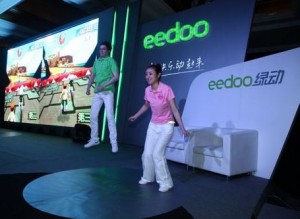
 I’ve been keeping a weather eye on Lenovo’s
 Kinect-clone game console “home entertainment center” the iSec since it was first announced (back then it was called the eBox). Console gaming isn’t particularly big in China, in large part because the sale of video game consoles is illegal here. There is, of course, a thriving gray market for them anyway, but that’s not something the system makers make much profit from, and game developers make literally nothing since the games for gray-market consoles are usually pirated.
So is the iSec, as a game console, even legal to sell in China? Lenovo says yes, because — they’re seriously arguing this — it isn’t a game console, it’s a home entertainment device. According to this article, their argument seems to be that gaming is just one of the console’s functions. It also can play movies and music. Of course, so can the banned Xbox 360 and Playstation 3 consoles, and even the PS2 and Xbox original — remember, the one with the giant controllers? — could play CDs and DVDs. But Lenovo is a Chinese company, and there’s some indication that they may be allowed to take their product to market in China even though it’s very clearly a console.
This raises some very interesting questions about protectionism, and I suggest you read this very thorough article by Stan Abrams over at China Hearsay about it. But I want to ask a different question entirely.
There are a few possible scenarios here:
- MIIT approves the iSec as an “entertainment device”, but other consoles remain illegal.
- MIIT approves the iSec, and other consoles also enter the legal Chinese market as “entertainment devices”.
- MIIT gets cold feet and halts the launch of the iSec.
I don’t think that any of these outcomes are particularly great for the iSec.
If outcome #1 occurs, and the iSec is the only legal device on the market, why on earth would anyone in China buy it? I expect Lenovo will have a hard time offering titles that are on par with the AAA titles on offer from American and Japanese developers, and remember, Chinese games get Xbox 360 titles (for example) basically for free on pirated discs. Why pay $40 for one decent iSec game when you can get five great XBox 360 games for $2? Why even buy an iSec?
(Pricing for iSec games isn’t clear yet, and the console will come bundled with at least one game, but there’s simply no way that developers could afford to offer games at the prices for which pirated games are offered, so regardless of whether the pricing is really $40/game or not, you can be sure iSec games are going to cost more than pirated Xbox discs).
And who would buy the iSec outside China’s borders, where Lenovo doesn’t seem to even be marketing it? Perhaps they’ve got something up their sleeve here, but right now it looks like their only real selling points are that their console is Chinese and that it is legal in China. These are not factors that American, European, or Japanese gamers are likely to care about.
If outcome #2 occurs, then the iSec faces extremely stiff competition from rivals who can immediately bring a huge library of games and international development teams to bear on the market. Since most Chinese gamers prefer PC anyway, it doesn’t seem likely the iSec could carve out a big enough slice of what market there is to make this entire endeavor worth it. Of course, being a Chinese system, the iSec would probably have the advantage of having more local games — Three Kingdoms RPGs and whatnot — but there are so many of these available on the PC already that I can’t see many people buying a console specially for that purpose.
Moreover, even with consoles legalized, there’s no real reason to believe pirated discs and systems wouldn’t continue to be widely available. The iSec itself may well be susceptible to piracy if China’s lax enforcement strategy isn’t changed dramatically, and unlike Microsoft or Sony, their console can’t be floated by strong sales numbers abroad.
Of course, the iSec’s ability to compete at all depends largely on whether or not the tech actually works. Microsoft’s Kinect is a bit fiddly, and if at times the experience is sublime, most games for the system fall flat on their face. I haven’t gotten a chance to try the iSec firsthand, but some of their promotional videos make it look like there’s a noticeable delay between the player’s movements and the onscreen avatar’s reactions. This, for example, is pretty unconvincing:
“DanceWall”, the game that will come bundled with the system as one of iSec’s flagship titles, appears to be a long, long, long way behind games like Dance Central on the Kinect.





Stay updated on the go with our mobile app.
Get latest insights with smoother, more personalized experience through TIA mobile app.










📅 Upcoming Events
22 October 2026
Payoneer x CSPN Summit 2026