 Steven Millward · · 4 min read
Baidu Pushes ‘Box Computing’ for Smarter, Interactive Web Searches [REVIEW]
 Baidu is pushing to make its search results box smarter, more relevant, and more alive – that’s why numerous popular searches in the Baidu search bar can bring up an interactive frame that could, among other things, play music (pictured above) or games, post to a microblog, let you check currency conversions, or download a popular app with just one click.
Google and Bing haven’t ventured so far as Baidu into smart or semantic content results from the search box. Sure, Google’s updated mobile page is impressive – using your geolocation to provide locally relevant results and/or nearby listings – but it’s not quite the approach that Baidu describes as “box computing” – ie: to understand semantically what the user is really looking for, and make life easier for them in finding it, all in one page.
So, let’s have a look at what fun and useful things appear at the top of some popular Chinese web searches, and get some facts and stats from Kaiser Kuo, Baidu’s top PR man, as to what Baidu is shooting for…
Omnipotent search box

Box computing at Baidu isn’t new, and in fact first rolled out two years ago, but now Baidu has expanded it to an open API wherein any developer can make its own application that fires up when certain semantic web searches are entered. So now a lot of users, without realizing it, are getting these interactive search results – coming from plug-ins built by hundreds of Chinese developers – that allow a lot of web searches to start and end on the same page: Baidu’s. Their PR man Kaiser Kuo says, “60% of queries on Baidu include results from the box platform”.
For example, looking at the image, above, you see the search results for a popular Chinese TV serial. The frame that’s presented is actually a Baidu-built plug-in, that lays out episodes that can be played on Baidu’s video-on-demand Qiyi.com, with just one extra click, right from the search results page. Or, searching for a book by the popular writer Han Han brings up a frame where you can read reviews and then purchase the item from Wenku, the company’s own online library/bookstore.
I put it to Kaiser Kuo that it might be seen as unfair when a Baidu-related product fills a users’ entire screen after their search result; he countered, “The search results are still done algorithmically, so the most relevant still comes up first. The box platform is an open platform, to showcase your data, and it has a large ecosystem of developers.”
Indeed, a search for Douban.fm, a popular music-steaming site, brings up a music player at the top of the search results (pictured, top), allowing you to jump into Douban’s music live-stream with just one click. Also a search for the very vague term “online music” results in an online player that belongs to the relatively small music site YiShouGe.com.
For China’s developers, the process is similar to most app stores: create your frame that ties into Baidu’s box platform, and then submit it to Baidu. Plus, says Kuo, “Baidu has its own developer fund,” to encourage smaller devs to get on board as well.
Smarter mobile answers
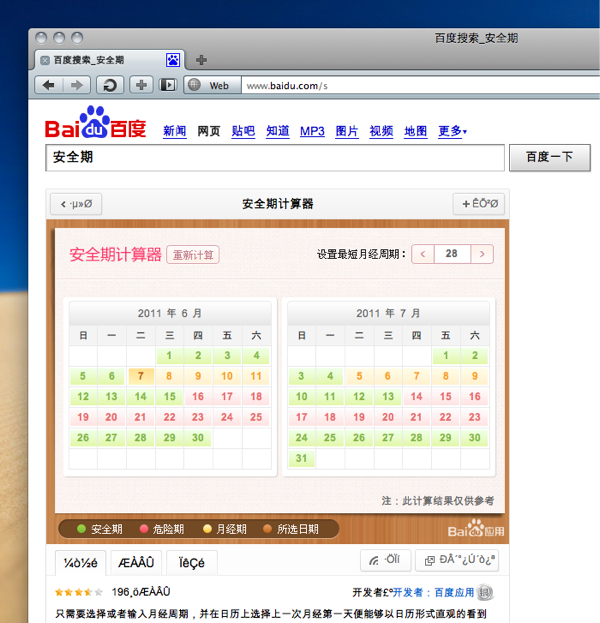
The search results can yield some gems, too. For example, a search on Baidu for “safe week” – a reference to the “rhythm method” of avoiding getting pregnant – brings up a choice of box-based widgets that allow a user to figure out if today is a good day for getting on the down low (and apparently it is). It all happens within the frame on the Baidu results page, and feels and looks like a polished web app.
Where is Baidu heading with its smart results? “It dovetails with mobile,” explains Kaiser Kuo, “because on mobile it’s even more important to get relevant results, on a limited sized screen. Also, we see a future of quick to power-on mobile devices, where these semantic terms could be spoken, or of course typed, and it’ll understand semantically what you ask.”





Stay updated on the go with our mobile app.
Get latest insights with smoother, more personalized experience through TIA mobile app.








📅 Upcoming Events
22 October 2026
Payoneer x CSPN Summit 2026