- Insights This article was written by a TIA community member. Insights pieces undergo the same rigorous editorial process that newsroom-produced articles have.
 Alvin Cahyadi · · 4 min read
Understanding the 3 lending models of Indonesian fintech startups

Photo credit: Mohamad Trilaksono
This article is part of Tech in Asia’s partnership with Convergence Ventures, where we publish articles that feature the firm’s valuable insights. Read more from Convergence Ventures here.
A few months ago, our managing partner, Adrian Li, wrote about how fintech lending can boost Indonesia’s lackluster growth. After reading this, my team and I thought it might be useful to illustrate the various ways Indonesian fintech players approach the space.
Let’s first briefly recall the opportunity that fintech lending presents. Indonesia’s finance authority (OJK) estimated a total of US$74 billion in unmet financing needs in 2016. This is due to a lack of credit data of loan applicants, a critical gap that is largely being served by unlicensed offline lenders (i.e. loan sharks).
This sizeable market opportunity for alternative lending has generated a myriad of fintech companies in the past several years. Indonesia’s Fintech Association’s latest data indicates that there are 134 fully registered fintech companies as of April 2018, a significant increase from only 55 in 2016.
Lending models
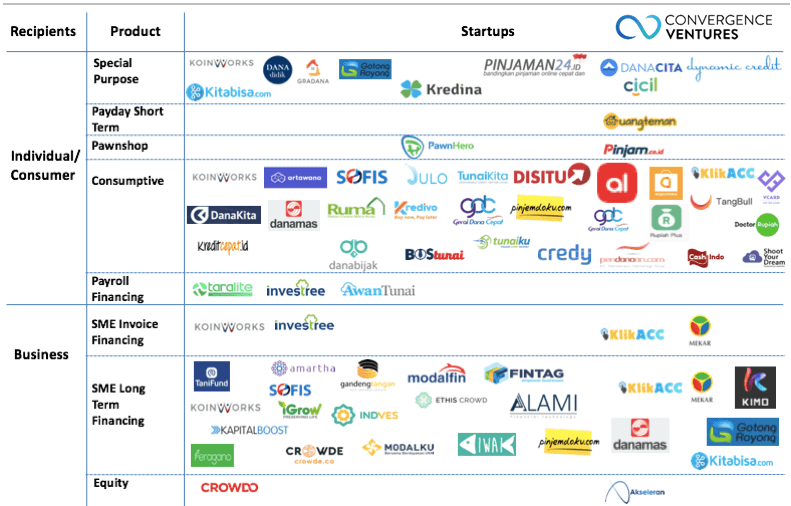
The existing fintech lending players can be categorized based on the recipient of loans, purpose of loans, and source of lending capital. Based on our study, here’s how fintech players in Indonesia are categorized according to the financial product/s they offer.
In terms of sources of lending capital, some startups combine various models. Here are some of the models we can identify today.
1. Crowd-lending or P2P Model
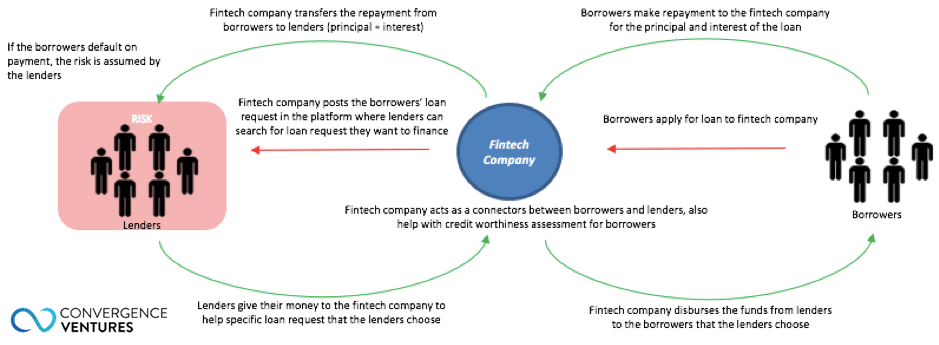
In P2P lending, a financial technology startup acts as a connector between borrowers and retail lenders, essentially becoming a marketplace for lending services. On top of being a connector, the company also runs a risk management platform to assess creditworthiness and assign interest rates.
The platform usually pools money from multiple retail lenders to fully satisfy the funding requirements. Since it only mediates the borrowing process, lenders carry the default risk. They see the risk level for each loan request and make a decision based on that.





Stay updated on the go with our mobile app.
Get latest insights with smoother, more personalized experience through TIA mobile app.