Nadine Freischlad · · 9 min read
How to scale your business across Indonesia’s remote islands

Deni Sugiarto steers the minivan down a deserted road in western Sumbawa toward the regency’s capital, Sumbawa Besar. Equipment rattles around in the trunk as we fly past nondescript towns, separated by stretches of arid hills, fields of corn, onions, and rice, and the occasional herd of grazing goats and wild ponies.
Sumbawa is one in a long chain of roughly 17,000 islands that make up the Indonesian archipelago. Even by Indonesian standards, it’s off the beaten track, but Deni has come to know this region well.

The location of Lombok and Sumbawa in the Indonesian archipelago. Image credit: Wikipedia.
A few days ago, he made the same journey, from Poto Tano, the harbor, to the capital and the villages beyond, on a motorbike. Based in neighboring Lombok, he’s been crossing the narrow sea between both islands regularly in the past months. Sometimes he’s alone, or, like this time, with another colleague and a reporter.
Kopernik, the social enterprise Deni works for, is in expansion mode. It started building its program in Lombok 3 years ago. Now Deni’s task is to push into new territory.
The 46 percent
Kopernik is something of a hardware startup for basic appliances.
It has a range of durable, easy-to-use tools in its inventory: solar lamps, water filters, biomass stoves. It sources them from different suppliers and distributes them in remote villages of Indonesia through a network of resellers who earn a commission for each item they sell.
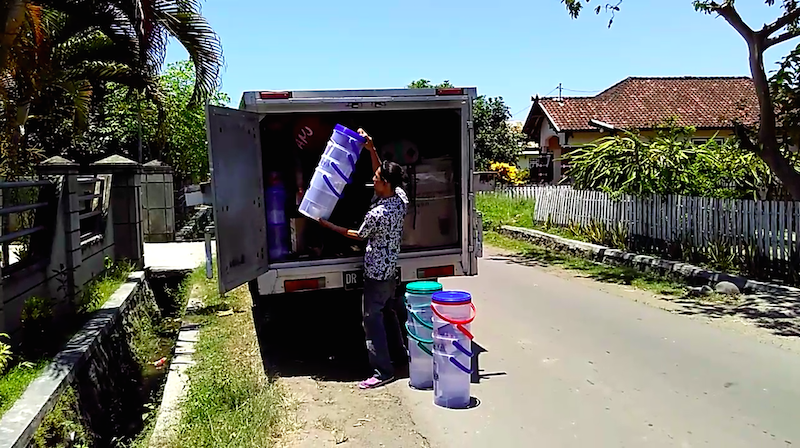
Deni and his colleague unload a number of water filter units from the truck. In Sumbawa, this is Kopernik’s best-selling item. Photo credit: Tech in Asia.
Let’s say you live in Sumbawa Besar and think you can sell 10 water filters to people in the neighborhood in the coming weeks. Deni will deliver the product to you, and on his next visit, he’ll collect part of the money while you get to keep the rest.
Kopernik has become expert at working in the far-flung, sparsely populated parts of Indonesia.
The idea is to offer entrepreneurial islanders an opportunity to make extra income.
Lesson 1: Study the intricacies of your new market
Lesson 2: Personal networks work best
Lesson 3: Let go of assumptions and (some) ideals
Lesson 4: Repetition and rituals
Lesson 5: Payment in installments is a must
Lesson 6: TV shapes expectations
Lesson 7: Gadgets don’t matter that much (yet)





Stay updated on the go with our mobile app.
Get latest insights with smoother, more personalized experience through TIA mobile app.