- Insights This article was written by a TIA community member. Insights pieces undergo the same rigorous editorial process that newsroom-produced articles have.
 Jeng Yang Chia · · 5 min read
The rise of embedded finance companies
Embedded finance refers to non-financial companies that significantly increase or even transform their value propositions through embedding associated financial products and services onto their platforms.
Essentially, these companies are embracing the trend of non-fintech companies venturing into financial services, and the first-, second-, and third- order implications of such a macro trend.
With this article, we at Saison Capital want to answer three main questions:
- How and why does this trend play out in the tech and financial ecosystem?
- What and who has been investing in embedded finance companies?
- What are the different buckets of opportunity that exist in the market today?
We believe that startups of almost every vertical can and may move into financial services. It is not just about being better and more tech-driven or taking more risks. It is also about finding opportunities to combine data, process, and capital in ways that accomplish the same “jobs to be done.”
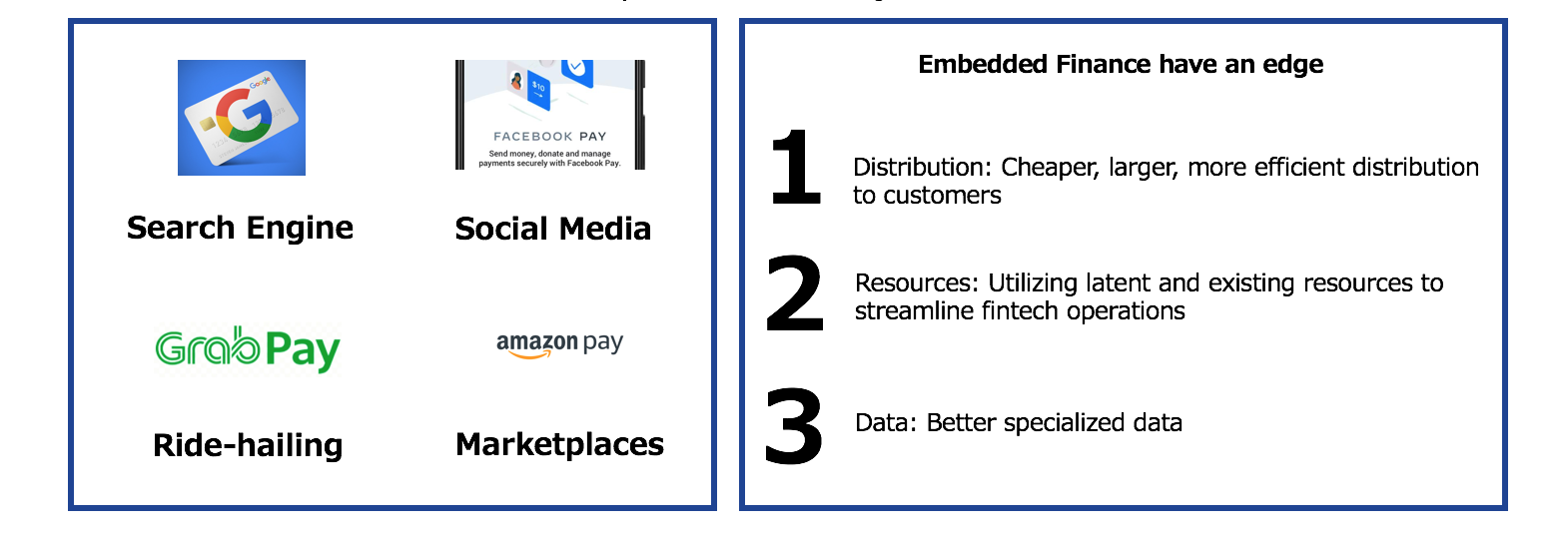
Embedded finance companies have an edge to distribute financial services because of distribution, data, and resources, and there are already examples of these across multiple verticals – from search engines (Google with Google Bank), ride-hailing (Grab with GrabPay), to marketplaces (Amazon with Amazon Pay).
Evolution and trends
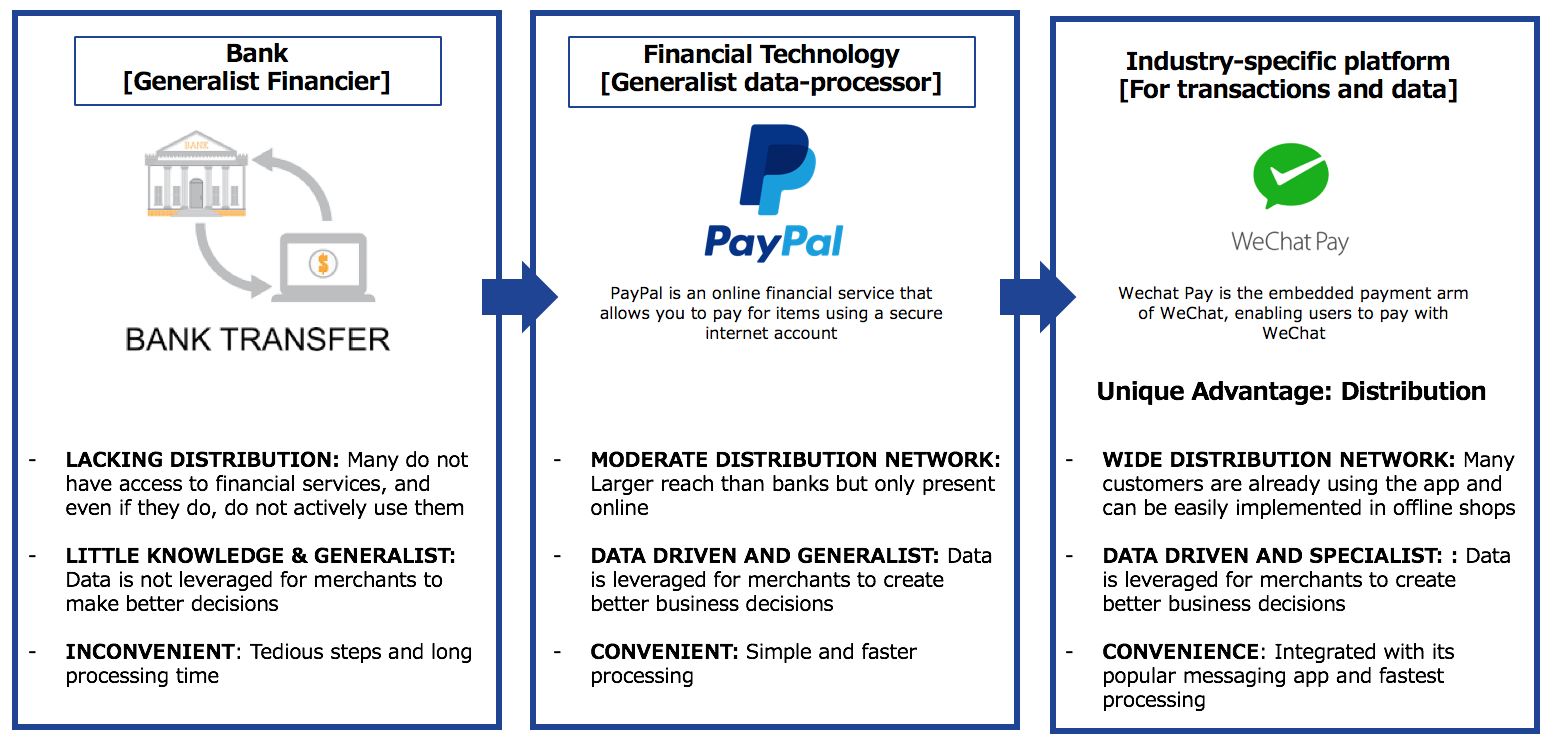
At a high level, we see a three-step evolution in financial services.
First, financial services originated from banks and other such generalist financial institutions. For example, bank transfers were the only means of transferring money from one entity to another.
Second, a slew of first-wave fintech companies emerged. These firms were focused on using technology to enable financial services outside of/on top of a traditional banking process. For example, PayPal allowed people to make payments online.
Third, financial services were democratized. This resulted in specific financial transactions (potentially segmented by customer or industry type) that are better served or distributed by specific non-fintech platforms. For example, WeChat Pay can now be used for peer-to-peer transfers.
We see this trend happening across multiple core functions of fintech. If we break down the role of capital and value, we see three core functions:
Vast opportunities in embedded finance





Stay updated on the go with our mobile app.
Get latest insights with smoother, more personalized experience through TIA mobile app.