 Nathaniel Fetalvero · · 4 min read
How ecommerce in the Philippines can become a $10b economy

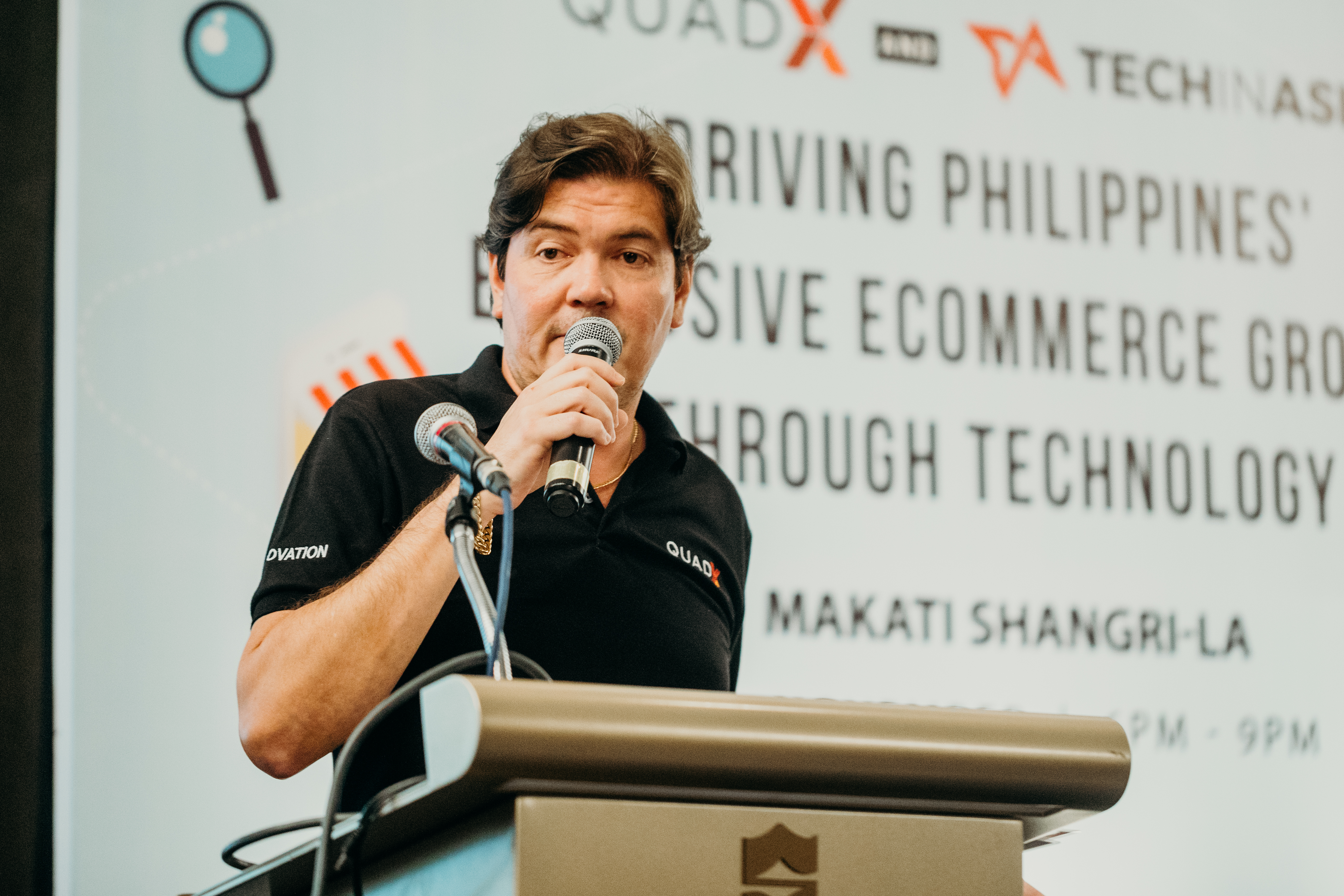
QuadX founder and CEO Dino Araneta / Photo credit: Tech in Asia
The Philippine ecommerce industry is poised for exponential growth, with its share of the Southeast Asian market expected to be worth US$10 billion by 2025, according to the latest report by Google and Temasek. However, there’s still a lot of work to do in order to achieve that.
“Ecommerce now is only 1.5 percent of the Philippines’ retail market, so there’s lots of room to grow,” said Dino Araneta, founder and CEO of digital logistics company QuadX at an ecommerce industry meetup in the country last month. “We can get that number to 5 percent in just three years, but we have to work on the experience of buyers and sellers in making orders online.”
What’s in store for the local industry as e-tailers push for a larger market share? Here are insights from some of the country’s ecommerce players.
Heading towards digital payment
In the Philippines, cash is still king. Cash-on-delivery is very popular in the country, with 80 percent of online merchants offering this payment option. This is largely because nearly 98 percent of Filipinos still don’t have credit cards.
Yet instead of just capitalizing on consumers’ inability to pay with anything other than cash, e-tailers should look into e-payments because this is the way to go, according to Martin Cu, country head of last-mile logistics company Ninja Van.
The Philippines could potentially ‘skip the phase of credit cards’ and go directly to using e-payment solutions.
“The reality is, it’s a better experience for everybody,” said Cu, who was part of a panel discussion at the QuadX event. He added, however, that getting Filipinos to use e-payment services requires giving them “a compelling reason to keep their money in [e-wallets].”
Kacper Marcinkowski, CEO of e-payment company TendoPay, shares this view, saying that the Philippines could potentially “skip the phase of credit cards” and go directly to using e-payment solutions, which have been rapidly and widely adopted in China.
“Everyone is always saying that [the] Philippines is perfect for it because it has a tech-savvy population,” Marcinkowski tells Tech in Asia. “Ecommerce can be the factor that drives the adoption of digital payments.”
Physical stores for online businesses
With hopes for online retailers to grab a larger slice of the Philippines’ retail pie in the coming years, some might say that physical shops will become a thing of the past. But Joseph Chan, ecommerce director of footwear specialist CMG Retail, thinks otherwise.
“I’m sure a lot of the ecommerce entrepreneurs here get a lot of inquiries from customers asking if they have a store,” said Chan during his keynote session at the event. “People want to touch an item in person, especially for shoes, where there’s a lot of risk with picking the wrong size.”

Photo credit: 123RF
He cites trust as another factor that will keep brick-and-mortar outlets alive. A lot of Filipino consumers still opt to visit physical stores because they’re worried that “an online seller won’t deliver their items.”
However, Araneta also cautioned ecommerce businesses against jumping on the bandwagon of “putting up a branch in a mall” before they’re ready.
“We have some clients who had 15 locations in 15 malls, but they had to bring it down to just three,” the QuadX CEO said. “It’s different setting up physical locations; you don’t need to have as much capital to set up online.”
Integrating emerging technology
Traditional businesses moving online is but the first chapter in the story of the Philippines’ ecommerce industry. As the nation’s internet literacy and access to digital services grow, the amount of requests and orders that online businesses need to handle will increase as well.
Micro, small, and medium-sized enterprises (MSMEs) that primarily use existing platforms such as Facebook to sell their products will be affected the most, as they may not have enough resources to put up a dedicated customer service department.
Tech in Asia spoke to industry insiders at the QuadX event to find out how technology can supplement the needs of ecommerce players.
“As more people start to go online, businesses will need a better way to interact with their customers,” says Andres Yepes, CEO of online marketplace CheapDeals.ph. “Using chatbots on social media will help a lot in that aspect.”
Ash Mandhyan, who heads client solutions for Facebook’s operations in the Philippines, agrees.
“Chatbots can bring forward everything you have within a website or an app without requiring Filipinos to have to download one more app,” he explains. “It provides a direct-to-consumer experience without leaving Facebook.”
Mandhyan also points out that augmented reality may soon see an uptick in adoption among online businesses.
“Imagine the filters on Messenger or Instagram, but instead of a funny face, you can select through a catalog of what pair of glasses work for you,” he says. “That’s what you can expect and I don’t think that’s too far away.”
On top of improving the operational efficiency and capabilities of existing MSMEs, QuadX’s chief operating officer Mia Bulatao says the use of emerging technology in ecommerce will enable aspiring entrepreneurs to enter the scene more easily.
“It’s becoming easier to get into – or at least try – ecommerce nowadays,” she contends. “The friction points of setting up a website, getting accredited by a bank, and other things are almost non-existent.”
As the Philippines’ first customer-centric digital logistics company, QuadX is dedicated to helping Filipino entrepreneurs by providing simple and seamless solutions.
Visit QuadX’s website to learn more about integrating digital logistics and payment processes into ecommerce business.
This article is part of the coverage of QuadX’s event, where established players in the Philippines’ ecommerce scene discussed how to drive the industry’s growth in the country on November 22, 2018 at the Makati Shangri-la Hotel in Manila.
Stay updated on the go with our mobile app.
Get latest insights with smoother, more personalized experience through TIA mobile app.
Recommended reads
 Fave names ex-Touch ‘n Go exec as chief product officer
 Indonesia’s iSeller bags series A round from Openspace Ventures, Mandiri Capital
 The many ways fraudsters abuse online retail platforms
 Gojek launches new POS device GoBiz Plus for MSMEs in Indonesia
 Chinese regulator proposes anti-monopoly rules against internet giants
 With regulations sharply rising, Ant Group’s Asia investees are more important than ever
 Decoding the rising retail opportunities and pitfalls for ecommerce businesses
 Funding Societies swipes right on payments in SEA
 Akulaku partners with Alipay+ for BNPL service
 Will cash-burning Shopee bring its parent firm Sea to the next level?





Editing by Charmaine de Lazo, Eileen C. Ang, and Judith Balea
(And yes, we’re serious about ethics and transparency. More information here.)





