 Jonathan Chew · · 6 min read
Uncover the changemakers imparting AI skills where it counts most

AI upskilling has become a buzzword, but what does it take to truly make training programs more accessible to the people who need it most?
That’s the challenge that AVPN, one of the largest networks of social investors in Asia, is tackling with the AI Opportunity Fund: Asia Pacific.
The US$15 million three-year AI training program was launched with the support of Google.org and the Asian Development Bank. Along with a US$10 million expansion for the fund earlier this year, it aims to support the training of 720,000 workers across Asia Pacific and 100,000 MSMEs in Southeast Asia.
Photo credit: Shutterstock
It works through 48 local training providers and other strategic partners across Asia Pacific to build community-led, culturally relevant AI training programs targeted at communities with unmet needs.
Tech in Asia sat down with two of its partners – non-profit organization and selected local training provider Remote Skills Academy (RSA), as well as Indonesian national collaborative body Korika, one of the Fund’s strategic partners – to learn more about how their collaboration with AVPN is playing out.
Who trains the trainers?
When it comes to AI upskilling, each organization has their own approach. RSA works directly on the ground, reaching out to end-users and local communities.
Meanwhile, Korika focuses more on building up training providers like RSA and establishing an AI training curriculum. Korika was established in August 2021 and is part of Indonesia’s National Artificial Intelligence Strategy.

Photo credit: Shutterstock
“Our key mission is to accelerate AI innovation by building talent pipelines and ensuring that AI development is inclusive, contextually relevant, and aligned with global ethical standards,” says Arie Wahyu Wijayanto, director of AI talent development and training at Korika.
It recently ran a “train-the-trainer” program in collaboration with the AI Opportunity Fund: Asia Pacific. This involved creating teaching guides and assessment tools for local training providers to enhance how they teach AI to end-users. These training providers can either be non-profits – similar to RSA – or for-profit organizations. The important part is that they have access to specific communities and can offer classes and workshops on the ground.
Training AI educators like this helps Korika and AVPN scale and localize training resources so that they can reach communities that might not have easy access to AI upskilling opportunities.
Wijayanto notes that the curriculum for the program is developed in line with global standards, such as those set by Google.org and the UNESCO AI Competency Framework for Teachers. Korika also developed a standard to assess whether trainers who undertake the program are qualified.
“Anybody can claim that they know AI, but we have to measure whether they’re really competent or not,” he points out.
Get a further look at AVPN’s AI upskilling efforts in the region
The curriculum also supports the needs of local AI educators.
For instance, Korika maintains a repository of AI use cases in Indonesia so that educators can better understand the range of applications in local, relevant contexts. Some examples include using AI to forecast the weather for farmers or detect floods, to name a few.
Unpacking the AI classroom
RSA was founded in April 2020 at the height of the pandemic. At the time, its goal was to help professionals in mostly manual jobs pick up remote, online skills like digital marketing or using virtual assistants for social media management. The non-profit has since expanded to include AI upskilling lessons.
Now, it conducts training workshops for small-business owners, university students, stay-at-home parents, and people who have left the workforce but are looking for a side income.
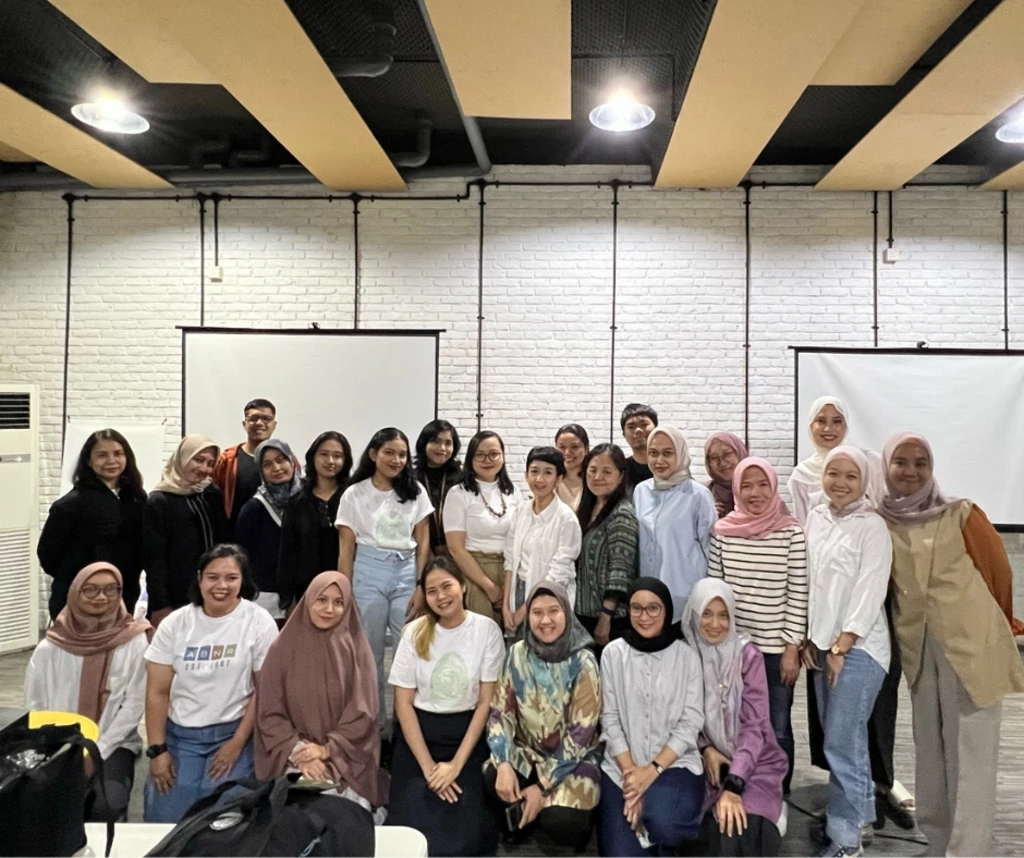
An offline bootcamp held by RSA in Jakarta / Photo credit: RSA
For these population segments, AI upskilling can be a hurdle for several reasons.
“In general, many people don’t know about the use cases for their specific situations and how to use AI tools to help them,” says Nafinia Putra, chief of programs at RSA
For instance, users might ask Gemini simple questions like “who is the Indonesian Minister of Health?” They don’t know that, they could use it for more difficult tasks, such as analyzing the weather forecast to create an action plan for their farm for the whole week, she says.
There’s also a language barrier at play. According to Wijayanto, a lot of existing AI training content is in English and have Western contexts which may not be relevant to, or well-understood by, Indonesian learners.
“There are hundreds of local languages in Indonesia – for many people, even Bahasa Indonesia might only be a second language,” Wijayanto points out, adding that AI training content and the AI tools themselves may not be equipped to handle these local languages.
He also highlights how contextual behavior in AI chatbots based on Western culture, for example, can differ greatly from local contexts. “Take customer service: Indonesian representatives may not be as direct as their Western counterparts,” he says.
Ultimately, getting AI upskilling right isn’t just about imparting knowledge but ensuring that information is relevant to the communities as well.
DIVE INTO AVPN’S AI UPSKILLING EFFORTS
Untapped potential
With all that said, successfully upskilling with AI has huge upsides.
For instance, small-business owners can learn to code an AI assistant to help balance accounts or manage inventory, while stay-at-home parents can leverage AI for remote jobs like social media management.
For stay-at-home parents, “many of them see that if they can work from home while caring for kids and get an income, it’s incredibly helpful for the whole family,” says Putra.
She notes that depending on the demographic, RSA can usually customize the workshops to fit people’s learning curves. For instance, university students are already generally digitally savvy – to make it more convenient, RSA would mostly hold its workshops for them online.
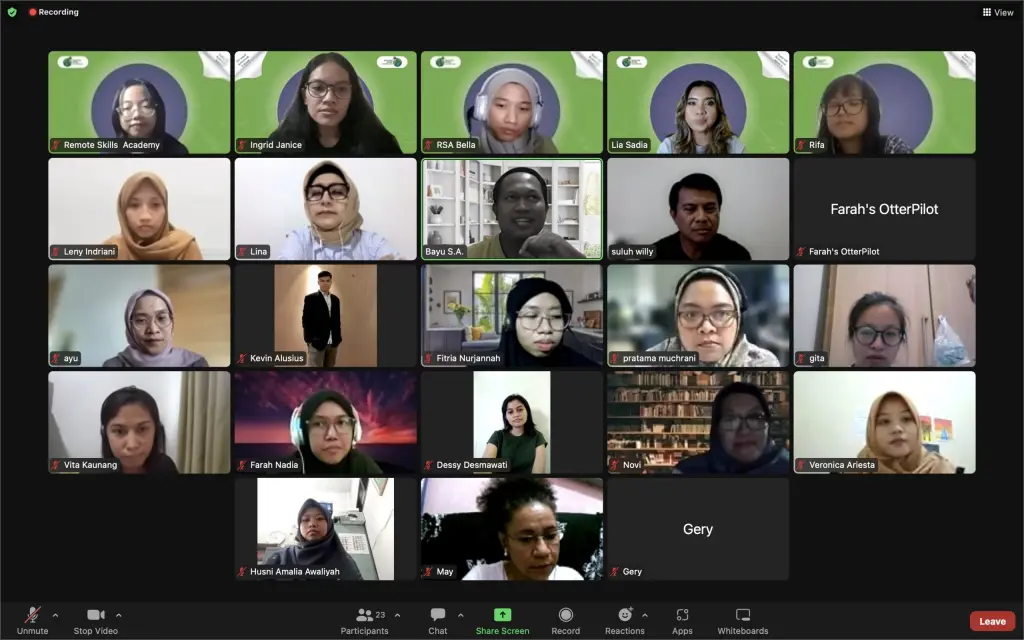
An online workshop on using AI for content and personal branding, organized by RSA / Photo credit: RSA
Small-business owners may not have as much baseline technical skills. So RSA holds classes for them offline to enable additional, in-person mentoring. The organization also provides training exercises for them, such as getting learners to come up with their own technique to prompt large language models effectively.
“We really want to make sure they understand AI and what to do with it,” Putra says.
No stopping the AI upskilling train
Korika and RSA have steadily gained momentum in their respective programs over the last few months.
With AVPN’s support, Korika has completed its first batch of the “train-the-trainer” program, which had a total of 83 participants. Wijayanto notes that within this first batch, more than 95% reported an increased understanding and awareness of how to improve productivity with AI. It also ran a second batch with 56 participants, using feedback from the first batch to improve its program.
Wijayanto says that apart from training AI educators, Korika is also working with AVPN to organize training initiatives for up to 4,000 beneficiaries, such as working professionals and academics.
As for RSA, it’s onboarded more than 2,000 learners since July. Out of this figure, 21% have completed their AI upskilling modules. It’s now planning to host a small AI hackathon in February 2026, where participants will use the skills they’ve picked up to develop something with Gemini.
This is part of the next stage of its training workshops. Putra notes that while imparting skills is a necessary first step, it’s important for learners to take things to the next level.
“After they’ve gotten a hang of AI skills, our ultimate goal is to help them learn how to actually build something with them,” she says.
AVPN is a social investor network with more than 700 members. It seeks to build an ecosystem that can deploy capital effectively, driving systemic changes across Asia. Find out more about its mission and how it’s fulfilling it here.
GET A DEEPER LOOK AT AVPN’S WORK
This content was produced by Tech in Asia Studios, which connects brands with Asia’s tech community. Learn more about partnering with Tech in Asia Studios.
Stay updated on the go with our mobile app.
Get latest insights with smoother, more personalized experience through TIA mobile app.
Recommended reads
 The real reason AI adoption falls short
 The myth of the set and forget AI agent
 Seedance takes over the internet
 Why robots still need humans to make warehouse automation work
 Has Southeast Asia reached its AI inflection point or stalled at pilots?
 Inside OpenAI’s public-first bet on medical AI
 TiDB is engineering the infrastructure for AI’s agentic future
 Southeast Asia pulls ahead of global average on AI adoption
 From data to durians: H2O.ai’s journey to AI-led accessibility





Editing by Winston Zhang, Stefanie Yeo, and Jaclyn Tiu
(And yes, we’re serious about ethics and transparency. More information here.)







📅 Upcoming Events
22 October 2026
Payoneer x CSPN Summit 2026