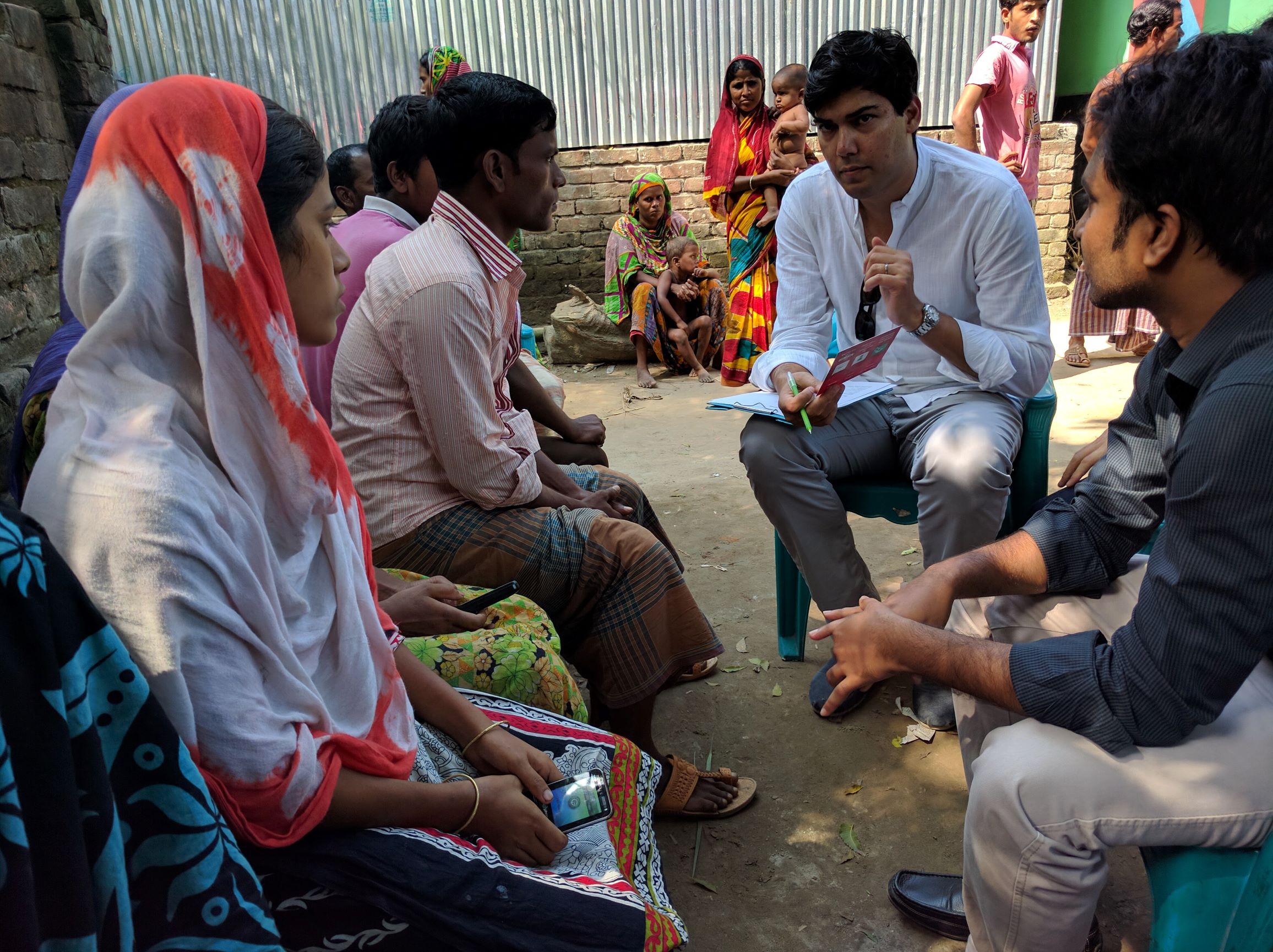
Bickey Russell (white shirt) conducting user research in Bangladesh.
A team from Google’s Area 120 startup incubator announced on Thursday that it has been working quietly behind the scenes on a new app. Called Kormo, the app helps people in Bangladesh find jobs.
“The team is now ready to come out of stealth mode,” said Bickey Russell, who formerly headed a team in Google’s marketing solutions department. He now leads the Kormo team full time.
Kormo, which means “work” in Bengali, went live about a year ago in Dhaka, Bangladesh’s capital city. So far, it has matched over 21,000 jobs to its users. Russell and his team have been on the ground interacting with users and growing their user base.
The app focuses on the “informal economy,” which usually refers to unregulated forms of employment. Contracts, fixed pay, and pensions, among others, are absent, and that opens up employees to many risks. To top that off, work credentials and past experience are rarely documented.
“What you see in the informal economy is a lot of unemployment and a lot of underemployment,” Russell told Tech in Asia.
 “We saw this problem firsthand in Bangladesh. People regularly struggle to find employment and are unaware of what to do, and employers complain about not being able to find talents or hire effectively,” the 36-year-old project head added.
South Asia’s informal economy stands at 80 to 90 percent of the labor force, according to the International Labour Organization, which estimates that 87 percent of Bangladesh’s labor force is employed in this way. Approximately two million of its citizens enter the workforce each year.
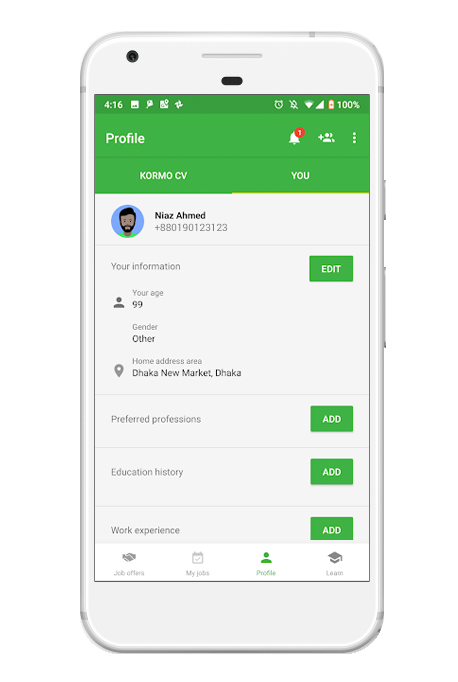
Using Kormo, users can update their resumes, look and apply for jobs, and even access content that helps them develop essential work skills like communication and interview prep — a feature the team is proud of. Kormo’s algorithm also recommends jobs to users based on their work experience and interests.
Weeding out bad apples
According to Russell, the app helps employers identify irresponsible workers by including performance ratings and references on the job seekers’ profile page.
For example, job seekers who consistently fail to turn up for interviews will receive a low rating. This holds them accountable for their inaction, and employers will be able to weed out flakey job seekers earlier.
“We found that interview attendance is the number one thing that the employers look for because a lot of people apply for a job and commit to an interview, but they don’t show up,” he said.
And if the user gets the job via a successful match on Kormo, this will be reflected in their profile. The app automatically updates the user’s in-app resume, and the team has received positive feedback about this feature.





Stay updated on the go with our mobile app.
Get latest insights with smoother, more personalized experience through TIA mobile app.