 Nikita Peer · · 4 min read
Grabbing insights from social data was the right move for this former news startup

The Frrole founders
While writing articles on startup trends, I often scan social media posts to get a sense of what the industry thinks. For example, when Housing was hacked last month just a few days after its CEO was fired, we tried to understand how Tweeps immediately put two and two together, and came up with five. Skimming through hundreds of tweets to provide an aggregated view was tough.
How cool would it be, had I known about Bangalore-based Frrole, which has an algorithm that provides real-time insights on any topic using social data?
The startup was initially an online newspaper that provides real-time and curated news from social media which was missing from newspapers, travel guides, events sites, and digital media. It was founded in 2012 by Nishith Sharma, Amarpreet Kalkat, and Abhishek Vaid. Sharma, a mechanical engineer and management grad loves reading history and fiction. His inclination on news goes back to his college days. Peers from college marveled at how he had opinions about everything – and informed ones at that.
But slowly his vision of a real-time social newspaper took a turn as he realized an actionable insight from social data could be far more useful. “It could help companies improve user engagement […] and amplify their marketing reach,” he shares. “And the opportunity in the space is also large.” Social analytics is worth US$1 billion currently, and it’s expected to grow to US$2.7 billion by 2019, according to a report by Markets and Markets.
Social data as service, anybody?
Frrole News had grown to almost a million monthly active users before it pivoted to social media insights in April 2013. Today, it filters real-time data in online platforms. These insights can be about an event, a keyword, a set of social media users, or any combination thereof.
For example, India’s leading daily newspaper Times of India used Frrole to give its audience real-time buzz about various sports. The hub displays popular content about the five most popular sports in India (cricket, football, tennis, golf, and racing), and also about most popular players, top trends, and most popular tweets and images for each sport.
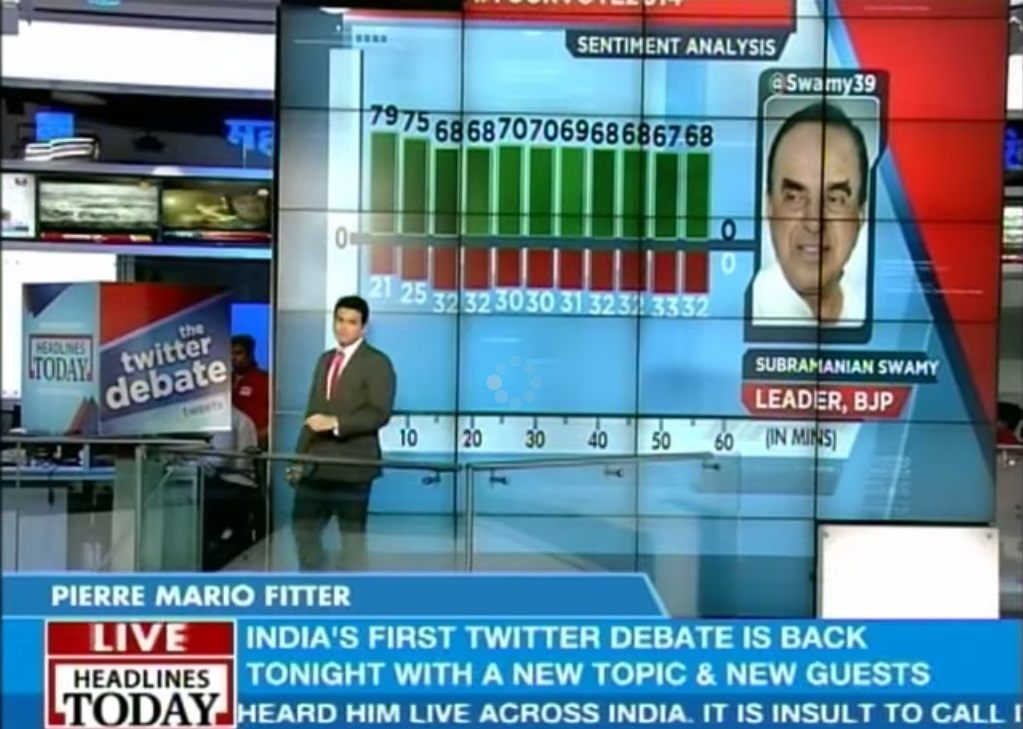
Frrole analyzed people’s reactions and provided real-time analysis and tweet counters during the show
Frrole has other uses. People who tweet a question relevant to a TV show or channel to the @BARCIndia handle (which belongs to Broadcast Audience Research Council) will receive an immediate response, automated by Frrole. Users can also subscribe to the service to receive an automated daily tweet in response to queries like, “top movie of the day,” “most watched TV show of the week,” and so on.
Besides topics, Frrole can also help any brand understand its followers better. Its audience intelligence tool is aimed at marketers looking for in-depth understanding of their consumers. Sharma feels that social analytics companies focus on topic intelligence and neglect audience intelligence.
That is changing with Facebook and Twitter launching heavy-duty audience insights products. However, these tools are useful only to an advertiser creating a campaign within the specific platform.
Frrole goes deeper, supplying intelligence on personality type, purchase behavior, brand affinity, and interests which can be used to redirect advertising spend on social media. For example, an Australian cinema chain could create anticipation for an upcoming movie by targeting fans of country music star Keith Urban, who were identified as a strong affinity group for the chain.
Battling odds
However, the startup’s biggest challenge is scaling up the business. “In building algorithms that are truly intelligent, serving millions of data requests every minute, we encounter new technology challenges everyday,” says Sharma. “While we are analyzing a fraction of tweets or Facebook posts generated every day, to scale up, [we need] to analyze a whole gamut of data. We also need to implement the technology in other social networks. We’re getting better every day with the engineering team getting bigger, but it will continue to be something that always keeps us on our toes,” he adds.





Stay updated on the go with our mobile app.
Get latest insights with smoother, more personalized experience through TIA mobile app.










📅 Upcoming Events
22 October 2026
Payoneer x CSPN Summit 2026