Paul Bischoff · · 4 min read
Highlights from day 2 afternoon sessions at Startup Asia Tokyo 2014
The founding of ZenDesk: from zero to IPO
Mikkel Svane, co-founder of the recently IPO’d online workflow startup Zendesk, kicked off the afternoon to chat with Tech in Asia’s own Anh Minh Do about the founding of his company.
Mikkel often used the metaphor of a romantic relationship to describe the rise of his company from a kitchen table (the original “zen desk”) to the listed company it is now. At one point, he talked about how he was discouraged by investors who refused to give him money shortly after the 2008 stock market crash. “It’s a bit like dating when you’re constantly being rejected,” he said. “You start thinking, ‘it’s not about them, it’s about me.'”
Happening now. @mikkelsvane on stage for fireside chat Founding story of Zendesk: from Zero to IPO #StartupAsia Tokyo pic.twitter.com/6ae9OHsDCH
— Shoko Yanagisawa (@shokoy) September 4, 2014
Is a startup bubble brewing in Japan?
This all-Japanese panel consisting of two venture capitalists and two startup founders discussed whether or not a startup bubble is brewing in Japan. The unanimous answer? Yes.
Infinity Ventures co-founder Masashi Kobayashi says the valuation of Japan’s startups are much higher than what is appropriate. Freee co-founder Daisuke Sasake says there’s too much focus on series A and seed stage startups, and not enough on growth stage. Shinichi Takamiya, chief strategy officer at Globis Capital, argues venture capitalists should invest money in a startup with an exit in mind, and that exit might not necessarily be an IPO. Nanapi founder Kensuke Furukawa says that even though a bubble is indeed brewing, it’s difficult to decide whether or not to invest: should we wait until after the eventual burst, or give them money so they can bounce back after?
#startupasia Is a startup ”bubble” in Japan? My feeling of the panel?? Japanese fear for the word is brewing up! Just power through!!!
— makeshift (@MakeshiftJP) September 4, 2014
"We were told our valuation was outrageously high in 2010. If we said it today, people would cry for us." Japanese startup, #StartupAsia
— Patrick McKenzie (@patio11) September 4, 2014
The Adways story: From a high school dropout to a multi-millionaire entrepreneur
This entertaining fireside chat with founder and CEO of Adways Haruhisa Okamura earned the most laughs of the day. In one particularly amusing anectdote, Okamura reminisced about a time when Adways was in the red. To save costs, he cut his own pay by 80 percent. Unfortunately, he still had to pay taxes based on his old salary from the year before, and he couldn’t afford rent. To prove solidarity with his employees, he challenged them to find an apartment without a bath or toilet.
“I didn’t actually expect them to find a room without a bath or toilet, but they did,” he said. At that point he couldn’t back out. When the company came back to profitability, he had gained a reputation as the CEO who lived in a crummy apartment, and felt pressured to stay there. He ultimately spent two and a half years living there.
See: How a high school dropout became a multi-millionaire entrepreneur
It's all smiles and laughter with @Adways_JP founder and CEO Haruhisa Okamura on stage now! #StartupAsia pic.twitter.com/WFbd2cYuHJ
— Tech in Asia (@Techinasia) September 4, 2014
Tech in Thailand: It’s worth your time
Paul Srivorakul, co-founder of Ardent Capital, dished out the stats to prove that Thailand is a growing tech hub in Southeast Asia. Despite the country’s repeated coups and political crises, the economy has continued to grow. Time spent on the internet in Thailand has surpassed time watching TV. Srivorakul also explained that Thailand has an advantage in connecting to China because of a shared border and being part of the Asian landmass, which countries like the Philippines and Indonesia don’t have.
Not everyone seems convinced, though…
What tech scene? “@Techinasia: Paul Srivorakul of Ardent Capital makes case for Thailand's tech scene. #StartupAsia pic.twitter.com/bTH0ui9GDh”
— BackinTokyo (@BackinTokyo) September 4, 2014
10 tactics that may improve your app engagement today
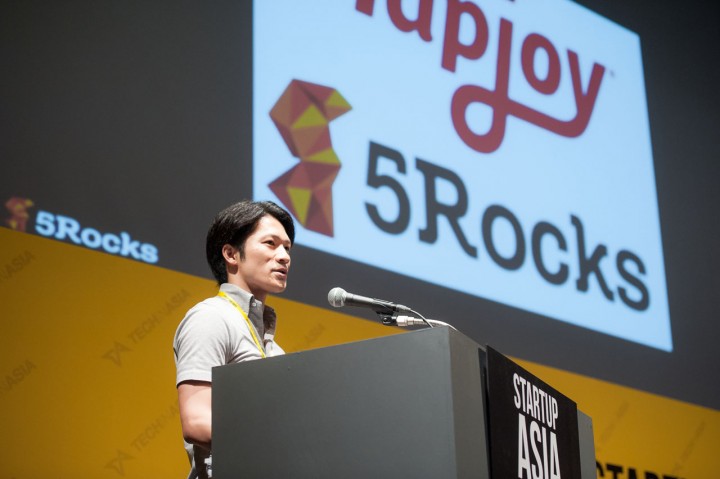
The Japan country manager for 5Rocks, Yasuo Sato, lists off 10 simple tips for app makers to improve engagement with users. Among them, he says not to just measure DAU, but measure it against other important metrics like retention and loyalty. Don’t forget to re-engage inactive users, but don’t do it too often or too quickly after inactivity. Finally, you can estimate a user’s exit risk by dividing time since last login by login frequency.
Startup Arena
The long-awaited Startup Arena begins! Check out all our Arena coverage here.
Keynote: How to build an amazing startup
Ycombinator partner Kevin Hale wrapped up the day’s talks with some advice for startups, first focusing on clarity of idea. Hale says he can get an impression of how clear an idea is by how many words a founder uses to describe a startup. “Explaining what you do simply is something you’ll do over and over again,” Hale says. “A clear idea is the foundation for growth.”
Hale explained the best procedure for quickly pitching an idea to both investors and media. The most important thing to remember: lead with what, not why. He also advises startups to focus on numbers, but not the numbers you can share today. “I wanna see acceleration. Growth is more important than where you are now,” he says.
YCombinator Startup School is coming to Asia – @ilikevests #StartupAsia
— David Corbin (@CorbinDB) September 4, 2014
(Top and last photos via Michael Holmes)
Stay updated on the go with our mobile app.
Get latest insights with smoother, more personalized experience through TIA mobile app.
Recommended reads
 Y Combinator cuts cohort size by 40% amid market downturn
 Meet the 50 top-funded startups and tech companies in Singapore
 Malaysia’s new tech hub plan rehashes old ideas. Here’s what it needs to do instead
 Upturn’s acceleration into venture building
 Investors keeping hope alive in Hong Kong
 A recap of the Tech in Asia Conference 2020
 SEA tech: scaling up or cutting back?
 Animoca backs $70m round of 🇹🇼 VC firm’s maiden Web3 fund
 Japanese VC firm MedVenture Partners raises $95m in final close of second fund
 I know what you’ll do this summer: join Tech in Asia’s Saigon Summit





Editing by Steven Millward
(And yes, we’re serious about ethics and transparency. More information here.)